Facts
The Petitioner was recruited as ASI/Radio Mechanic in the BSF on February 1, 2012
Source reference: p. 1On February 18, 2019, he was appointed as SI/JE (Electrical) on deputation for three years, a period later extended until April 23, 2023
Source reference: p. 3The appointment order and the governing Standing Operating Procedure (SOP) dated January 31, 2013, expressly stated that deputationists have no inherent right to absorption and that discretion rests solely with the BSF
Source reference: p. 2-3After his deputation ended, the Petitioner represented for permanent absorption on May 9, 2023, but was repatriated to his parent unit on May 19, 2023
Source reference: p. 3Following previous litigation, the DG BSF rejected his representation on July 31, 2023, citing his failure to complete 18 years of service (per a 2016 MHA policy), the fact that his deputation had already expired, and his prior undertaking not to seek absorption
Source reference: p. 5-6Issues
1. Whether a deputationist possesses an enforceable legal right to be absorbed into the borrowing department upon fulfilling eligibility criteria
Source reference: p. 9 / para. 21, 232. Whether the BSF was legally obligated to convene a Screening Committee to consider the Petitioner’s case for absorption simply because he completed two years of service
Source reference: p. 9 / para. 243. Whether the repatriation of the Petitioner following the expiry of his deputation tenure was valid
Source reference: p. 10 / para. 28Law Applied
The court primarily applied the principle that a deputationist has no vested right to absorption in the borrowing department and can be repatriated at any time
Source reference: p. 9It relied on Kunal Nanda v. Union of India regarding the lack of inherent right to absorption
Source reference: p. 9, fn 9and Ratilal B. Soni v. State of Gujarat regarding the power of repatriation
Source reference: p. 9, fn 10The court further noted that executive instructions (like the 2016 MHA letter) cannot override Recruitment Rules (RRs) framed under Article 309 of the Constitution
Source reference: p. 8 / para. 19and that eligibility for a post is distinct from an entitlement to it
Source reference: p. 9 / para. 23Reasoning
The court reasoned that the Petitioner’s claim failed because eligibility (completing two years of service) does not equate to a legal entitlement to a permanent post
Source reference: para. 23The 2013 SOP and 2019 appointment order explicitly reserved the BSF’s discretion and clarified that absorption was not a routine matter but reserved for "extremely deserving cases"
Source reference: para. 4, 25While the court disapproved of the BSF exacting an undertaking from the Petitioner to waive his right to represent
Source reference: para. 18and questioned the 18-year service requirement in the 2016 MHA letter as potentially ultra vires the RRs
Source reference: para. 19it held these were secondary to the fact that the Petitioner's deputation had already expired by the time he sought absorption
Source reference: para. 26, 27Since he was no longer "on the strength" of the engineering wing at the time of consideration, he was ineligible under the very SOP he relied upon
Source reference: para. 26Holding
The Court dismissed the writ petition
It held that the Petitioner had no enforceable right to absorption and the BSF had no corresponding legal obligation to absorb him
Source reference: para. 28, 30The court affirmed that once the deputation period ended on April 23, 2023, the BSF acted within its rights to repatriate the Petitioner to his parent unit
Source reference: para. 28Under the maxim ubi jus ibi remedium, the absence of a legal right precluded any judicial remedy
Source reference: para. 29Original Court PDF
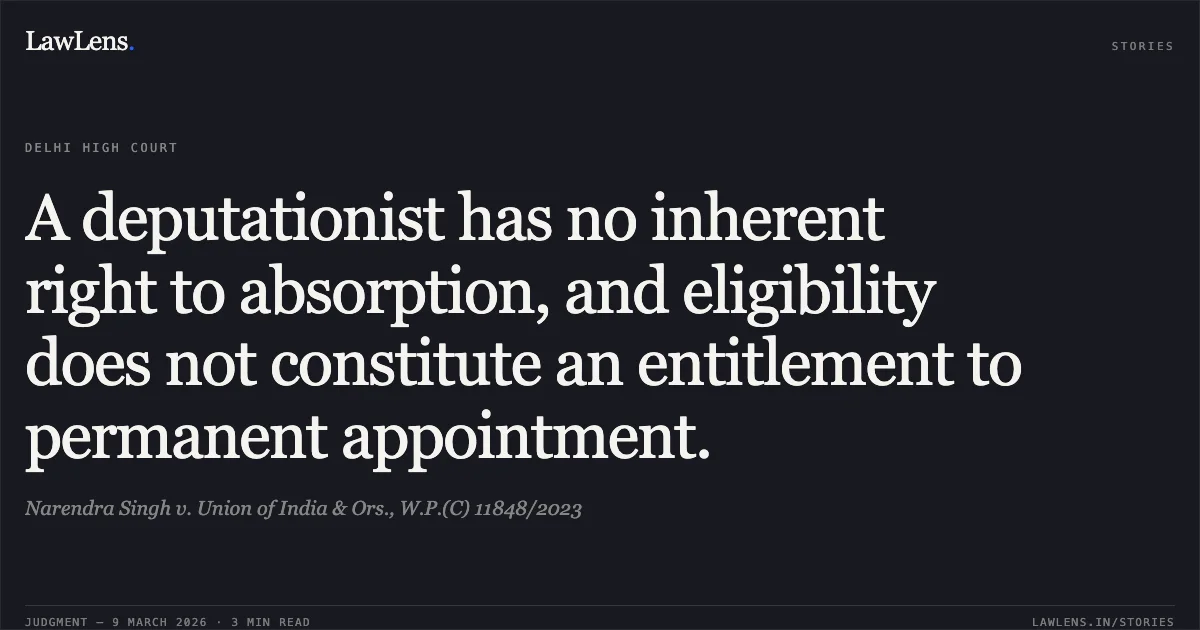
Narendra Singh v. Union of India & Ors., W.P.(C) 11848/2023
Click to open original judgment
Original judgment, available to read, download and summarize on LawLens.in


![Authorities must decide pensionary and retiral-benefit claims through a reasoned order within eight weeks.. Habibullah khan vs HOME DEPARTMENT. CAT - ['Srinagar']. LawLens](/stories/thumbnails/authorities-must-decide-pensionary-and-retiral-benefit-claims-through-a-reasoned-order-wit-d0cbe8a8119c48fbabe7df9f2d353488.webp)