Facts
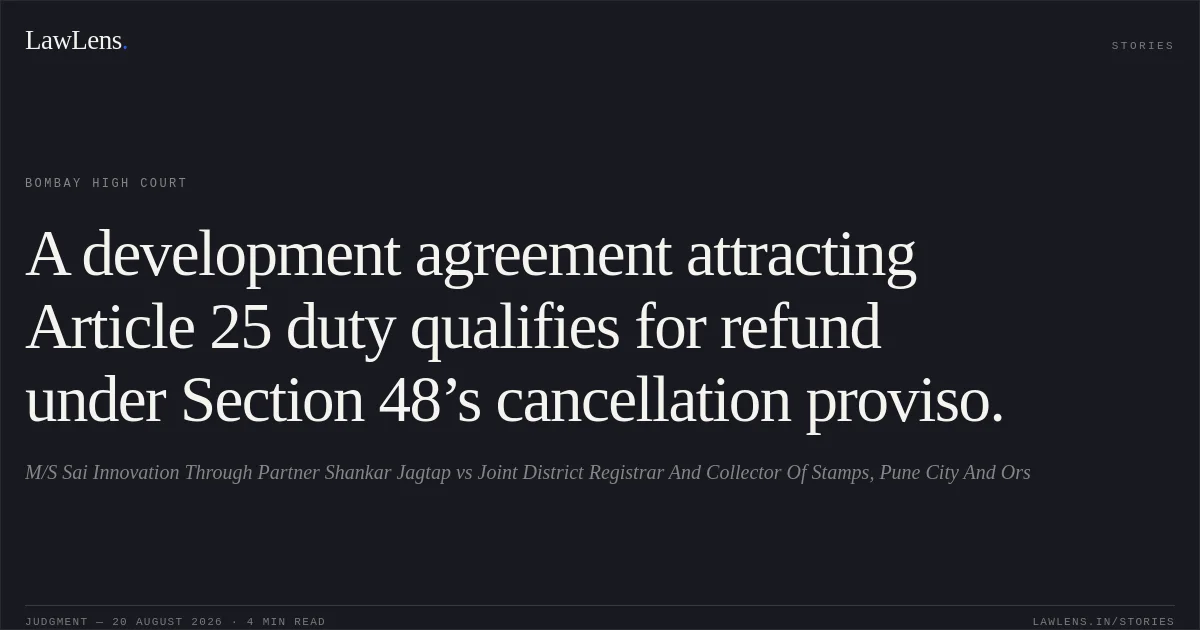
The petitioner, a partnership firm, executed and registered a Development Agreement dated 15 April 2013 with the property owners for development of approximately 8,000 sq. metres of land at Balewadi, Pune.
Source reference: para. 2Stamp duty of ₹70,12,500 was paid on the agreement under Article 25 read with Article 5 of Schedule I to the Maharashtra Stamp Act, 1958.
Source reference: para. 2As building plans were allegedly not sanctioned within a reasonable time and disputes arose, the parties executed and registered a Deed of Cancellation on 24 February 2014. The petitioner thereafter applied for refund of the stamp duty on 7 April 2014.
Source reference: paras. 2, 14The Deputy Controller of Stamps declined to recommend the refund on 11 August 2014, and the Joint District Registrar and Collector of Stamps rejected the claim on 6 December 2014, holding that the Development Agreement was not covered by the proviso to Section 48(1).
Source reference: paras. 1–3In the writ petition, the respondents additionally contended that possession had been delivered under Clause 13 of the Development Agreement and that the refund application was beyond the ordinary six-month period under Section 48(1).
Source reference: paras. 9–11, 23Issues
Whether the Development Agreement, on which stamp duty was calculated by reference to Article 25 of Schedule I, could receive the benefit of the proviso to Section 48(1) of the Maharashtra Stamp Act, despite being described as a Development Agreement rather than a conveyance.
Source reference: paras. 11–13, 23–26Whether the transaction failed to achieve its intended purpose so as to entitle the petitioner to refund under Section 47(c)(5) of the Act.
Source reference: paras. 12–17, 29Whether Clauses 11 and 13 of the Development Agreement established transfer of legal or exclusive possession sufficient to defeat the petitioner’s refund claim.
Source reference: paras. 18–22, 28Whether the refund application was barred by limitation under the ordinary six-month period in Section 48(1), or was saved by the extended period under its proviso.
Source reference: paras. 23–27Law Applied
Section 47(c)(5) of the Maharashtra Stamp Act, 1958 permits allowance or refund where an instrument, by reason of the refusal of a person to act under it or for a similar reason, fails of its intended purpose.
Source reference: para. 12Section 48 prescribes the period for applying for refund; its proviso does not create an independent substantive right but provides an extended limitation period where its statutory conditions are satisfied.
Source reference: para. 13Following M/s. Satyam Construction v. State of Maharashtra, the Court held that a Development Agreement may be treated at par with a conveyance for the limited purpose of the proviso to Section 48(1) where stamp duty payable on it is calculated by reference to Article 25, and the nomenclature of the instrument is not decisive.
Source reference: paras. 24–26The Court also applied the principle in Mohinder Singh Gill v. Chief Election Commissioner, (1978) 1 SCC 405, that an administrative order must ordinarily stand or fall on the reasons stated in it and cannot subsequently be supported by entirely new grounds through an affidavit.
Source reference: para. 28The decisions in Prasun Developers v. State of Maharashtra, W.P. No. 9923 of 2014, and the authorities discussed in Satyam Construction were considered on the distinction between a Development Agreement and a conveyance.
Source reference: paras. 10, 24–26Reasoning
The Court held that the Development Agreement had failed to achieve its intended purpose because the proposed development did not commence, no construction or third-party rights were shown, disputes arose, and the parties cancelled the agreement through a registered instrument.
Source reference: paras. 14–17The respondents’ principal objection—that the document was not a conveyance—was rejected because the stamp duty was calculated by reference to Article 25, bringing the instrument within the limited operation of the proviso to Section 48(1) under Satyam Construction.
Source reference: paras. 23–26On possession, Clause 13 could not be read in isolation. Clause 11 described the developer’s possession as being given “as a licensee for development,” while Clause 13 permitted entry, levelling and other acts necessary for development. Read together, the clauses created a limited contractual licence and did not conclusively establish transfer of complete or exclusive legal possession.
Source reference: paras. 18–22The absence of a separate possession receipt did not alter the legal character of the arrangement.
Source reference: no citationSince the registered cancellation occurred within the applicable statutory period and the refund application was treated as having been filed on 7 April 2014, the ordinary six-month limitation could not be applied independently of the proviso.
Source reference: para. 27Although the possession objection was raised only in the respondents’ affidavit, the Court examined it on merits and found that it did not defeat the claim.
Source reference: para. 28Holding
The writ petition was allowed.
The orders dated 6 December 2014 and 11 August 2014 refusing or declining to recommend refund were quashed and set aside.
Source reference: para. 32(i)–(ii)The petitioner’s refund application dated 7 April 2014 was allowed, and the respondents were directed to refund ₹70,12,500 towards stamp duty paid on the Development Agreement.
Source reference: para. 32(iii)–(iv)The refund was directed to carry simple interest at 6% per annum from 7 April 2014 until actual payment, with payment to be made within six weeks from uploading of the judgment.
Source reference: para. 32(v)–(vi)Rule was made absolute, with no order as to costs.
Source reference: para. 32(vii)–(viii)Acts & Sections Cited
2 provisions across 1 statute referred to in this judgment. Each provision opens on LawLens.
Maharashtra Stamp Act2
Original Court PDF
M/S Sai Innovation Through Partner Shankar JagtapvsJoint District Registrar And Collector Of Stamps, Pune City And Ors
Click to open original judgment
Original judgment, available to read, download and summarize on LawLens.in