Facts
The Appellant sanctioned and disbursed Venture Capital Assistance (VCA) of ₹23,39,000 to Respondent No. 1 under a 2005 loan agreement.
Source reference: para. 3–8After demanding repayment in 2012, the Appellant invoked the arbitration clause and obtained an award dated 9 March 2017 for the principal, interest and costs against Respondent No. 1 and its Directors, jointly and severally.
Source reference: para. 3–8Respondents challenged the award under Section 34 of the Arbitration and Conciliation Act, 1996. The District Judge set it aside, finding that notice of the arbitrator’s appointment had not been properly served and that the Directors could not be held personally liable.
Source reference: para. 10The Appellant appealed under Section 37.
Source reference: para. 1, 11Issues
1. Whether the Section 34 petition was barred by limitation under Section 34(3) of the 1996 Act
Source reference: para. 14(i)2. Whether the award was liable to be set aside for want of proper notice or because the Respondents were unable to present their case
Source reference: para. 14(ii)3. Whether the award could impose liability on Respondent Nos. 2 to 5, the Directors, and, if not, whether that portion was severable from the award against Respondent No. 1
Source reference: paras. 14(iii), 38–414. Whether the award was otherwise liable to be set aside on the grounds raised by the Respondents, including limitation of the underlying claim, prematurity, non-joinder, interest, stamping and the arbitrator’s appointment
Source reference: para. 14(iv)Law Applied
Section 34(3) of the 1996 Act requires a challenge to be filed within three months of receipt of the award, with a possible extension of up to thirty days for sufficient cause, but not thereafter; limitation begins upon delivery of the signed award under Section 31(5), not merely on its pronouncement (Union of India v. Popular Construction Co.; Union of India v. Tecco Trichy Engineers & Contractors; Benarsi Krishna Committee v. Karmyogi Shelters (P) Ltd.).
Source reference: paras. 21–22Under Section 34(2)(a)(iii), the applicant must establish lack of proper notice or inability to present its case; Sections 4, 13 and 16 require timely objection to known procedural or jurisdictional defects, and participation without objection may amount to waiver (Narayan Prasad Lohia v. Nikunj Kumar Lohia).
Source reference: paras. 26, 30–32Under Sections 34 and 37, judicial interference is confined to statutory grounds; the appellate court cannot reappreciate evidence or substitute its view for a plausible arbitral determination (MMTC Ltd. v. Vedanta Ltd.; UHL Power Company Ltd. v. State of Himachal Pradesh; Ssangyong Engineering & Construction Co. Ltd. v. NHAI).
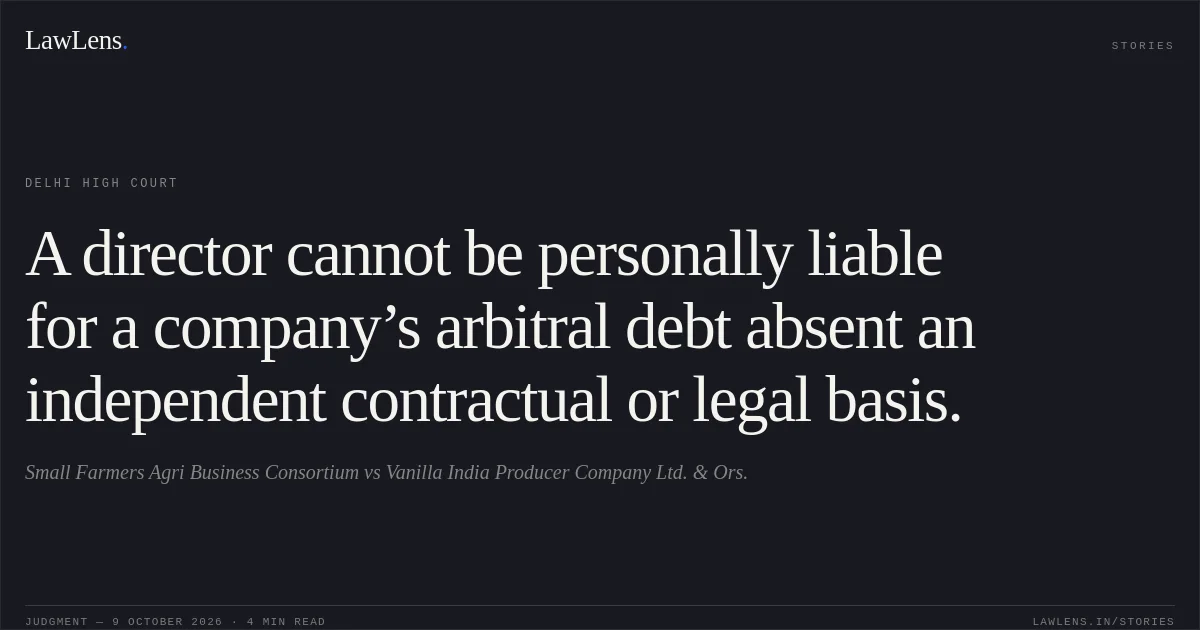
Source reference: paras. 15–19A company is a legal entity distinct from its Directors, who are not personally liable for its contractual debt absent an independent legal or contractual basis; a non-signatory cannot be bound to arbitration without established consent (Indowind Energy Ltd. v. Wescare (I) Ltd.; Cox and Kings Ltd. v. SAP India (P) Ltd.).
Source reference: paras. 34–37An invalid, separable portion of an award may be set aside while preserving the remainder, provided severance does not require reassessment of the merits (Gayatri Balasamy v. ISG Novasoft Technologies Ltd.).
Source reference: paras. 38–40Reasoning
The Appellant did not establish that the signed award had been delivered to the Respondents before they obtained it on 24 April 2019; their Section 34 petition, filed on 7 June 2019, was therefore within time.
Source reference: paras. 22–25Although the appointment-intimation letter had been returned undelivered, the Respondents appeared through counsel, filed a defence, raised objections and were afforded an opportunity to lead evidence. They did not show what case they had been prevented from presenting, and their participation without a timely objection defeated the notice challenge.
Source reference: paras. 27–33The Directors had neither signed the agreement in their personal capacities nor given guarantees, and no independent basis for their liability was pleaded or proved. Their liability could be severed without affecting the award against Respondent No. 1.
Source reference: paras. 34–41The Tribunal’s finding that the claim was within limitation was plausible on the record; the agreement’s repayment trigger and the later one-time settlement did not establish a ground for setting aside the award against Respondent No. 1. The remaining objections were either unsupported or raised for the first time on appeal.
Source reference: paras. 42–47Holding
The appeal was partly allowed.
The District Judge’s judgment was set aside insofar as it had set aside the award against Respondent No. 1; the Section 34 petition was dismissed to that extent, and the award was restored and made enforceable against that company.
Source reference: para. 48The setting aside of the award against Respondent Nos. 2 to 5 was upheld, and execution was directed to proceed against Respondent No. 1, subject to the Executing Court considering any payments or amounts realised toward the award debt.
Source reference: para. 48Acts & Sections Cited
8 provisions across 1 statute referred to in this judgment. Each provision opens on LawLens.
Arbitration and Conciliation Act, 19968
Original Court PDF
Small Farmers Agri Business ConsortiumvsVanilla India Producer Company Ltd. & Ors.
Click to open original judgment
Original judgment, available to read, download and summarize on LawLens.in
![Any proposed recovery from retired employees’ benefits requires due process and a reasonable opportunity to be heard.. mohd ashraf badana and others vs JAL SHAKTI DEPARTMENT. CAT - ['Srinagar']. LawLens](/stories/thumbnails/any-proposed-recovery-from-retired-employees-benefits-requires-due-process-and-a-reasonabl-d5f39906030c4f97862f0641e0341695.webp)
![Authority directed to decide retirement-benefit representations by a reasoned order within four weeks.. RAKESH KUMAR vs TRANSPORT DEPARTMENT (GNCTD). CAT - ['Delhi']. LawLens](/stories/thumbnails/authority-directed-to-decide-retirement-benefit-representations-by-a-reasoned-order-within-e3b788607a974e9c878b122c4648a971.webp)