Facts
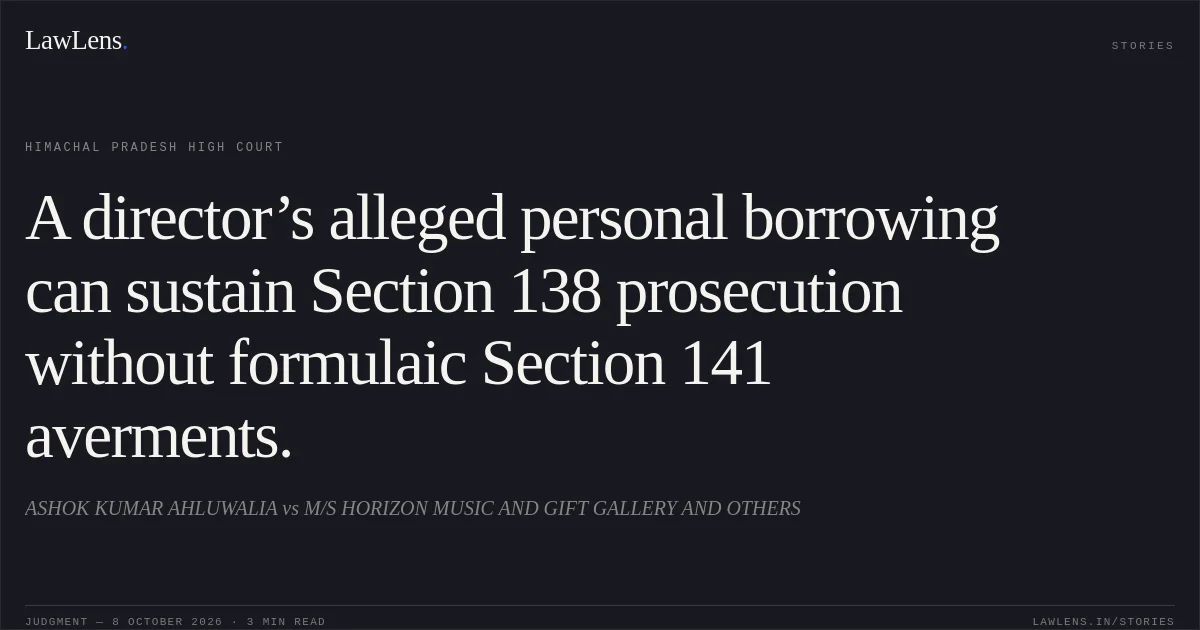
The complainant alleged that Accused Nos. 2 and 4, including the petitioner, sought and received a loan of ₹30 lakh for their business, promised repayment, and later issued a cheque that was dishonoured for insufficient funds.
Source reference: para. 1–4, 6After service of a statutory demand notice and non-payment, the complainant filed a complaint under Section 138 of the Negotiable Instruments Act, 1881 (“NI Act”).
Source reference: para. 1–4, 6The Judicial Magistrate summoned the accused.
Source reference: para. 1–4, 6The petitioner sought quashing, contending that the complaint contained only general allegations, the summoning order was cryptic, and he had resigned as a director in December 2022.
Source reference: para. 1–4, 6The complaint alleged that the petitioner had personally participated in obtaining the loan and was responsible for dealing with the complainant.
Source reference: para. 13, 19Issues
1. Whether the complaint and its supporting material disclosed a sufficient factual basis to proceed against the petitioner under Sections 138 and 141 of the NI Act.
Source reference: para. 13–212. Whether the petitioner’s asserted resignation as a director justified quashing the complaint at the threshold.
Source reference: para. 283. Whether the summoning order and continuation of proceedings warranted interference under Section 482 of the Code of Criminal Procedure, 1973.
Source reference: para. 4, 6, 9–12Law Applied
Section 138 of the NI Act penalises dishonour of a cheque in the circumstances prescribed by that provision; Section 141 permits vicarious liability for a company’s offence only where the statutory requirements are met.
Source reference: para. 14–20Under *S.M.S. Pharmaceuticals Ltd. v. Neeta Bhalla* and related authorities, a director is not liable merely by designation: the complaint must provide the requisite averments or factual foundation linking that person to responsibility for the company’s business or to the transaction.
Source reference: para. 14–20However, the complaint need not mechanically reproduce Section 141 if its substance discloses a sufficient, person-specific factual basis for liability (*Mansi Finance (Chennai) Ltd. v. M. Lalitha*).
Source reference: para. 14–20The High Court’s inherent power under Section 482 CrPC is to be exercised sparingly; the court ordinarily accepts the complaint’s allegations as true and does not conduct a mini-trial, though proceedings may be quashed where the allegations do not make out an offence or continuation would amount to abuse of process (*State of Haryana v. Bhajan Lal* and authorities cited).
Source reference: para. 9–12, 22–27Reasoning
The Court found that the complaint did more than rely on the petitioner’s designation as a director: it alleged that he personally approached the complainant, obtained the loan, promised repayment, and dealt with the complainant on the company’s behalf.
Source reference: para. 19–21Applying *Mansi Finance*, the Court held that these allegations supplied a factual basis to continue the prosecution, notwithstanding the absence of a mechanical recital of the statutory wording.
Source reference: para. 19–21The petitioner’s denial of the allegations could not be determined in a Section 482 proceeding, which was not the forum for a mini-trial.
Source reference: para. 22–27Nor could his claimed resignation be accepted as conclusive: he relied on photocopies, while the complainant produced material indicating that he remained a director; the authenticity and significance of those documents were matters for trial.
Source reference: para. 28Holding
The High Court held that the complaint disclosed a sufficient basis to proceed against the petitioner and that neither the disputed resignation nor the other grounds justified quashing at the threshold.
The petition was dismissed, and the summoning order and complaint remained undisturbed.
Source reference: para. 28–30The Court clarified that its observations would not affect the merits of the trial.
Source reference: para. 31Acts & Sections Cited
5 provisions across 2 statutes referred to in this judgment. Each provision opens on LawLens.
Negotiable Instruments Act, 18812
Code of Criminal Procedure, 19733
Original Court PDF
ASHOK KUMAR AHLUWALIAvsM/S HORIZON MUSIC AND GIFT GALLERY AND OTHERS
Click to open original judgment
Original judgment, available to read, download and summarize on LawLens.in