Facts
A disciplinary inquiry under Rule 14 of the Central Civil Services (Classification, Control and Appeal) Rules, 1965 resulted in a report dated 10 May 2021 exonerating the respondent
Source reference: p. 2, para. 6In an earlier writ petition, the High Court set aside that order because the Authority had not followed Rule 15(2), and directed it to pass a speaking order; neither party appealed, and the decision attained finality
Source reference: pp. 3–4, paras. 9–13The appellants subsequently issued an order dated 2 March 2024, invoking Rule 15(1) and directing further inquiry from the stage of inspection of records.
Source reference: pp. 4–5, paras. 14–18The respondent successfully challenged that order, which the Single Judge quashed for non-compliance with Rule 15(2). The State appealed.
Source reference: pp. 4–5, paras. 14–18Issues
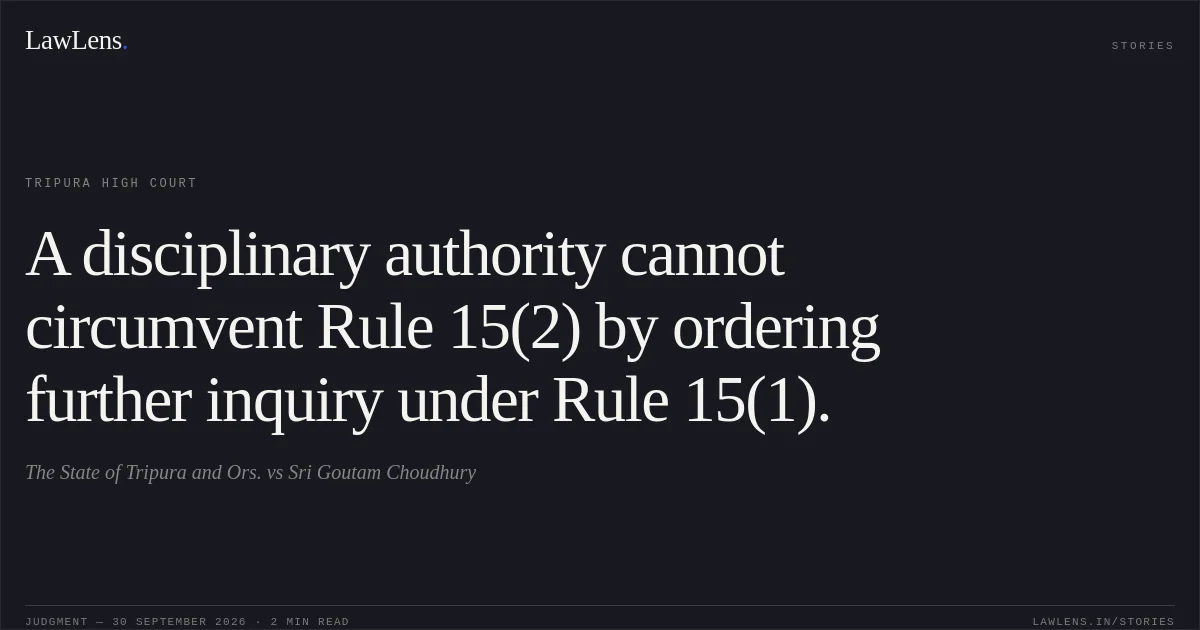
Whether the Disciplinary Authority could invoke Rule 15(1) to order further inquiry after the High Court’s final order had set aside its earlier action for failure to comply with Rule 15(2)
Source reference: pp. 5–6, paras. 20–21Whether the order dated 2 March 2024 was sustainable despite the Authority not communicating its tentative reasons for disagreement with the inquiry report to the respondent
Source reference: p. 5, para. 18Law Applied
Rule 15(1) of the CCS (CCA) Rules, 1965 permits a Disciplinary Authority, for reasons recorded in writing, to remit a case to the Inquiring Authority for further inquiry and report.
Source reference: p. 3, para. 11Under Rule 15(2), where the Disciplinary Authority is not the Inquiring Authority, it must communicate the inquiry report together with its tentative reasons for disagreement, if any, and provide the government servant an opportunity to make a written representation
Source reference: p. 4, para. 16A prior High Court order that has attained finality cannot be overridden by the parties devising a different procedure
Source reference: p. 6, paras. 20–21Reasoning
The Court noted that the earlier judgment had set aside the Authority’s order because Rule 15(2) had not been followed, and that judgment had become final
Source reference: pp. 3–4, paras. 11–13The State could not avoid the consequence of that ruling by invoking Rule 15(1) in its subsequent order; the appellants offered no explanation for doing so
Source reference: p. 6, paras. 20–21Further, the respondent had not been given the tentative reasons for disagreement and an opportunity to respond as required by Rule 15(2).
Source reference: p. 5, para. 18Holding
The High Court dismissed the writ appeal for lack of merit and set aside the order dated 2 March 2024
It directed the Disciplinary Authority to communicate its tentative reasons for disagreement with the inquiry report within four weeks; the respondent was allowed four weeks thereafter to object, following which the Authority must pass and communicate a final order strictly in accordance with law
Source reference: p. 5, para. 23No costs were awarded.
Source reference: p. 6, para. 24Original Court PDF
The State of Tripura and Ors.vsSri Goutam Choudhury
Click to open original judgment
Original judgment, available to read, download and summarize on LawLens.in