Facts
The petitioner, appointed as a Technical Assistant (Category D) in 1982, was promoted to Category G. The department questioned his 1992 Leave Travel Concession (LTC) claim of ₹12,775 and initiated disciplinary proceedings.
Source reference: para. 3A departmental promotion committee considered him for Category H on 1 April 1997 but kept his case in a sealed cover because proceedings were pending.
Source reference: para. 12Following an inquiry, the disciplinary authority’s order dated 21 May 1999 reverted him from Category G to F, ordered recovery with interest, and placed him at the bottom of the Category F seniority list. His departmental challenge was unsuccessful.
Source reference: para. 16In an earlier writ petition, the High Court directed reconsideration of the seniority issue; the department’s order of 10 March 2010 maintained its position. The petitioner then challenged the punishment and related orders, alleging, among other things, denial of a fair inquiry and the imposition of impermissibly combined penalties.
Source reference: para. 3, 12, 16Issues
1. Whether the disciplinary proceedings and resulting orders were invalid for denying the petitioner an effective opportunity to defend himself, including access to the inquiry report and an opportunity to test the department’s evidence.
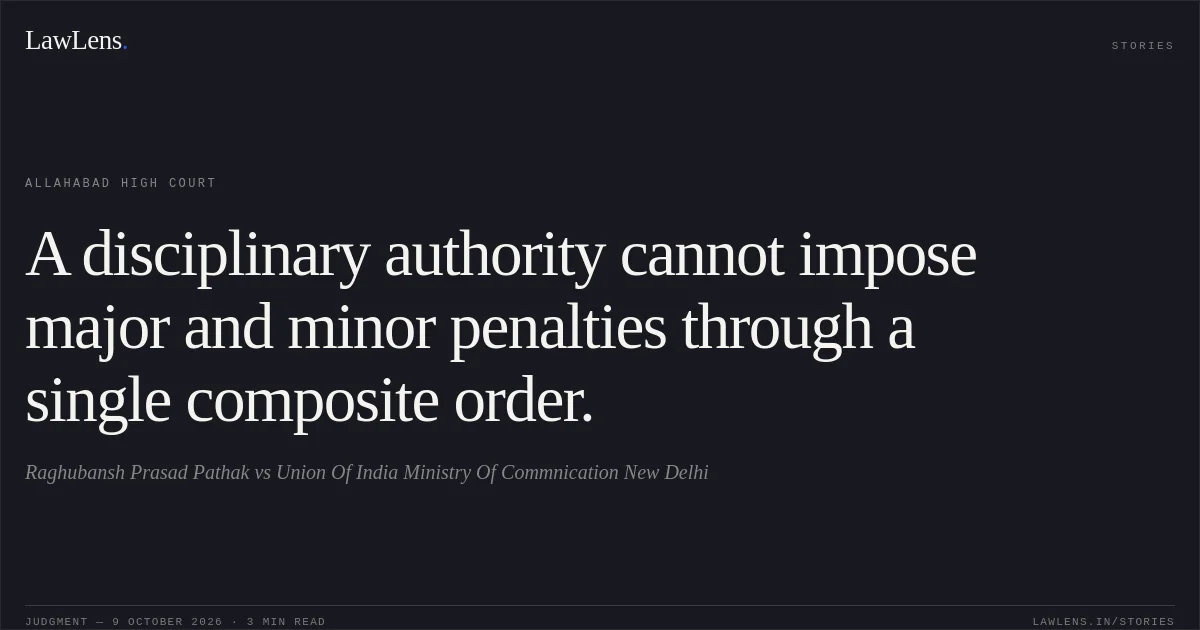
Source reference: para. 18–19, 23, 252. Whether the disciplinary authority could impose, in one composite order, a major penalty together with penalties treated as minor penalties.
Source reference: para. 14, 243. Whether the orders were unsustainable for failure to give reasons, including failure to address the specific issue remitted for reconsideration.
Source reference: para. 15–174. Whether the petitioner was entitled to promotion to Category H from 1 April 1997 and consequential benefits after the disciplinary action was set aside.
Source reference: para. 21–22, 27Law Applied
The Court applied the principle in Union of India v. S.C. Parashar, (2006) 3 SCC 167, that a disciplinary authority cannot combine a major penalty with minor penalties in a single order.
Source reference: para. 14, 24It relied on the principles of natural justice, including the employee’s right to the inquiry report and a meaningful opportunity to defend against the evidence, citing State of U.P. v. Saroj Kumar Sinha, (2010) 2 SCC 772, and Suresh Bahadur Singh Kaushik v. State of U.P. (Writ-A No. 7914 of 2009).
Source reference: para. 18–19It also applied the requirement that decisions affecting civil and pecuniary rights give reasons, relying on Siemens Engineering & Manufacturing Co. of India Ltd. v. Union of India, (1976) 2 SCC 981, and Kranti Associates (P) Ltd. v. Masood Ahmed Khan, (2010) 9 SCC 496.
Source reference: para. 15–17The Court further cited State of Bihar v. Lakshmi Shankar Prasad, (2002) 10 SCC 351, and Ram Pal Singh v. Director of Agriculture, 2012 SCC OnLine All 244, in addressing the failure to comply meaningfully with the earlier direction for reconsideration.
Source reference: para. 15–17Reasoning
The Court found that the inquiry did not afford a real opportunity to contest the documentary material: no departmental witnesses were examined in the petitioner’s presence, and the inquiry proceeded substantially on his written explanation. The petitioner had also not been supplied the inquiry report or allowed meaningful access to the material relied upon.
Source reference: para. 18–19, 23The punishment order combined reversion from Category G to F with recovery and adverse seniority consequences, which the Court treated as an unlawful combination of major and minor penalties.
Source reference: para. 14, 24The original punishment order gave no reasons, while the 2010 reconsideration order failed to address the seniority concern identified in the earlier writ proceedings.
Source reference: para. 15–17The Court also noted that only ₹7,610 of the ₹12,775 LTC claim was alleged to be disputed, and that the petitioner’s Category H promotion had been withheld solely because of the disciplinary proceedings, not an adverse assessment on merit.
Source reference: para. 20–22Holding
The Court allowed the petition and quashed the orders dated 10 March 2010, 21 May 1999, 4 September 1999, and 27 May 2002.
It directed the respondents to refund ₹22,098 and to grant the petitioner promotion to Technical Assistant (Category H) with effect from 1 April 1997, with consequential pecuniary benefits up to superannuation and 10% simple interest until payment.
Source reference: para. 27Acts & Sections Cited
1 provisions across 1 statute referred to in this judgment. Linked provisions open on LawLens.
Industrial Employment (Standing Orders) Act, 19461
Original Court PDF
Raghubansh Prasad PathakvsUnion Of India Ministry Of Commnication New Delhi
Click to open original judgment
Original judgment, available to read, download and summarize on LawLens.in