Facts
Disciplinary charges were issued against the third respondent, then Principal-cum-Associate Professor, alleging irregular purchases and failure to act against teaching and non-teaching staff who were unauthorisedly absent.
Source reference: paras. 1, 3–5The Enquiry Officer found the purchase-related charge unproved but the charge concerning staff absence proved.
Source reference: paras. 1, 3–5The Disciplinary Authority imposed a penalty of withholding four increments with cumulative effect.
Source reference: paras. 1, 3–5The Karnataka State Administrative Tribunal set the penalty aside, finding the enquiry findings perverse; the Registrar, Karnataka Lokayukta, challenged that order before the High Court.
Source reference: paras. 1, 3–5Issues
Whether the Tribunal was justified in setting aside the penalty on the ground that the finding on the charge concerning unauthorised staff absence was perverse and unsupported by adequate particulars.
Source reference: paras. 6, 9–10Whether the High Court, exercising judicial review over disciplinary proceedings, should interfere with the Tribunal’s decision.
Source reference: paras. 5, 8, 11Law Applied
Under the Karnataka Civil Services (Classification, Control and Appeal) Rules, 1957, the Disciplinary Authority may impose a penalty in disciplinary proceedings.
Source reference: para. 5The Court stated that judicial review in such matters is limited: it does not sit as an appellate authority to reappreciate evidence, but may examine whether the enquiry complied with the principles of natural justice, whether the finding is based on no evidence, and whether the penalty is proportionate to the charges.
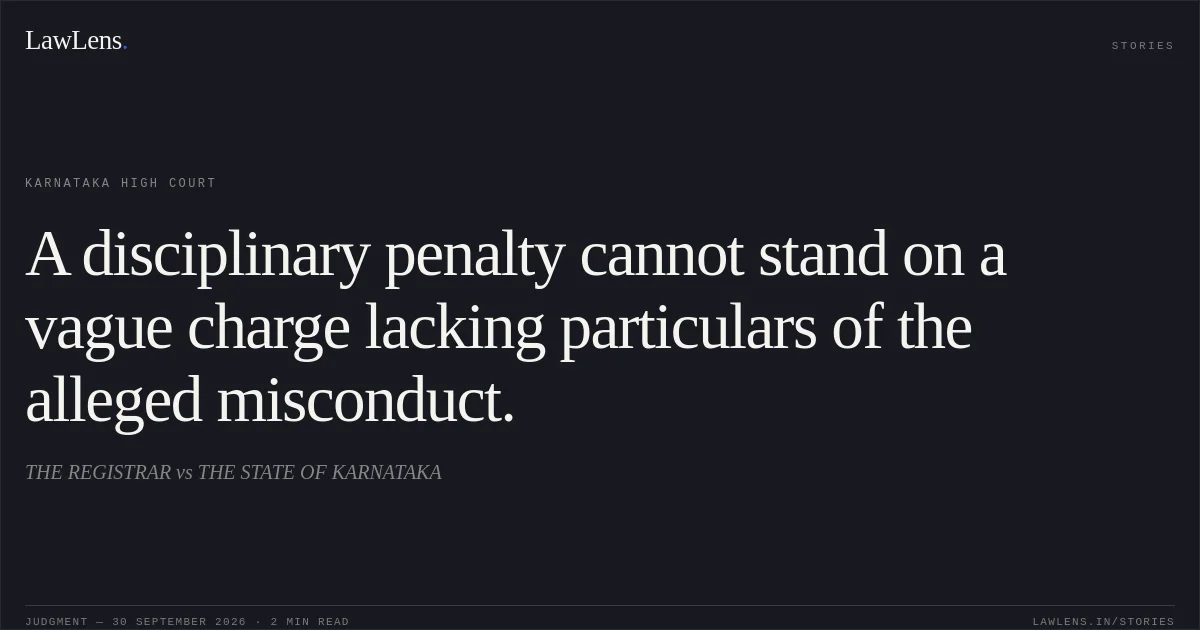
Source reference: para. 8A disciplinary charge must provide sufficient particulars to enable the employee to understand and answer the allegation; a vague charge cannot properly sustain an adverse finding.
Source reference: paras. 9–10Reasoning
The first part of the charge, concerning purchases, was found unproved and did not form the basis of the penalty under review.
Source reference: paras. 9–11The second part alleged generally that the respondent had failed to act against absent staff, but identified neither the staff members concerned nor the relevant periods of absence.
Source reference: paras. 9–11The Court held that this lack of particulars made the charge vague and supported the Tribunal’s conclusion that the Enquiry Officer’s finding was perverse and not in accordance with the material on record.
Source reference: paras. 9–11The Tribunal’s decision therefore did not warrant interference under the limited scope of judicial review.
Source reference: paras. 9–11Holding
The High Court found no error or illegality in the Tribunal’s order and held that the writ petition lacked merit.
It rejected the writ petition, leaving the Tribunal’s order setting aside the penalty undisturbed.
Source reference: para. 11Original Court PDF
THE REGISTRARvsTHE STATE OF KARNATAKA
Click to open original judgment
Original judgment, available to read, download and summarize on LawLens.in