Facts
M/s. Pravin Corporation and M/s. Sangita Distributors, proprietorship concerns, traded in household-cleaning products manufactured by M/s. Glaccay Consumer Care Pvt. Ltd. (“GCC”).
Source reference: para. 2The Central Excise Department alleged that GCC cleared goods bearing the brand name “GLACCAY”, which allegedly belonged to another entity, while wrongly availing the SSI exemption under Notification No. 08/2003-CE dated 1 March 2003.
Source reference: para. 2During the investigation, the Appellants’ premises were searched and their statements recorded. They stated that they had purchased the goods from GCC and sold them to M/s. Star C.J., and that they were unaware of any non-payment of excise duty by GCC.
Source reference: para. 2A show-cause notice dated 22 June 2015 proposed penalties against the Appellants under Rule 26 of the Central Excise Rules, 2002.
Source reference: paras. 1–2The Principal Commissioner confirmed a penalty of ₹1,00,000 against each Appellant by Order-in-Original No. 27/SRK/PR.COMMR/M-II/2015-16 dated 17 February 2016.
Source reference: paras. 1–2Issues
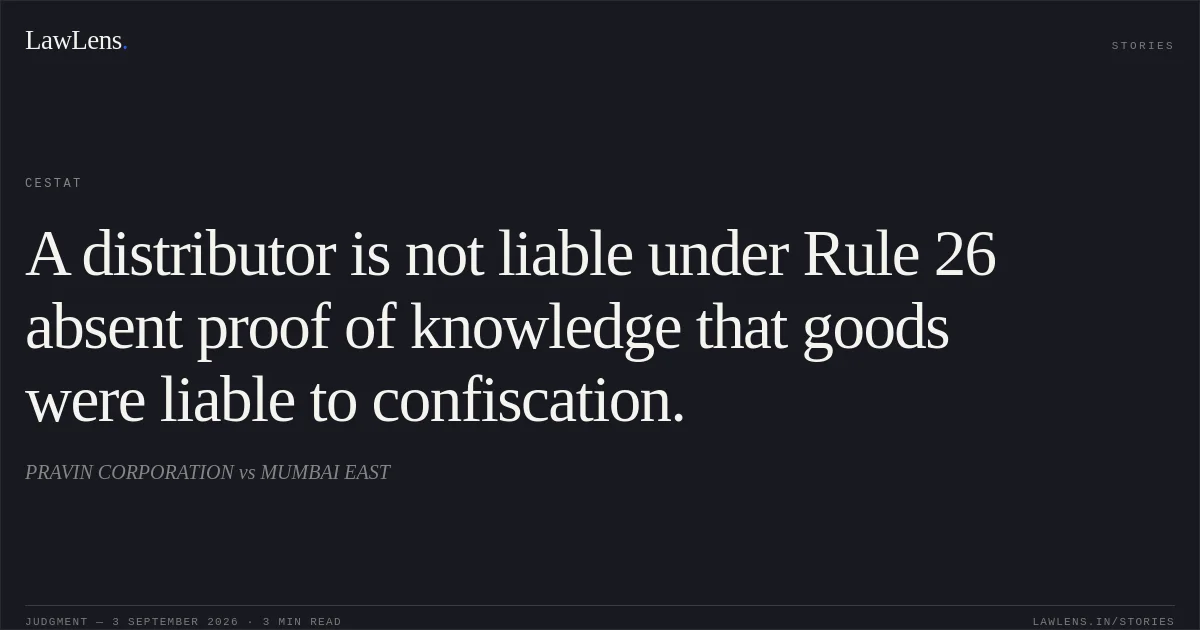
Whether the Appellants, merely by purchasing and distributing the goods manufactured by GCC, could be penalised under Rule 26 of the Central Excise Rules, 2002 without proof that they knew or had reason to believe that the goods were liable to confiscation?
Source reference: paras. 3, 5Whether a distributor or purchaser has a legal obligation to verify whether the manufacturer has correctly discharged excise duty at the time of clearance?
Source reference: para. 5Whether the alleged relationship between the Appellants and GCC, including the assertion that they were owners of GCC, was sufficiently established to justify the penalties?
Source reference: para. 5Law Applied
Rule 26 of the Central Excise Rules, 2002 requires, for imposition of penalty, both dealing with excisable goods and knowledge or reason to believe that the goods were liable to confiscation.
Source reference: para. 3The Tribunal relied on Electron Industries Ltd. v. Commissioner of Central Excise, Mumbai, 2014 (307) E.L.T. 746 (Tri.–Mumbai), which held that the liability to pay excise duty rests on the manufacturer and that a buyer cannot ordinarily be treated as having violated the law merely because the manufacturer failed to pay duty.
Source reference: paras. 3, 5The Tribunal also applied the principle that a distributor is not under a mandatory legal duty to investigate the manufacturer’s payment or non-payment of excise duty.
Source reference: para. 5Reasoning
Although the Appellants had dealt with the goods as distributors, the Department did not establish the second essential requirement under Rule 26—namely, that they knew or had reason to believe that the goods were liable to confiscation.
Source reference: paras. 3, 5Their statements indicated that they purchased the products from GCC and were unaware of the alleged excise-duty default.
Source reference: para. 2The Tribunal rejected the contention that their status as sole distributors or their familiarity with GCC’s turnover, by itself, established knowledge of non-payment of duty.
Source reference: para. 4It also found that the Principal Commissioner’s assertion that the Appellants were owners of GCC was not supported by the investigation material; the statements relied upon described them as distributors, not owners.
Source reference: para. 5Applying Electron Industries, the Tribunal held that the manufacturer remained responsible for payment of duty and that the Appellants, as buyers or distributors, could not be penalised merely for failing to verify the manufacturer’s compliance.
Source reference: para. 5Holding
The Tribunal answered the issues in favour of the Appellants.
It held that the necessary knowledge or reason to believe required for penalty under Rule 26 was not proved and that the Appellants had no legal obligation to ascertain whether GCC had discharged its excise-duty liability.
Source reference: para. 5The appeals were allowed, the Principal Commissioner’s Order-in-Original dated 17 February 2016 was set aside, and consequential relief, if any, was granted.
Source reference: para. 6Original Court PDF
PRAVIN CORPORATIONvsMUMBAI EAST
Click to open original judgment
Original judgment, available to read, download and summarize on LawLens.in