Facts
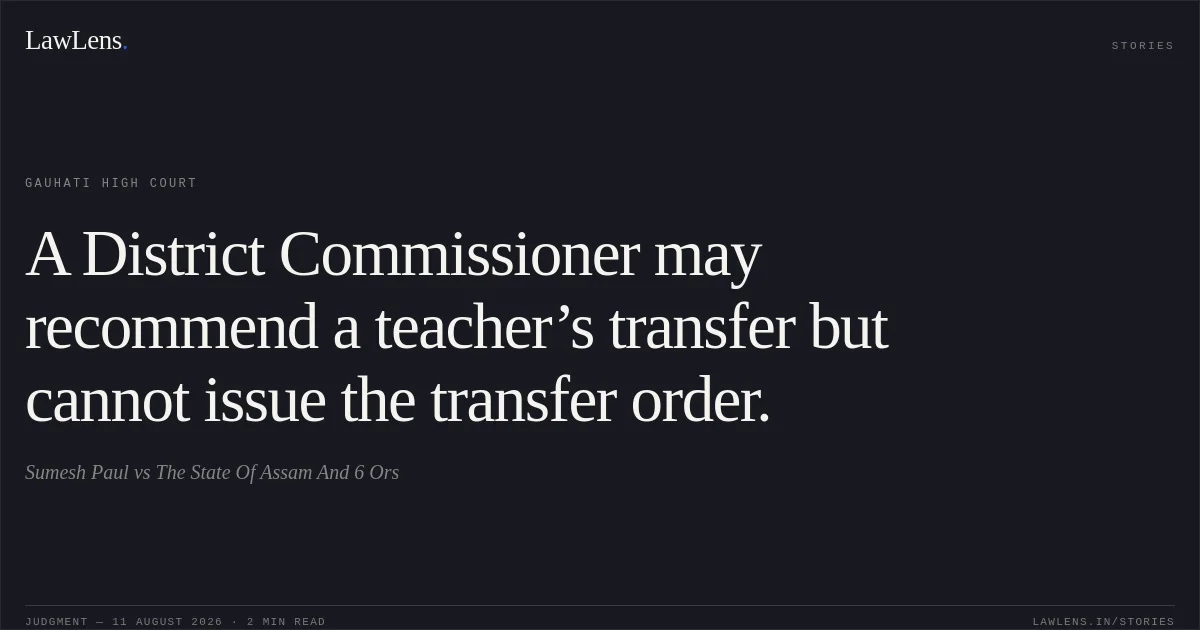
The petitioner, a teacher serving at 1 No. Lankeswari Grant LP School, challenged an order dated 20 June 2024 issued by the District Commissioner, Hojai, transferring him to Balipathar Jurapukhuri LPS.
Source reference: p.3, para. 2He contended that the District Commissioner lacked statutory authority to issue a transfer order under the Assam Elementary and Secondary School Teachers (Regulation of Posting and Transfer) Act, 2020.
Source reference: p.3, paras. 3–6The respondents asserted that the power to transfer and post teachers was vested in the departmental and district authorities under the 2020 Act.
Source reference: p.4, para. 7Issues
1. Whether the District Commissioner was competent under the Assam Elementary and Secondary School Teachers (Regulation of Posting and Transfer) Act, 2020, to directly issue an order transferring the petitioner.
Source reference: pp. 5–6, paras. 9–112. Whether the impugned transfer order dated 20 June 2024 was liable to be quashed for being issued without jurisdiction.
Source reference: pp. 6–7, paras. 11–153. Whether setting aside the transfer order prevented the respondents from issuing a fresh transfer order or initiating disciplinary proceedings against the petitioner.
Source reference: p.8, para. 16Law Applied
The Court applied Sections 2(a), 2(b) and 2(c) of the 2020 Act, defining the “appointing authority,” teacher categories or cadres, and “competent authority,” respectively.
Source reference: p.5, para. 9Section 9 authorises the Deputy Commissioner, in specified exigencies involving academic atmosphere, peace and tranquillity, or the safety and security of a female teacher, to refer a transfer proposal to the competent authority; it does not empower the Deputy Commissioner to directly issue a transfer order.
Source reference: pp. 5–6, paras. 9–10The competent authority must consider the proposal and recommend it to the concerned appointing authority, which alone may issue the transfer order.
Source reference: pp. 5–6, paras. 9–10The Court also relied on the principle that where a statute vests power in a particular authority, that power must be exercised only by that authority and in the manner prescribed by law, unless expressly delegated, as recognised in Commissioner of Police, Bombay v. Gordhandas Bhanji, 1951 SCC 1088.
Source reference: p.7, para. 13Reasoning
The Court found that the petitioner’s appointing authority was not the Deputy Commissioner and that Section 9 conferred only a limited power on the Deputy Commissioner to refer a transfer proposal to the competent authority.
Source reference: p.6, para. 11The statutory scheme required the competent authority to consider the proposal and recommend it to the appointing authority, which alone could issue the final transfer order.
Source reference: pp.5–6, paras. 9–10Since the District Commissioner directly issued the impugned transfer order, without acting through the statutory proposal, recommendation and appointing-authority process, the order was beyond the authority conferred by the 2020 Act and was therefore ultra vires and without jurisdiction.
Source reference: pp.6–7, paras. 11–14Holding
The Gauhati High Court held that a District Commissioner is not empowered under the 2020 Act to directly transfer a teacher.
Accordingly, the transfer order dated 20 June 2024, insofar as it concerned the petitioner, was set aside.
Source reference: p.7, para. 15The Court clarified that its decision did not prevent the respondents from issuing a fresh transfer order in accordance with law or from initiating disciplinary proceedings, including placing the petitioner under suspension if warranted.
Source reference: p.8, para. 16The writ petition was disposed of accordingly.
Source reference: p.8, para. 17Acts & Sections Cited
3 provisions across 1 statute referred to in this judgment. Linked provisions open on LawLens.
Assam Elementary and Secondary School Teachers (Regulation of Posting and Transfer) Act, 20203
Original Court PDF
Sumesh PaulvsThe State Of Assam And 6 Ors
Click to open original judgment
Original judgment, available to read, download and summarize on LawLens.in