Facts
The complainant alleged that the petitioner had improperly claimed family pension and created or used documents concerning her entitlement.
Source reference: no citationThe Magistrate declined to take cognizance; the revisional court set aside that order and remitted the matter with a direction to take cognizance of offences under Sections 419, 420, 462 and 471(a) IPC
Source reference: p. 2, para. 4The petitioner sought relief under Section 482 CrPC, contending, among other things, that the complainant had been divorced, that the petitioner was the deceased’s second wife and a nominee in his service records, and that the alleged offences were not made out
Source reference: pp. 3–5, paras. 7–11The judgment’s opening states that the petition challenged the Magistrate’s cognizance order, while its reasons identify the revisional court’s order as the order under challenge
Source reference: p. 1; p. 2, para. 4Issues
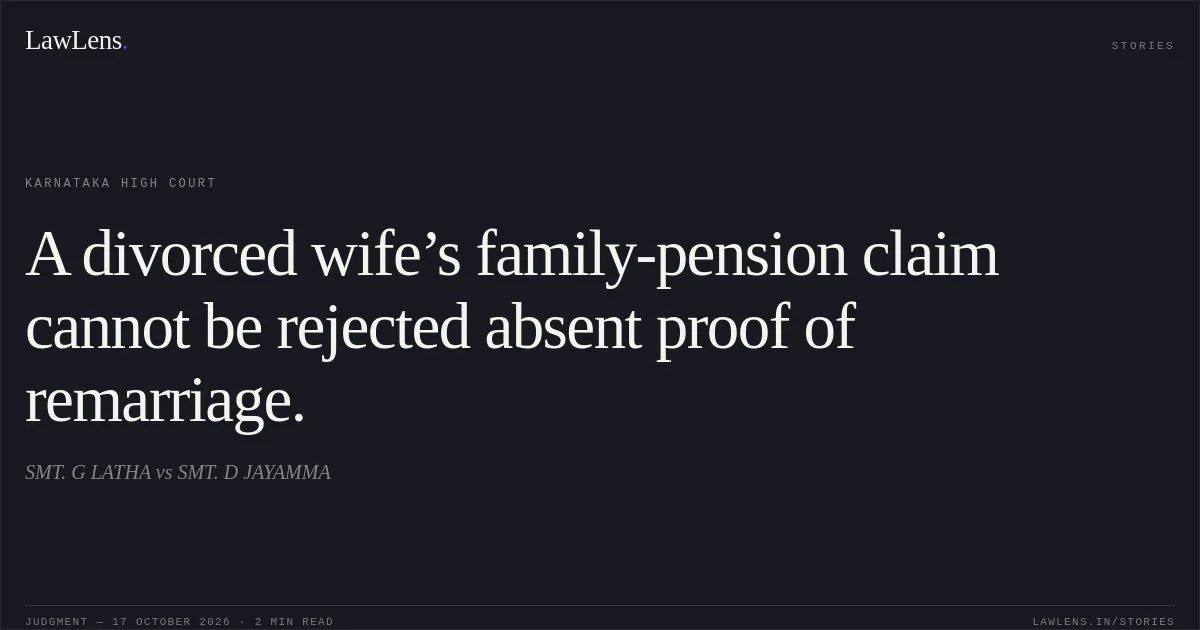
Whether the alleged divorce, without production of the divorce decree or evidence of the complainant’s remarriage, provided a basis to deny her claim to family pension and to set aside the revisional court’s direction for further proceedings.
Source reference: pp. 5–6, paras. 12–13Whether the allegations concerning creation or use of documents warranted further consideration by the trial court, and whether the petitioner could contest the ingredients of the alleged offences at the charge stage.
Source reference: pp. 6–7, paras. 13–14Law Applied
The Court considered Section 482 CrPC, under which the High Court may exercise its inherent jurisdiction, and the alleged offences under Sections 419, 420, 462 and 471(a) IPC.
Source reference: p. 1; p. 2, para. 4It applied the principle that an alleged divorce does not, by itself, bar a divorced wife from claiming family pension if she has not remarried; the judgment identifies no supporting statutory provision or precedent.
Source reference: p. 5, para. 12It further treated the absence of a divorce decree and evidence of remarriage as material to whether the complainant’s pension claim could be rejected, while leaving the alleged document offences for reconsideration by the trial court.
Source reference: pp. 5–6, paras. 12–13Reasoning
The Court found no material establishing either a valid divorce decree or the complainant’s remarriage. Accordingly, the petitioner’s reliance on an alleged divorce did not establish that the complainant was disentitled to claim family pension.
Source reference: p. 5, para. 12Given that the complainant’s status as the deceased’s wife was not disputed, the Court held that the pension dispute and allegations of creating and using documents as genuine required consideration by the trial court.
Source reference: p. 6, para. 13The petitioner remained at liberty to argue at the charge stage that the ingredients of Sections 419 and 420 IPC were not satisfied.
Source reference: p. 6, para. 14Holding
The Court found no ground to set aside the revisional court’s order and disposed of the criminal petition.
It left the petitioner at liberty to contest, at the charge stage, whether Sections 419 and 420 IPC were attracted; the allegations concerning Sections 462 and 471(a) IPC remained for consideration by the trial court.
Source reference: p. 6, paras. 13–14Acts & Sections Cited
5 provisions across 2 statutes referred to in this judgment. Each provision opens on LawLens.
Code of Criminal Procedure, 19731
Indian Penal Code, 18604
Original Court PDF
SMT. G LATHAvsSMT. D JAYAMMA
Click to open original judgment
Original judgment, available to read, download and summarize on LawLens.in