Facts
On 13.05.2014, the deceased was brought to the Community Health Centre, Charama, with extensive burn injuries. An Executive Magistrate recorded her dying declaration, in which she stated that she had poured kerosene on herself and set herself ablaze following a quarrel with her husband regarding his alleged illicit relationship with another woman; she also alleged that her husband had assaulted her for about one year.
Source reference: p.1She subsequently died before being shifted to a higher medical centre. A merg inquiry under Section 174 CrPC was registered, followed by FIR No. 160/2014 under Section 306 IPC against the accused-husband.
Source reference: p.2After investigation, a charge-sheet was filed and the matter proceeded as Sessions Trial No. 58/2014. The trial Court acquitted the accused on the ground that the prosecution failed to prove abetment of suicide beyond reasonable doubt.
Source reference: pp.2–3The State preferred an appeal against acquittal under Section 378(1) CrPC.
Source reference: p.1Issues
Whether the trial Court’s judgment of acquittal suffered from perversity or illegality warranting interference by the High Court?
Source reference: para. 8, p.4Whether the trial Court was justified in declining to rely upon the deceased’s dying declaration, Ex. P/26, for establishing the offence under Section 306 IPC?
Source reference: para. 8, p.4Law Applied
The Court applied Section 306 IPC, which requires proof that the accused abetted the commission of suicide, including through instigation or intentional aid.
Source reference: para. 9, p.4It considered Section 32(1) of the Indian Evidence Act, under which a statement relating to the cause of a person’s death or the circumstances resulting in that death is relevant.
Source reference: para. 9, p.4However, a dying declaration can form the sole basis of conviction only if it is voluntary, truthful, reliable, and made while the declarant was in a fit mental and physical condition; courts must guard against tutoring, prompting, imagination, or improper recording.
Source reference: para. 14, pp.7–9Relying on Irfan @ Naka v. State of Uttar Pradesh, the Court held that a dying declaration must inspire confidence before it can be acted upon and identified factors such as the declarant’s fitness, voluntariness, consistency, proper recording, and absence of prompting.
Source reference: para. 14, pp.7–9In an appeal against acquittal, appellate interference is warranted only where the acquittal is patently perverse, based on misreading or omission of material evidence, or where no two reasonable views are possible, as stated in Constable 907 Surendra Singh v. State of Uttarakhand.
Source reference: para. 16, p.10Reasoning
The High Court found that the prosecution evidence did not establish the essential element of abetment.
Source reference: no citationThe deceased’s mother, PW-2, admitted that the deceased and accused had a love marriage, that she had not complained to her about harassment or cruelty during the marriage, and that the alleged quarrel concerning the accused’s character had not been communicated to her.
Source reference: para. 10, p.5The reliability of Ex. P/26 was also doubtful. The doctor, PW-11, had not certified the deceased’s mental fitness and admitted that the medical records did not establish whether the deceased had self-immolated or had been burnt by another person; the deceased had suffered approximately 91% burns.
Source reference: para. 11, pp.5–6The Tehsildar who recorded the declaration, PW-14, admitted that the declaration did not record whether the deceased was capable of speaking or understanding, whether a doctor had certified her fitness, whether it had been read over and explained to her, or whether a medical officer was present.
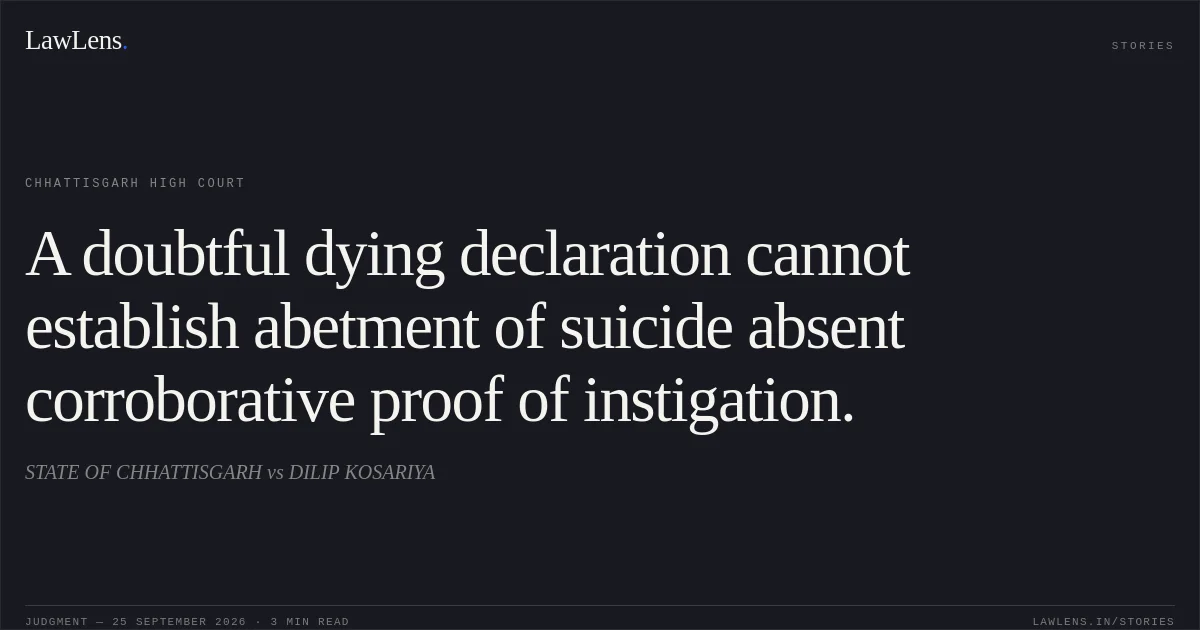
Source reference: para. 12, p.6In these circumstances, the dying declaration did not inspire sufficient confidence and could not safely establish instigation or intentional aid by the accused.
Source reference: para. 13, p.7; para. 15, pp.9–10Since the trial Court’s view was a reasonable one supported by the evidence, the High Court held that the stringent standard for interference with an acquittal was not satisfied.
Source reference: paras. 16–17, pp.10–11Holding
The High Court answered both issues against the State.
It held that the dying declaration was not sufficiently reliable to sustain a conviction and that the prosecution had failed to prove that the accused instigated or otherwise abetted the deceased to commit suicide under Section 306 IPC.
Source reference: para. 17, p.11Finding no perversity or illegality in the trial Court’s judgment, the Court dismissed the acquittal appeal and affirmed the judgment dated 06.10.2017 acquitting Dilip Kosariya in Sessions Trial No. 58/2014.
Source reference: paras. 18–19, p.11Acts & Sections Cited
3 provisions across 2 statutes referred to in this judgment. Each provision opens on LawLens.
Code of Criminal Procedure, 19732
Indian Penal Code, 18601
Original Court PDF
STATE OF CHHATTISGARHvsDILIP KOSARIYA
Click to open original judgment
Original judgment, available to read, download and summarize on LawLens.in