Facts
The complainant and his family occupied a residential house purchased from respondent No. 1, Hanifkhan Pathan, under an instalment arrangement. The prosecution alleged that, following disputes regarding unpaid instalments and drainage, the respondents assaulted the complainant’s brother and threatened the complainant and his wife with eviction and death if they did not vacate the house.
Source reference: pp.1–3, paras.1–5On 7 January 2008, the complainant’s wife, Umatunnisha, allegedly poured kerosene on herself and set herself ablaze. While undergoing treatment, she allegedly attributed the suicide attempt to harassment and threats by the respondents. An FIR was registered for offences under Sections 387, 306, 323, 506(2) and 114 of the IPC.
Source reference: pp.1–3, paras.1–5After investigation, the respondents were tried in Sessions Case No. 275 of 2008 and acquitted by the Additional Sessions Judge, Fast Track Court No. 1, Ahmedabad, on 11 February 2011. The State preferred an appeal against acquittal under Section 378(1) and (3) of the Code of Criminal Procedure, 1973.
Source reference: pp.1–3, paras.1–5The prosecution examined twelve witnesses and produced seventeen documentary exhibits. The complainant, the deceased’s brother-in-law and her father-in-law did not support the prosecution case. The principal evidence relied upon against the respondents consisted of dying declarations, including the declaration recorded by the Executive Magistrate.
Source reference: p.3, 7–8, paras.2.3, 11–12Issues
1. Whether the trial court was justified in acquitting the respondents of the offences under Sections 387, 306, 323, 506(2) and 114 of the IPC?
Source reference: p.5, para.9(1)2. Whether the trial court properly appreciated the oral and documentary evidence, particularly the dying declarations and the testimony of the prosecution witnesses?
Source reference: p.5, para.9(2)3. Whether the judgment of acquittal suffered from illegality, irregularity or perversity warranting appellate interference?
Source reference: p.5, para.9(3)Law Applied
The Court considered the offences charged under Sections 387, 306, 323, 506(2) and 114 of the Indian Penal Code, 1860, and exercised appellate jurisdiction under Section 378(1) and (3) of the Code of Criminal Procedure, 1973.
Source reference: p.1, para.1The prosecution was required to establish the respondents’ criminal conduct and its connection with the deceased’s suicide beyond reasonable doubt.
Source reference: no citationThe Court applied the principles governing appeals against acquittal stated in Chandrappa v. State of Karnataka, (2007) 4 SCC 415, reaffirmed in Rajesh Prasad v. State of Bihar, (2022) 3 SCC 471, Babu Sahebagouda Rudragoudar v. State of Karnataka, (2024) 8 SCC 149 / AIR 2024 SC 2252, and Ramesh v. State of Karnataka, (2024) 9 SCC 169: an appellate court may fully reappreciate the evidence, but an acquittal carries a double presumption of innocence; where two reasonable views are possible, the view favouring the accused should ordinarily be maintained; and interference is justified only where the trial court’s conclusion is manifestly illegal or perverse.
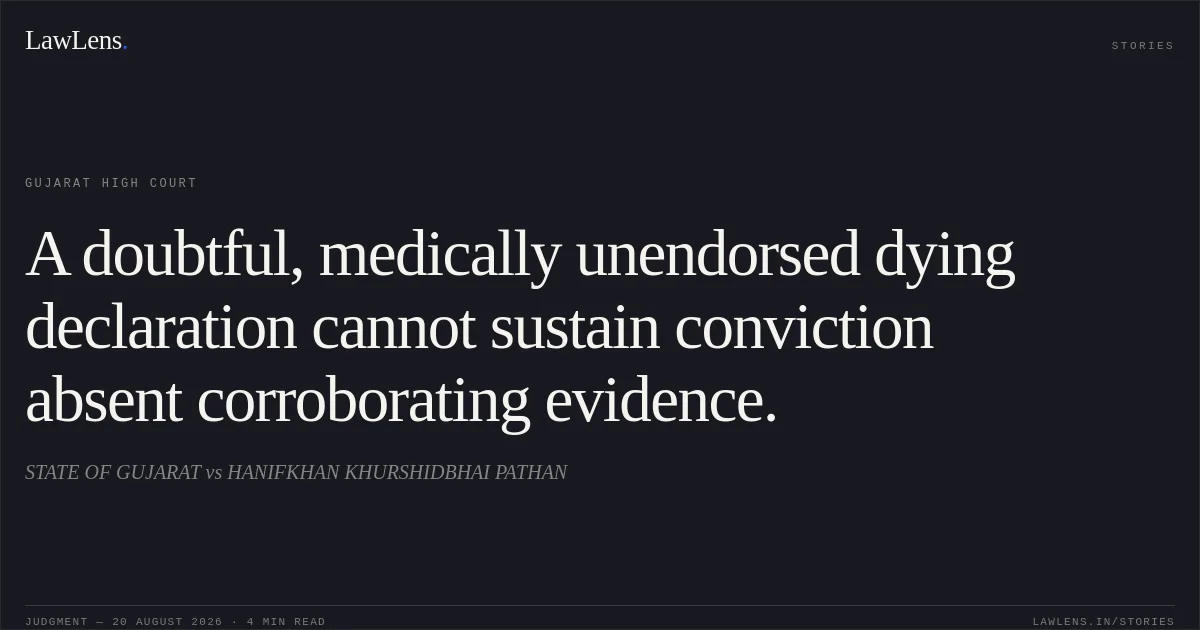
Source reference: pp.9–11, paras.14–17A dying declaration must also be shown to be reliable and made by a person in a fit physical and mental condition; the absence of medical or other assurance of fitness may substantially affect its evidentiary value.
Source reference: p.7, para.11Reasoning
The Court held that the principal dying declaration was doubtful because the Executive Magistrate had not obtained any medical endorsement regarding the deceased’s physical and mental fitness to make a statement.
Source reference: p.7, para.11This omission assumed particular significance because the Investigating Officer stated that, when he visited the hospital, the deceased was unable to speak or give a statement.
Source reference: p.7, para.11The Court therefore found that the dying declaration could not safely support a conviction. The remaining evidence was also insufficient: the complainant, the deceased’s brother-in-law and her father-in-law did not support the prosecution; the alleged brother-in-law assault was not corroborated; and the police evidence indicated that the deceased and her husband lived separately from the respondents, weakening the prosecution’s account of continuing harassment.
Source reference: pp.7–8, para.12In light of these evidentiary deficiencies, the prosecution failed to establish a credible link between the respondents’ alleged threats and the deceased’s suicide beyond reasonable doubt.
Source reference: pp.8–10, paras.13–16, 18–19Applying the enhanced restraint applicable in an appeal against acquittal, the Court found no perversity or manifest error in the trial court’s assessment.
Source reference: pp.8–10, paras.13–16, 18–19Holding
The High Court answered all issues in favour of the respondents. It held that the prosecution had failed to prove the charged offences beyond reasonable doubt and that the trial court’s acquittal was neither illegal nor perverse.
The State’s appeal was dismissed, the judgment and order of acquittal dated 11 February 2011 were confirmed, the bail bonds were cancelled, and the record and proceedings were directed to be returned to the trial court forthwith.
Source reference: p.12, para.20Acts & Sections Cited
7 provisions across 2 statutes referred to in this judgment. Each provision opens on LawLens.
Code of Criminal Procedure, 19732
Indian Penal Code, 18605
Original Court PDF
STATE OF GUJARATvsHANIFKHAN KHURSHIDBHAI PATHAN
Click to open original judgment
Original judgment, available to read, download and summarize on LawLens.in