Facts
Triveni, wife of the appellant Jagan, sustained extensive burn injuries at the matrimonial home on 23 December 2015. Her brother lodged an FIR alleging that Jagan had poured kerosene oil on her and set her ablaze, leading initially to registration under Section 326 IPC.
Source reference: para. 3A dying declaration was recorded by the Additional City Magistrate after medical certification that Triveni was fit and lucid; she allegedly stated that Jagan had sprinkled kerosene oil on her and set her on fire because they had no children. She subsequently died, and the post-mortem found superficial-to-deep ante-mortem burns over the body with a smell of kerosene; death was attributed to shock and burn injuries.
Source reference: paras. 3–4The prosecution examined eight witnesses, including the deceased’s relatives, the Investigating Officer, the Magistrate who recorded the dying declaration, and the post-mortem doctor.
Source reference: paras. 5–12In his statement under Section 313 CrPC, Jagan denied the accusation and stated that Triveni had set herself on fire following a dispute regarding whether a child from her parental family or his brother’s family should be adopted. Defence witnesses testified that Jagan had suffered burn injuries while attempting to extinguish the fire and that his family had taken Triveni to the hospital.
Source reference: paras. 13–18The trial court convicted him under Section 304 IPC and sentenced him to life imprisonment with a fine of Rs. 50,000. He appealed to the High Court.
Source reference: para. 19Issues
1. Whether the dying declaration could safely be relied upon when it was allegedly recorded in the presence of the deceased’s relatives and was therefore susceptible to tutoring or influence.
Source reference: paras. 20, 232. Whether the prosecution proved beyond reasonable doubt that Jagan had poured kerosene oil on Triveni and set her on fire, rather than that Triveni had self-immolated during a domestic dispute.
Source reference: paras. 21–233. Whether the imposition of life imprisonment under Section 304 IPC was legally sustainable without recording special reasons under Section 354(3) CrPC after following the sentencing procedure under Section 235(2) CrPC.
Source reference: para. 21Law Applied
The court considered Section 304 IPC, which criminalises culpable homicide not amounting to murder, and the prosecution’s charge under Section 326 IPC.
Source reference: paras. 2, 4It also considered Sections 235(2) and 354(3) CrPC, under which the accused must be heard on sentence and special reasons must be recorded where life imprisonment is imposed in an offence permitting a lesser sentence.
Source reference: para. 21On dying declarations, the court relied upon Mohan Lal v. State of Haryana, (2007) 9 SCC 151, and Sanjay Kumar Sharma v. State of Bihar, 2026 SCC OnLine SC 357, for the principle that a dying declaration must be voluntary and free from tutoring; the presence of relatives, coupled with surrounding circumstances suggesting influence, may render it unreliable.
Source reference: para. 20A conviction cannot be sustained where the evidence leaves a reasonable doubt regarding the accused’s authorship of the act causing death.
Source reference: para. 23Reasoning
The High Court found material circumstances inconsistent with the prosecution’s allegation that Jagan intentionally set Triveni on fire. The defence evidence indicated that Jagan had himself suffered burn injuries while attempting to save her, and that his mother had taken Triveni to the hospital.
Source reference: para. 23The marriage had lasted approximately 18 years, and the evidence disclosed no established dowry-related motive; the recurring dispute concerned adoption of a child from either side of the family.
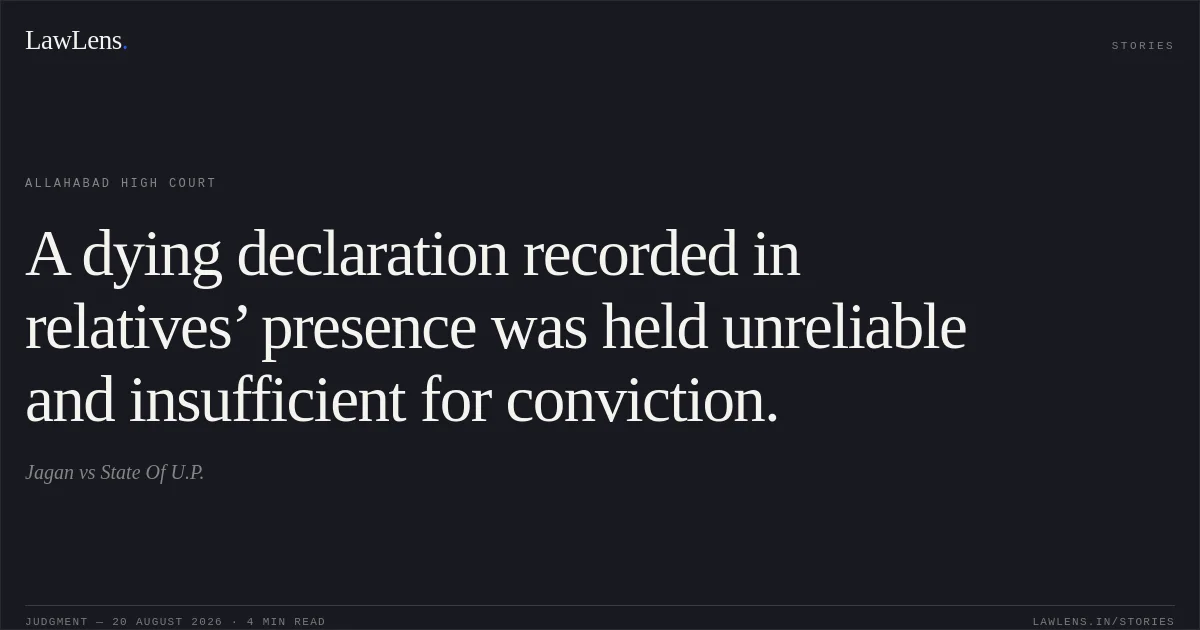
Source reference: para. 23Although the dying declaration attributed the act to Jagan, the Court attached no decisive weight to it because it was recorded in the presence of family members, creating a possibility of tutoring or influence, particularly in light of the principles stated in Mohan Lal.
Source reference: paras. 20, 23Considering the surrounding circumstances cumulatively, the Court held that it could not be established with certainty that Jagan had poured kerosene oil on Triveni and set her ablaze.
Source reference: para. 23In view of this conclusion, the sentencing objection under Sections 235(2) and 354(3) CrPC did not require independent determination.
Source reference: no citationHolding
The High Court answered the principal issues in favour of Jagan and held that the prosecution had failed to prove beyond reasonable doubt that he caused Triveni’s death by setting her on fire.
The dying declaration was considered unreliable in the circumstances, and the evidence that Jagan attempted to rescue Triveni raised substantial doubt about his guilt.
Source reference: para. 23The appeal was allowed, the trial court’s judgment and order dated 8 August 2018 were set aside, and Jagan was honourably acquitted of the charges.
Source reference: paras. 24–26If he was on bail, he was not required to surrender; his bail bonds and sureties were discharged, and the trial court record was directed to be returned.
Source reference: paras. 24–26Acts & Sections Cited
5 provisions across 2 statutes referred to in this judgment. Each provision opens on LawLens.
Indian Penal Code, 18602
Code of Criminal Procedure, 19733
Original Court PDF
JaganvsState Of U.P.
Click to open original judgment
Original judgment, available to read, download and summarize on LawLens.in