Facts
The appellant challenged his conviction under Sections 376 and 420 of the Indian Penal Code (IPC) and sentences imposed by the Sessions Court.
Source reference: p. 2–4The prosecution alleged that he had sexual intercourse with the complainant on the promise of marriage and later refused to marry her.
Source reference: p. 2–4The complainant, aged 24 at the time of medical examination, was the principal prosecution witness; the medical evidence reported no signs of recent intercourse, and forensic examination detected no seminal stains on the samples examined.
Source reference: p. 9–10The Sessions Court convicted the appellant and sentenced him to seven years’ rigorous imprisonment under Section 376 and two years’ rigorous imprisonment under Section 420, with fines.
Source reference: p. 4Issues
Whether the appellant had established grounds to interfere with the conviction and sentence for offences under Sections 376 and 420 IPC.
Source reference: p. 7Whether the sexual relationship, said to have occurred on a promise of marriage, established rape through consent vitiated by misconception of fact, or cheating.
Source reference: p. 10–11, 31–32Law Applied
The Court considered Sections 375, 376, 90 and 420 IPC.
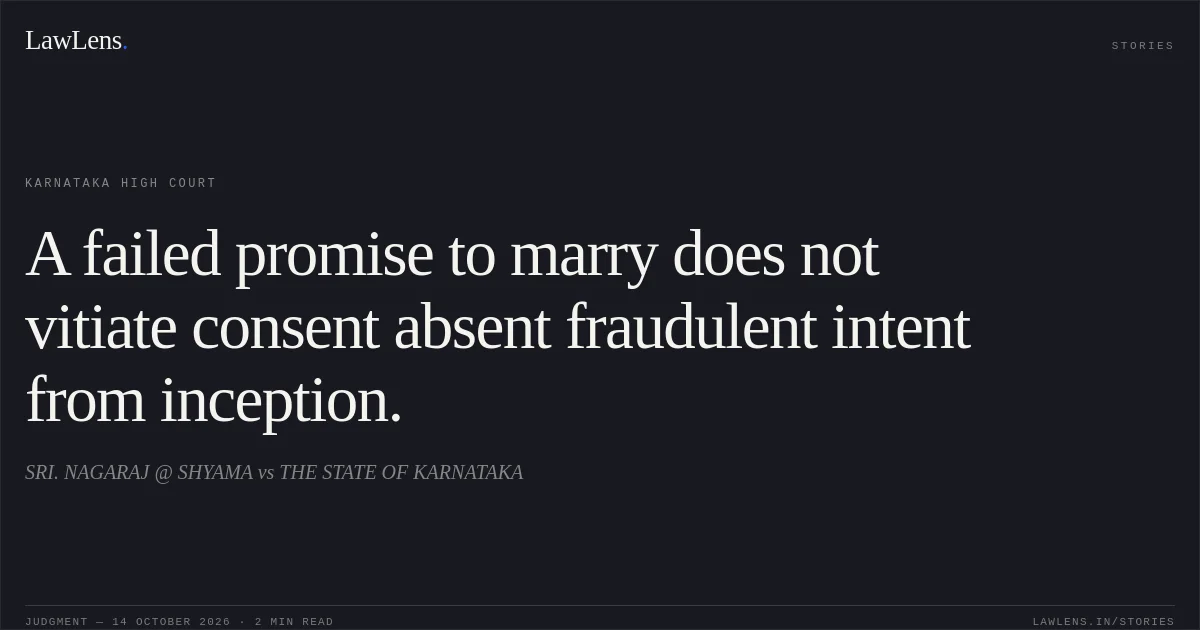
Source reference: no citationFor rape based on a promise to marry, a promise that is not fulfilled is distinct from a false promise made without any intention of fulfilment from the outset; consent is vitiated by misconception of fact only where the false promise induced the complainant’s consent and the accused knew, or had reason to believe, that it did so.
Source reference: p. 11–20The Court also relied on Samadhan v. State of Maharashtra, including the principle that a prolonged consensual relationship cannot, without credible evidence of deception or absence of free consent, be retrospectively treated as rape merely because it did not result in marriage.
Source reference: p. 21–31The prosecution was required to prove the charged offences beyond reasonable doubt.
Source reference: no citationReasoning
The Court found that the relationship between the appellant and the complainant continued for more than four years and that they remained emotionally close; the evidence did not establish that the appellant had made the promise without intending to fulfil it from the outset or that the complainant’s consent resulted from such a misconception.
Source reference: p. 31–32The Court therefore treated the physical intimacy as arising during the course of the relationship, rather than as rape merely because the relationship did not culminate in marriage.
Source reference: p. 32In light of the evidentiary record, including the medical and forensic evidence, the Court concluded that the prosecution had not proved the offences under Sections 376 and 420 IPC.
Source reference: p. 9–10, 31–32Holding
The Court answered the question of interference in the affirmative and allowed the appeal.
It set aside the conviction and sentences, acquitted the appellant of the offences under Sections 376 and 420 IPC, cancelled his bail bond and directed the trial court to refund any fine paid.
Source reference: p. 32–33Acts & Sections Cited
14 provisions across 4 statutes referred to in this judgment. Each provision opens on LawLens.
Code of Criminal Procedure, 19737
Indian Penal Code, 18605
Bharatiya Nagarik Suraksha Sanhita, 20231
Indian Contract Act, 18721
Original Court PDF
SRI. NAGARAJ @ SHYAMAvsTHE STATE OF KARNATAKA
Click to open original judgment
Original judgment, available to read, download and summarize on LawLens.in


