Facts
On 30 August 2012, a tanker bearing registration No. GJ-14-W-1509 allegedly collided rashly and negligently with the claimant’s rickshaw, causing grievous injuries.
Source reference: p.2, para. 2The Motor Accident Claims Tribunal partly allowed the claim petition and awarded compensation of ₹2,53,960 with interest at 7% per annum.
Source reference: p.1, para. 1The Tribunal directed the Insurance Company to pay the compensation and recover it from the vehicle owner on the ground that the tanker driver, Dharmender Paswan, did not possess a valid driving licence.
Source reference: p.3, para. 4The vehicle owner challenged the “pay and recover” direction, contending that the licence had been produced before the Tribunal, that the Insurance Company had not properly proved its falsity, and that it had not established the owner’s knowledge of, or wilful breach concerning, the allegedly fake licence.
Source reference: pp.3–4, paras. 4–4.1The Insurance Company relied on correspondence from its investigator and the Kamrup RTO stating that the licence number had not been issued in the driver’s name.
Source reference: pp.4–5, paras. 5, 7Issues
Whether the Insurance Company sufficiently proved that the tanker driver’s driving licence was fake or invalid?
Source reference: p.5, para. 7Whether the Insurance Company was required to prove that the vehicle owner knew, or ought reasonably to have known, that the driver possessed a fake or invalid licence before obtaining a “pay and recover” direction?
Source reference: pp.5–7, paras. 7–8Whether the Tribunal’s direction permitting the Insurance Company to recover the compensation from the vehicle owner was sustainable?
Source reference: p.7, para. 10Law Applied
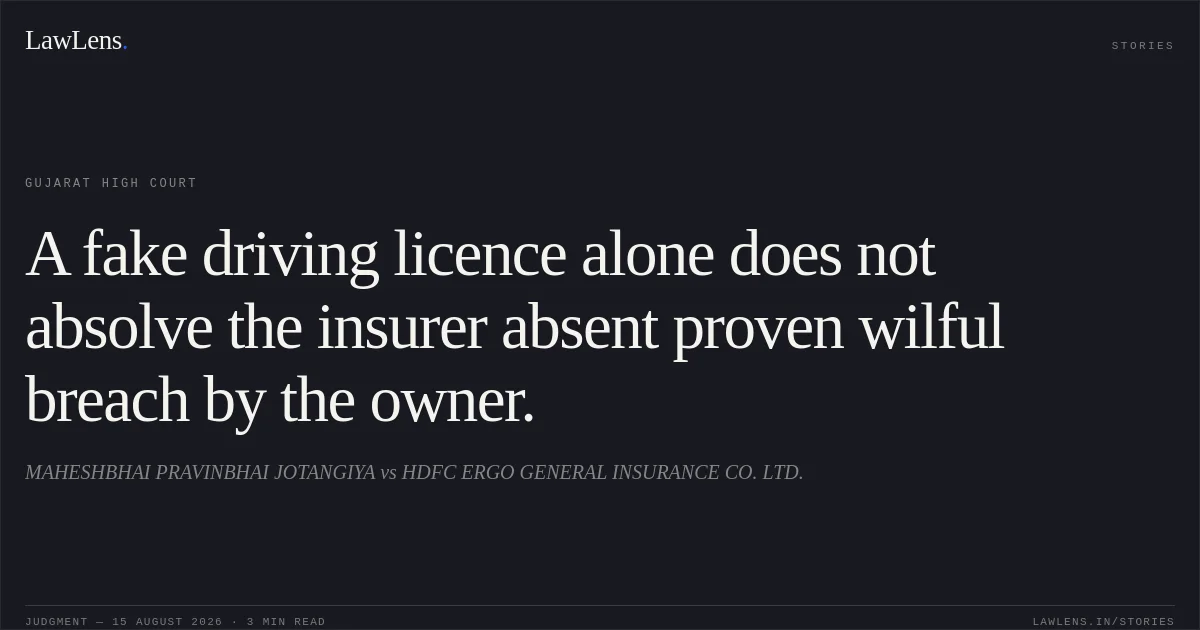
The Court applied the principle that the mere fact that a driver’s licence is fake or invalid does not, by itself, absolve the insurer from liability to third-party victims or justify recovery from the vehicle owner.
Source reference: pp.6–7, para. 8Relying on IFFCO Tokio General Insurance Co. Ltd. v. Geeta Devi & Ors., the Court held that the insurer must establish a wilful breach by proving that the owner knew of the licence’s falsity or had failed to exercise reasonable diligence where circumstances warranted verification.
Source reference: pp.6–7, para. 8A seemingly valid licence need not ordinarily be independently verified with the licensing authority unless it is facially suspicious, expired, or otherwise raises a genuine doubt.
Source reference: p.6, para. 8The Court also relied on Rishi Pal Singh v. New India Assurance Co. Ltd. & Ors., holding that an owner is expected to verify the driver’s competence, not routinely investigate the genuineness of the licence with the RTO; absent proof of wilful breach, the insurer cannot recover the award from the owner.
Source reference: p.7, para. 9The Court further referred to the principle in Ram Chandra Singh v. Rajaram, that a fake licence, per se, does not absolve the insurer.
Source reference: p.6, para. 8Reasoning
Although the Insurance Company produced the investigator’s letter and the Kamrup RTO’s reply stating that the licence had not been issued in Dharmender Paswan’s name, it examined neither the investigator nor any RTO official to prove the documents and the alleged invalidity through appropriate evidence.
Source reference: p.5, para. 7More importantly, the Insurance Company led no evidence showing that the vehicle owner knew that the licence was fake, or that the licence was so suspicious that reasonable diligence required independent RTO verification.
Source reference: pp.5–7, paras. 7–9Since the owner had a licence apparently issued for the relevant vehicle categories, the insurer failed to establish a wilful breach of the policy condition.
Source reference: pp.5–7, paras. 7–9Applying the principles in *Geeta Devi* and *Rishi Pal Singh*, the Court held that the “pay and recover” direction could not be sustained.
Source reference: p.7, para. 10Holding
The appeal was allowed to the extent that the “pay and recover” direction was set aside.
The award of ₹2,53,960 with interest at 7% per annum remained payable by the Insurance Company, which was directed to satisfy the award within six weeks of receiving the judgment.
Source reference: p.8, para. 12Upon deposit, the Tribunal was directed to disburse the amount to the claimants after deducting any deficit court fees and completing due verification.
Source reference: p.8, para. 13The connected civil application for stay was disposed of as infructuous, with no order as to costs.
Source reference: p.8, paras. 14–15Original Court PDF
MAHESHBHAI PRAVINBHAI JOTANGIYAvsHDFC ERGO GENERAL INSURANCE CO. LTD.
Click to open original judgment
Original judgment, available to read, download and summarize on LawLens.in