Facts
Mohammad Manjur, aged approximately 22–23 years, died in a motor-vehicle accident on 15 June 2000 due to the rash and negligent driving of truck No. PBP-5151 by respondent No.1, Balwinder Singh. The truck was owned by respondent No.2 and insured with respondent No.3-Insurance Company.
Source reference: paras. 2, 9, 14–15His wife and father instituted a claim petition under Section 166 of the Motor Vehicles Act, 1988. The Tribunal awarded ₹2,81,500 with interest at 9% per annum, assessing the deceased’s monthly income at ₹2,000, applying a multiplier of 17, and directing the Insurance Company to pay the award initially with liberty to recover it from the owner on the ground that the driver possessed a fake driving licence.
Source reference: paras. 2–3, 15, 22The claimants appealed for enhancement of compensation. The owner filed cross-objections challenging the finding that the driving licence was fake and the grant of recovery rights to the Insurance Company. The cross-objections were treated as an independent appeal pursuant to an earlier order of the High Court.
Source reference: para. 4During the proceedings, additional evidence was led regarding the driving licence and records from the DTO, Sangrur.
Source reference: paras. 23–25Issues
Whether the claimants were entitled to enhancement of compensation beyond ₹2,81,500, particularly on account of reassessment of income, future prospects, dependency, multiplier, and conventional heads?
Source reference: paras. 9–21Whether the driving licence produced by the driver was fake or invalid?
Source reference: paras. 22–25Whether the Insurance Company could avoid liability or obtain recovery rights against the owner merely because the driver possessed a fake driving licence, in the absence of proof of a wilful breach by the insured?
Source reference: paras. 26–29Whether the attached property of the owner was liable to be released after the Insurance Company was held liable to indemnify the insured?
Source reference: paras. 34–36Law Applied
The Court applied Section 166 of the Motor Vehicles Act, 1988, under which claimants are entitled to “just compensation” for death caused by a motor accident.
Source reference: paras. 2, 13In assessing compensation, it relied on Sarla Verma v. Delhi Transport Corporation, 2009 (6) SCC 121, for deductions towards personal expenses and the appropriate multiplier; National Insurance Co. Ltd. v. Pranay Sethi, 2017 (16) SCC 680, for future prospects and conventional heads; Magma General Insurance Co. Ltd. v. Nanu Ram, 2018 (4) RCR (Civil) 333, and United India Insurance Co. Ltd. v. Satinder Kaur, (2021) 11 SCC 780, for consortium; and Chandra alias Chander alias Chanda Ram v. Mukesh Kumar Yadav, (2022) 1 SCC 198, for reasonable assessment of income where documentary proof is unavailable.
Source reference: paras. 10, 16–19The Court further relied on Sadhana Tomar v. Ashok Kushwaha, 2025 LiveLaw (SC) 309, to treat the deceased’s father as a dependent.
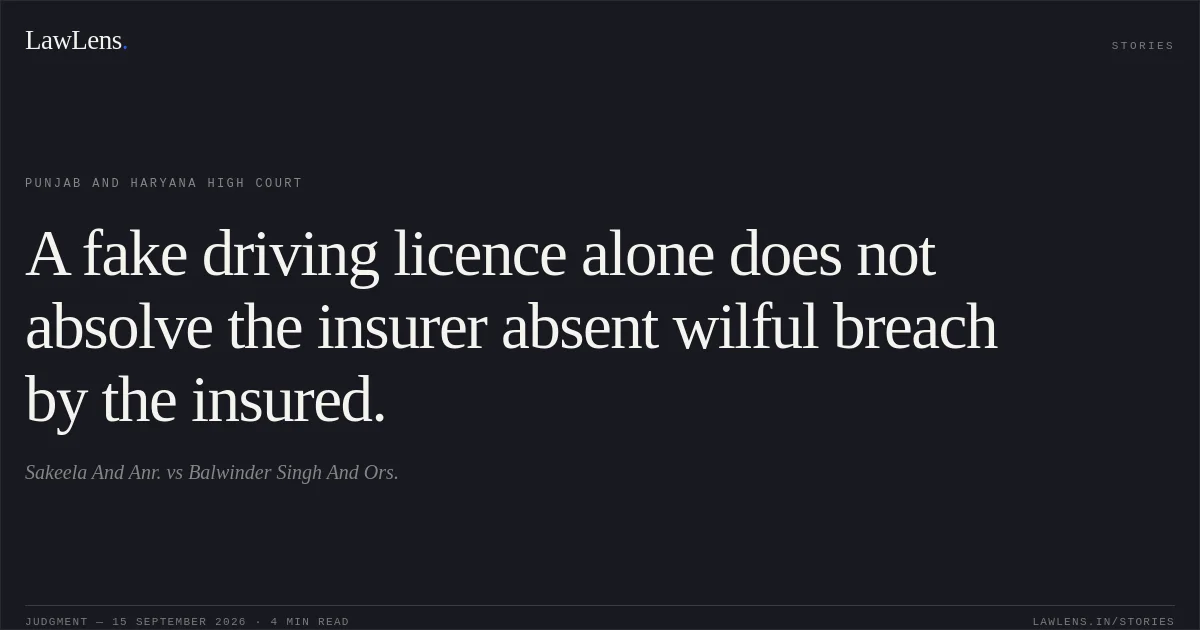
Source reference: para. 18On liability, the Court applied the principle that a fake or invalid driving licence, by itself, does not absolve the insurer; the insurer must prove that the insured committed a conscious or wilful breach by knowingly entrusting the vehicle to an unlicensed driver.
Source reference: paras. 26–29This principle was drawn from Rishi Pal Singh v. New India Assurance Co. Ltd., 2022 ACJ 1868; IFFCO Tokio General Insurance Co. Ltd. v. Geeta Devi, 2023 SCC OnLine SC 1398; and Hind Samachar Ltd. v. National Insurance Co. Ltd.
Source reference: paras. 26–29Section 151 CPC was invoked in the application seeking release of the attached property.
Source reference: para. 34Reasoning
The Court reassessed the deceased’s income at ₹2,500 per month, observing that strict documentary proof was not mandatory for an unorganised-sector worker and that the income had to be determined on a reasonable and probable basis.
Source reference: para. 16Since the deceased was 22–23 years old, 40% was added towards future prospects, resulting in a monthly income of ₹3,500.
Source reference: para. 17Treating both the wife and father as dependants, the Court deducted one-third towards personal expenses and applied a multiplier of 18, resulting in a loss of dependency of ₹5,03,928.
Source reference: para. 18It additionally awarded ₹70,000 to the wife under conventional heads and ₹40,000 to the father towards filial consortium, making the total compensation ₹6,13,928.
Source reference: paras. 19–20Although the evidence from the DTO, Sangrur, established serious discrepancies in the licence records—including the absence of regular entries, the later affixation of a photocopy, and inconsistency between old licence numbers 5151 and 5152—the Court upheld the finding that the licence was not genuine.
Source reference: paras. 23–25However, it held that the Insurance Company had not proved that the owner knowingly permitted the driver to operate the vehicle with a fake licence or had otherwise committed a wilful breach of the policy conditions. Therefore, the fake licence alone could not justify either exoneration of the insurer or a direction to recover the compensation from the owner.
Source reference: paras. 26–29Holding
The claimants’ appeal was partly allowed and the owner’s cross-objections were allowed.
The compensation was enhanced by ₹3,32,000, representing the rounded difference between the reassessed compensation of ₹6,13,928 and the Tribunal’s award of ₹2,81,500.
Source reference: paras. 21, 30–31The enhanced amount was directed to carry interest at 9% per annum from 7 August 2000 until realization.
Source reference: paras. 30–31Respondents Nos. 1 to 3—the driver, owner, and Insurance Company—were held jointly and severally liable, and the Insurance Company was held liable to indemnify the insured without any right of recovery.
Source reference: paras. 30–31Out of the enhanced compensation, ₹1,00,000 with proportionate interest was directed to be paid to the deceased’s father, with the balance payable to his wife.
Source reference: para. 31Since the insurer was held liable to indemnify the owner, the attached property of the owner was ordered to be released under the application filed under Section 151 CPC.
Source reference: paras. 34–36Acts & Sections Cited
2 provisions across 2 statutes referred to in this judgment. Each provision opens on LawLens.
Motor Vehicles Act, 19881
Code of Civil Procedure, 19081
Original Court PDF
Sakeela And Anr.vsBalwinder Singh And Ors.
Click to open original judgment
Original judgment, available to read, download and summarize on LawLens.in