Facts
The appellant-claimant, a rickshaw puller, suffered injuries in a motor vehicle accident on 27 November 1999 involving Tata-608 vehicle No. HR-37-2401, driven by respondent No.1, owned by respondent No.2 and insured with respondent No.4-Insurance Company.
Source reference: p.2–3The Motor Accident Claims Tribunal, Yamunanagar at Jagadhri, found the accident attributable 67% to the rash and negligent driving of respondent No.1 and 33% to the claimant’s contributory negligence while crossing the road on his rickshaw.
Source reference: p.2–3; para. 7The Tribunal assessed compensation at ₹90,000, deducted one-third for contributory negligence, and awarded ₹60,000 with interest at 9% per annum.
Source reference: p.3; paras. 6–8It further held that the driver’s licence was fake, directed the Insurance Company to pay the award, but granted it recovery rights against the insured.
Source reference: p.4; para. 8The claimant appealed seeking enhancement.
Source reference: no citationThe appellate record and Tribunal record had been destroyed in a fire, and the appeal was therefore decided on the basis of the facts and evidence recorded in the impugned award.
Source reference: p.2; para. 3Issues
Whether the compensation of ₹60,000 awarded by the Tribunal was inadequate and required enhancement under the various pecuniary and non-pecuniary heads of damages?
Source reference: p.4; paras. 10, 13–22Whether the finding of 33% contributory negligence against the claimant warranted interference?
Source reference: p.3; para. 7; p.12; para. 27Whether the Insurance Company proved that the driver possessed a fake or invalid driving licence?
Source reference: p.9–10; paras. 23–24If the driver’s licence was fake, whether the Insurance Company could avoid liability or recover the compensation from the vehicle owner in the absence of proof of a wilful breach of the insurance policy?
Source reference: p.10–12; paras. 24–25Law Applied
The Court applied Section 166 of the Motor Vehicles Act, 1988, under which an injured claimant is entitled to just and reasonable compensation for injuries caused by the use of a motor vehicle.
Source reference: p.2; para. 2Relying on G. Ravindranath @ R. Chowdary v. E. Srinivas, 2013 (3) RCR (Civil) 934, it held that personal-injury compensation may include treatment expenses, loss of earnings during treatment, loss of future earning capacity, future medical expenses, pain and suffering, loss of amenities and loss of expectation of life, depending on the evidence.
Source reference: p.5–7; para. 16Applying Chandra alias Chander alias Chanda Ram v. Mukesh Kumar Yadav, (2022) 1 SCC 198, the Court held that absence of documentary proof of income does not preclude a reasonable assessment of income, particularly for a worker in the unorganised sector.
Source reference: p.7–8; para. 18On insurance liability, the Court held that a report from a licensing authority is not, by itself, admissible without proper proof and that the insurer bears the burden of proving the policy breach.
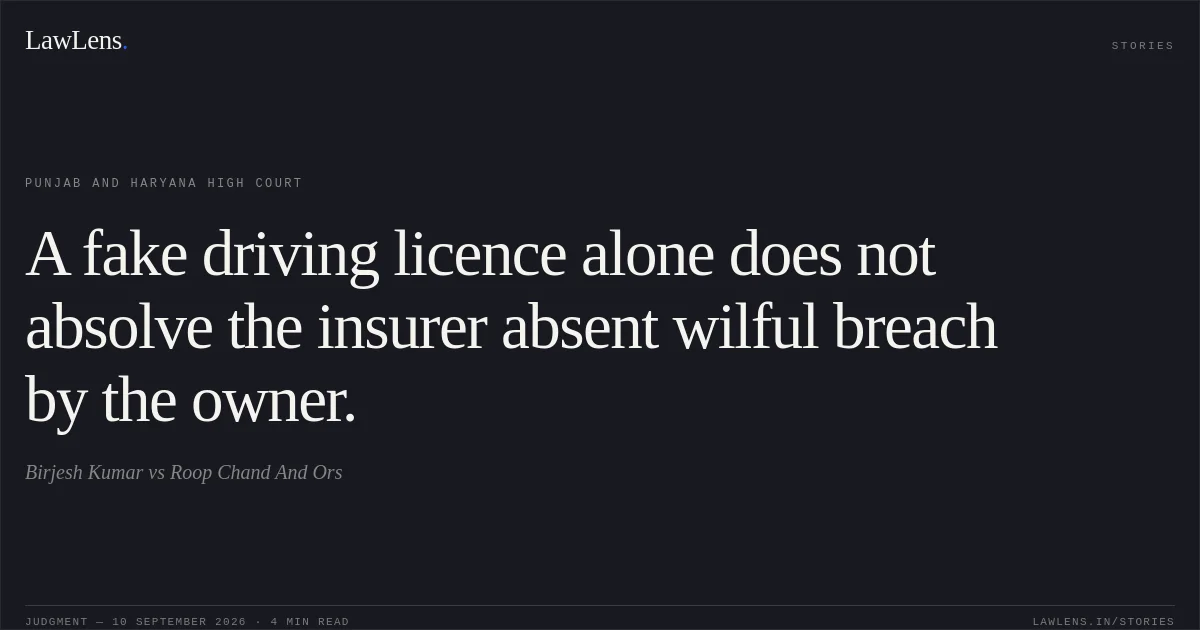
Source reference: p.9–12; paras. 23–25Under Rishi Pal Singh v. New India Assurance Co. Ltd., 2022 ACJ 1868, and Hind Samachar Ltd. (Delhi Unit) v. National Insurance Co. Ltd., the insurer cannot obtain recovery rights merely by showing that the driver’s licence was fake; it must establish a wilful breach by the insured, including deliberate entrustment of the vehicle to a driver known to lack a valid licence or failure to exercise due diligence.
Source reference: p.9–12; paras. 23–25Reasoning
The Court found the Tribunal’s assessment inadequate because it had substantially confined compensation to treatment expenses and disability despite the claimant having suffered grievous injuries, undergone surgery and sustained 15% permanent disability.
Source reference: p.5–7; paras. 13–17Although the claimant produced treatment bills totalling approximately ₹11,721.50, the Tribunal’s award of ₹15,000 for treatment expenses was maintained as adequate.
Source reference: p.5; para. 13In the absence of documentary proof of earnings, the Court assessed the income of the rickshaw puller at ₹2,500 per month, having regard to the 1999 accident and the principles governing assessment of income for unorganised-sector workers.
Source reference: p.7–8; para. 18It awarded ₹7,500 for three months’ loss of income, ₹20,000 for pain and suffering, ₹10,000 towards nutritious diet, attendant and transportation expenses, ₹50,000 for permanent disability, and ₹10,000 for loss of amenities.
Source reference: p.8–12; paras. 19–22The resulting gross compensation was ₹1,12,500.
Source reference: p.12; para. 26The Court did not disturb the Tribunal’s finding of 33% contributory negligence and accordingly reduced the gross amount by one-third.
Source reference: p.12–13; para. 27On liability, the Court held that the Insurance Company had neither properly proved the licensing authority’s report nor established that the owner had wilfully breached the policy conditions.
Source reference: p.9–12; paras. 23–25Consequently, neither exoneration nor pay-and-recover directions were justified.
Source reference: p.9–12; paras. 23–25Holding
The appeal was partly allowed.
The Court enhanced the gross compensation to ₹1,12,500, reduced it by one-third for the claimant’s contributory negligence, and fixed the net compensation at ₹75,000.
Source reference: p.12–13; para. 27Since ₹60,000 had already been awarded by the Tribunal, the enhanced amount was ₹15,000, carrying interest at 9% per annum from the date of filing of the claim petition, stated as 1 March 2002, until realization.
Source reference: p.12–13; para. 27Respondents No.1, 2 and 4—the driver, owner and Insurance Company—were held jointly and severally liable for the entire compensation, and the Insurance Company was not granted recovery rights against the owner.
Source reference: p.11–12; para. 25; p.13; para. 27The Registry was directed to email the authenticated judgment to the Insurance Company in accordance with the Supreme Court’s directions in Bajaj Allianz General Insurance Co. v. Union of India.
Source reference: p.13; para. 28Acts & Sections Cited
1 provisions across 1 statute referred to in this judgment. Each provision opens on LawLens.
Motor Vehicles Act, 19881
Original Court PDF
Birjesh KumarvsRoop Chand And Ors
Click to open original judgment
Original judgment, available to read, download and summarize on LawLens.in