Facts
The petitioner sought to quash two criminal proceedings arising from a matrimonial dispute.
Source reference: p. 2–3Crime No. 147/2018 alleged kidnapping under Sections 363 and 34 IPC after the father took the children; the petitioner argued that, as their father and natural guardian, he could not be prosecuted for kidnapping, particularly while custody proceedings were pending.
Source reference: p. 2–3, 6–9Crime No. 9/2018 arose from allegations of assault, insult and criminal intimidation, invoking Sections 323, 504 and 506 IPC.
Source reference: p. 2–3, 6–9The petitioner contended that these were non-cognizable offences and that the investigation had not followed the procedure under Section 155 CrPC.
Source reference: p. 2–3, 6–9The State submitted that the FIRs had been registered on the complaints and that the investigation was pending.
Source reference: p. 2–3, 6–9Issues
1. Whether the father could be prosecuted under Sections 363 and 34 IPC for taking his children in the circumstances of the pending matrimonial and custody dispute.
Source reference: p. 4–6, 9–102. Whether the FIR concerning the alleged offences under Sections 323, 504 and 506 IPC could stand where the offences were non-cognizable and the procedure under Section 155 CrPC had not been properly followed.
Source reference: p. 6–8, 10–11Law Applied
Sections 361 and 363 IPC govern kidnapping from lawful guardianship and its punishment.
Source reference: p. 4–6The Court relied on Capt. Vipin Menon v. State of Karnataka and Chandrakala Menon (Mrs.) v. Vipin Menon (Capt.), which address whether a father, as a natural guardian, can be held liable for kidnapping his child in the circumstances considered in those cases.
Source reference: p. 4–6For non-cognizable offences, Section 155 CrPC prescribes the applicable procedure, including the requirement under Section 155(2) for a Magistrate’s order before police investigation.
Source reference: p. 6–8, 10–11The Court referred to Lalita Kumari v. Government of Uttar Pradesh on police duties concerning cognizable and non-cognizable offences, and to Prakash Raj v. State of Karnataka and Vijesh Pillai v. State of Karnataka in relation to the procedural issue.
Source reference: p. 6–8, 10–11Reasoning
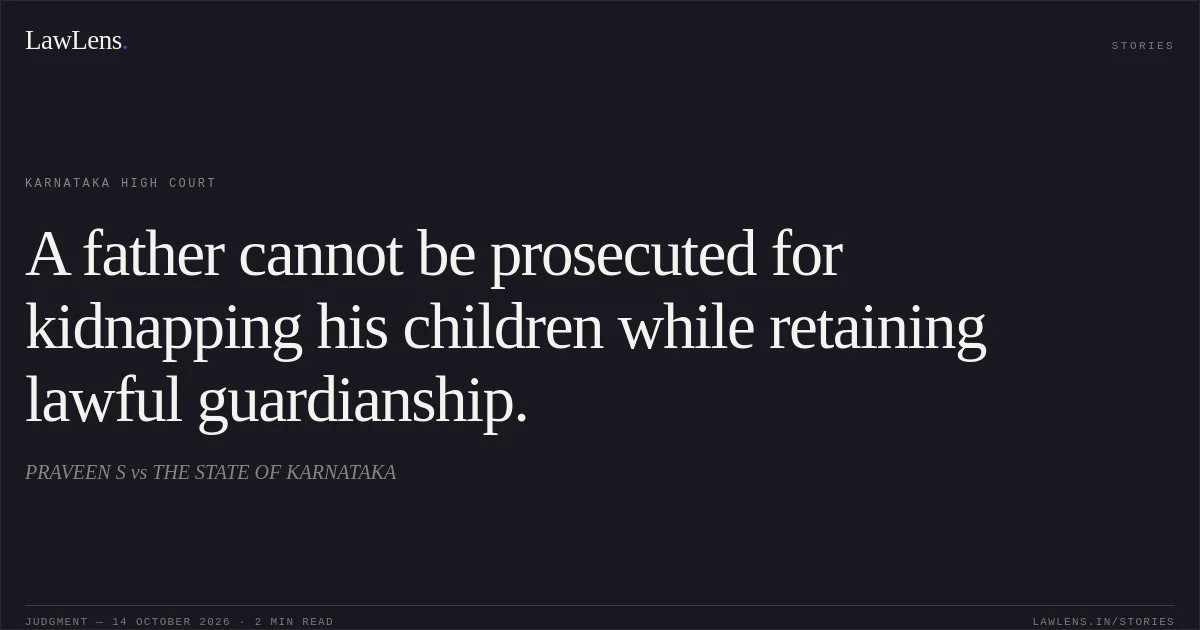
As to the kidnapping FIR, the Court considered the petitioner’s status as the children’s father and the pending matrimonial and custody proceedings, and concluded that the principles in the cited authorities precluded criminal prosecution under Section 363 IPC in the circumstances presented.
Source reference: p. 9–10As to Crime No. 9/2018, the Court treated the alleged offences as non-cognizable and held that the investigation had to comply with Section 155 CrPC.
Source reference: p. 10–11Although the record showed that the Magistrate had endorsed the police requisition, the Court found that the endorsement reflected no application of mind; it therefore held that the prosecution could not proceed on that basis.
Source reference: p. 10–11Holding
The High Court allowed both petitions.
It quashed the FIR in Crime No. 147/2018 for offences under Sections 363 and 34 IPC, and quashed the FIR and complaint in Crime No. 9/2018 for offences under Sections 323, 504 and 506 IPC.
Source reference: p. 11The order further stated that prosecution in the latter matter was subject to compliance with Section 155 CrPC.
Source reference: p. 12Acts & Sections Cited
9 provisions across 3 statutes referred to in this judgment. Each provision opens on LawLens.
Code of Criminal Procedure, 19732
Indian Penal Code, 18606
Hindu Minority and Guardianship Act, 19561
Original Court PDF
PRAVEEN SvsTHE STATE OF KARNATAKA
Click to open original judgment
Original judgment, available to read, download and summarize on LawLens.in


