Facts
The plaintiffs claimed that the suit property belonged to their mother, Aktar Sayeeda Begum, and that they inherited it on her death.
Source reference: pp. 5–6They disputed that she had executed a general power of attorney (GPA) authorising M. Raziyuddin Nadeem to sell the property, and sought a declaration of title and possession, cancellation of the sale deed dated 16 June 1984, and an injunction.
Source reference: pp. 5–6The trial court decreed the suit, finding for the plaintiffs on title and possession and cancelling the sale deed.
Source reference: p. 10The first appellate court reversed that decree.
Source reference: pp. 11–12In the second appeal, the High Court admitted the matter on a substantial question concerning the first appellate court’s decision in the absence of evidence of the alleged GPA.
Source reference: pp. 13–14Issues
1. Whether the first appellate court was justified in setting aside the trial court’s decree without the defendants producing evidence of the alleged GPA authorising the sale of the property?
Source reference: paras. 13; pp. 13–142. Whether the first appellate court’s judgment could stand when it had not framed proper points for consideration, re-appreciated the evidence, and given its own reasons for reversing the trial court?
Source reference: paras. 15–16; pp. 15–17Law Applied
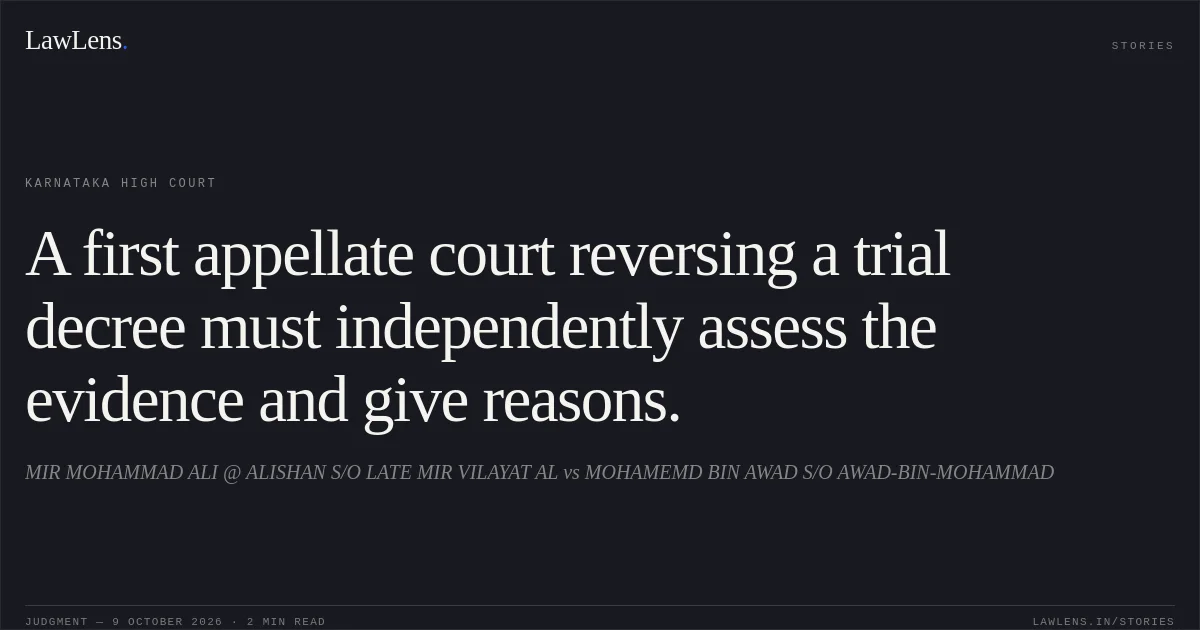
Under Order XLI Rule 31 of the Code of Civil Procedure, a first appellate court must identify the points for determination, consider the evidence and submissions, and give reasons for its decision.
Source reference: paras. 11, 15–16; pp. 12–13, 16–17The appellate court’s duty to provide an independent and reasoned judgment when reversing a trial court was supported by Lakshmi v. Gopi, 2026 SCC OnLine SC 1338, and H. Siddiqui (Dead) by LRs. v. A. Ramalingam, AIR 2011 SC 1492.
Source reference: paras. 11, 15–16; pp. 12–13, 16–17Reasoning
The High Court found that the first appellate court had reversed the trial decree without framing proper points for consideration or undertaking a reasoned re-appraisal of the evidence; it had principally extracted portions of testimony and referred to exhibits without supplying its own reasons for reversal.
Source reference: para. 15; pp. 15–16This failed to meet the appellate court’s obligations under Order XLI Rule 31 and the principles in the cited Supreme Court decisions.
Source reference: paras. 15–16; pp. 16–17Because the appeal required reconsideration by the first appellate court, the High Court expressly refrained from deciding the merits, including the parties’ substantive contentions.
Source reference: para. 16; p. 17Holding
The High Court answered the substantial question of law in the affirmative and allowed the second appeal.
It set aside the first appellate court’s judgment and restored the regular appeal to that court, directing it to frame proper points for consideration, re-appreciate the entire evidence, give detailed reasons, and decide the matter afresh in accordance with law.
Source reference: para. 17; pp. 17–18The merits were left open, and the parties were directed to appear before the first appellate court on 2 November 2026.
Source reference: para. 17; pp. 17–18Acts & Sections Cited
1 provisions across 1 statute referred to in this judgment. Each provision opens on LawLens.
Code of Civil Procedure, 19081
Original Court PDF
MIR MOHAMMAD ALI @ ALISHAN S/O LATE MIR VILAYAT ALvsMOHAMEMD BIN AWAD S/O AWAD-BIN-MOHAMMAD
Click to open original judgment
Original judgment, available to read, download and summarize on LawLens.in