Facts
On 3 October 2019, the appellant allegedly snatched Brijesh’s mobile phone while Brijesh and co-worker Dileep were loading goods in Anand Parbat, Delhi.
Source reference: p. 2–5; paras. 5–14When they chased and apprehended him, the appellant stabbed Brijesh in the chest and Dileep in the hip; the victims recovered the phone, and members of the public apprehended the appellant at the scene.
Source reference: p. 2–5; paras. 5–14The Trial Court convicted him under Sections 307, 392 and 397 IPC, sentencing him to life imprisonment under Section 307 and 14 years’ imprisonment under Section 392, with no separate sentence under Section 397.
Source reference: p. 2–5, 18; paras. 5–14, 48The appellant appealed against the conviction and sentence.
Source reference: p. 1; para. 2Issues
1. Whether the evidence established the appellant’s identity and proved the offences under Sections 307, 392 and 397 IPC
Source reference: p. 8–16; paras. 23–452. Whether the 14-year sentence under Section 392 IPC was legally sustainable, and what sentences were appropriate in light of the circumstances
Source reference: p. 13–14, 18–20; paras. 29–35, 46–52Law Applied
Section 307 IPC requires an intention or knowledge to commit murder, together with an overt act; the nature of the injury is relevant but not determinative (State of M.P. v. Saleem, (2005) 5 SCC 554; State of Madhya Pradesh v. Harjeet Singh, (2019) 20 SCC 524).
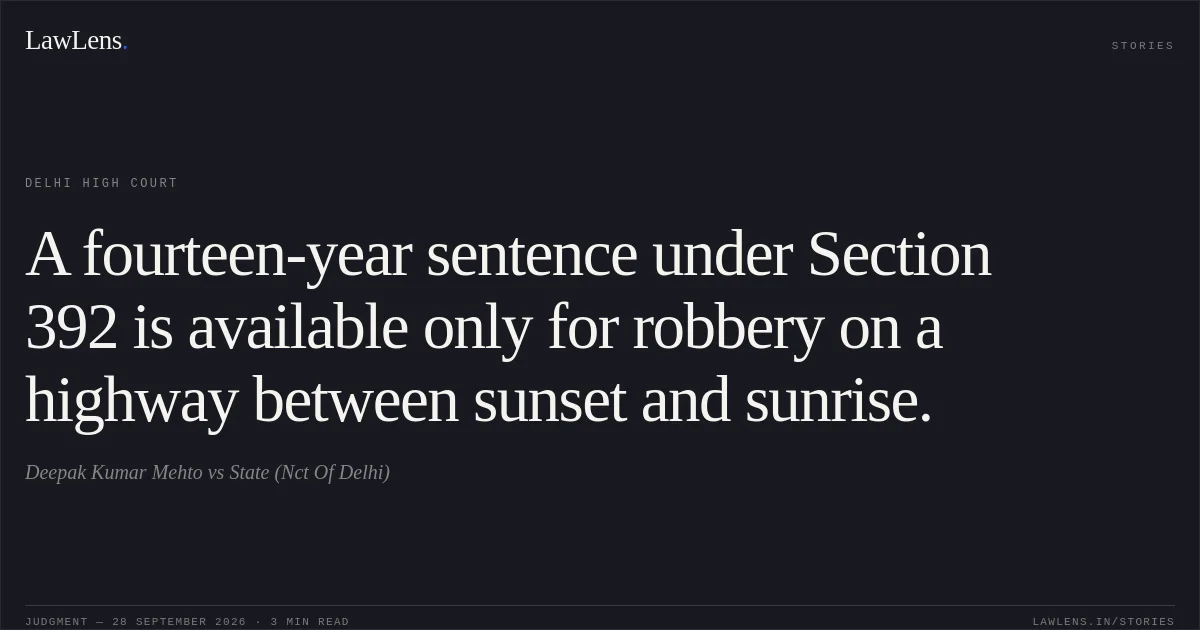
Source reference: p. 8–12; paras. 24–27Under Section 390 IPC, theft accompanied by voluntarily causing or attempting to cause hurt, death, restraint, or fear of such harm in order to commit or carry away the theft amounts to robbery; Section 392 provides a sentence of up to ten years, extendable to fourteen years where robbery is committed on a highway between sunset and sunrise.
Source reference: p. 12–13; paras. 29–31Section 397 prescribes a minimum seven-year sentence where, during robbery or dacoity, the offender uses a deadly weapon, causes grievous hurt, or attempts to cause death or grievous hurt; “use” includes an overt act such as brandishing or displaying the weapon (Phool Kumar v. Delhi Administration, (1975) 1 SCC 797).
Source reference: p. 14–16; paras. 35–38An injured witness’s testimony generally carries particular weight (Abdul Sayeed v. State of M.P., (2010) 10 SCC 259), and in-court identification is substantive evidence; failure to hold a TIP does not by itself render that evidence inadmissible (Malkhansingh v. State of M.P., (2003) 5 SCC 746).
Source reference: p. 17–18; paras. 44–45Reasoning
The Court accepted the injured witnesses’ account, noting that both identified the appellant in court and that their testimony was corroborated by the injuries, medical evidence and evidence that the appellant was apprehended at the scene.
Source reference: p. 6–8, 16–18; paras. 17–22, 39–45It held that the witnesses’ inability to see the appellant’s face at the moment of the snatching did not undermine identification, given their chase, apprehension of the appellant and subsequent identification; a TIP was not necessary on these facts.
Source reference: p. 6–8, 16–18; paras. 17–22, 39–45The Court found that stabbing Brijesh in the chest with a knife established the requisite knowledge for Section 307, notwithstanding its finding that the act arose during a sudden scuffle rather than from a premeditated plan.
Source reference: p. 11–16; paras. 27–38The stabbing while carrying away the stolen phone constituted robbery, and the appellant’s actual use of the knife attracted Section 397.
Source reference: p. 11–16; paras. 27–38However, the incident occurred near Gali No. 2, Industrial Area, New Rohtak Road—not on a highway—and neither the charge nor the evidence established the highway condition necessary for the enhanced 14-year sentence under Section 392.
Source reference: p. 14; paras. 33–34In reassessing sentence, the Court considered the sudden sequence of events, the appellant’s age, the single blow inflicted on each victim and the period already served, while also taking account of Section 397’s seven-year minimum.
Source reference: p. 18–20; paras. 46–52Holding
The High Court upheld the convictions under Sections 307, 392 and 397 IPC but set aside the 14-year sentence under Section 392 because the highway condition was not established.
It substituted a sentence of seven years’ rigorous imprisonment for each offence, to run concurrently.
Source reference: p. 18–20; paras. 48–53The appeal was partly allowed, and pending applications were disposed of.
Source reference: p. 18–20; paras. 48–53Acts & Sections Cited
8 provisions across 2 statutes referred to in this judgment. Each provision opens on LawLens.
Indian Penal Code, 18606
Code of Criminal Procedure, 19732
Original Court PDF
Deepak Kumar MehtovsState (Nct Of Delhi)
Click to open original judgment
Original judgment, available to read, download and summarize on LawLens.in