Facts
The petitioner, Constable No. 765 in the Bihar Police, was deputed at Mehsi Circle Guard along with Constables Nebulal Prasad and Prithvi Nath Dubey.
Source reference: paras. 3–4On the intervening night of 22–23 March 1998, the three constables allegedly went to Somlata Theatre without the Guard Havildar. During the incident, Constable Nebulal Prasad allegedly opened fire, causing the death of two persons and injuries to another.
Source reference: paras. 3–4A criminal case was registered under Sections 302/307/34 IPC and Section 27 of the Arms Act, while Departmental Enquiry No. 4 of 1999 was initiated against the petitioner.
Source reference: paras. 4–5The petitioner was initially dismissed from service, but the Director General of Police set aside the punishment and directed a fresh enquiry because statements of departmental witnesses had not been supplied to him.
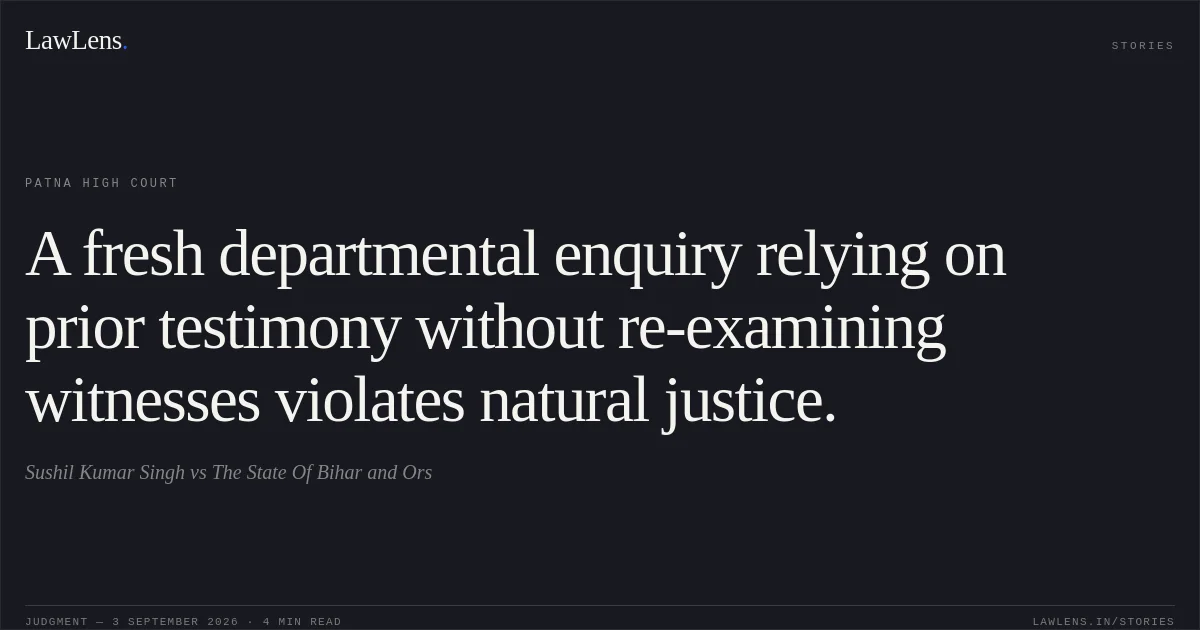
Source reference: para. 6In the purported fresh enquiry, the Enquiry Officer did not re-examine the witnesses and instead relied upon statements recorded during the earlier enquiry. The charges were again held proved, and the petitioner was dismissed by order dated 9 August 2007.
Source reference: paras. 7–8His departmental appeal and appeal memorial were rejected.
Source reference: paras. 9, 12Meanwhile, the petitioner was acquitted in Sessions Trial No. 28 of 1999, arising from the same occurrence, by judgment dated 9 August 2016.
Source reference: para. 11He thereafter challenged the dismissal, appellate order and memorial decision before the High Court, principally alleging violation of natural justice, denial of effective cross-examination, and the effect of his acquittal in the criminal case.
Source reference: paras. 13–14Issues
1. Whether the charges, evidence, witnesses and factual circumstances in the criminal prosecution were identical or substantially similar to those in the departmental proceeding, such that the petitioner’s acquittal rendered the departmental findings vulnerable?
Source reference: para. 17(i)2. Whether the enquiry conducted afresh pursuant to the Director General of Police’s order was genuinely fresh and compliant with natural justice, despite the Enquiry Officer’s failure to independently examine the departmental witnesses?
Source reference: para. 17(ii)Law Applied
The Court applied the principles of natural justice, particularly the requirement that a delinquent employee must receive a real and effective opportunity to defend himself, including the opportunity to cross-examine material departmental witnesses.
Source reference: paras. 23, 27–28It relied on G.M. Tank v. State of Gujarat & Anr., (2006) 5 SCC 446, and Capt. M. Paul Anthony v. Bharat Gold Mines Ltd., (1999) 3 SCC 679, for the principle that where departmental and criminal proceedings arise from substantially identical facts and evidence, an acquittal on merits must be given due weight, and sustaining a contrary departmental finding may be unjust and oppressive.
Source reference: paras. 20–22The Court also relied on Maharana Pratap Singh v. State of Bihar & Ors., Civil Appeal No. 5497 of 2025, 2025 INSC 554, which reiterated that the substance of the acquittal, rather than labels such as “benefit of doubt,” must be examined, and that failure to produce the complete departmental record may attract an adverse inference under Section 114(g) of the Indian Evidence Act, 1872.
Source reference: paras. 21–22The disciplinary action was purportedly imposed under Rule 824(a)–(c) of the Bihar Police Manual.
Source reference: para. 15Reasoning
The Court found that the departmental proceeding and the criminal prosecution arose from the same occurrence at Somlata Theatre and were based on substantially overlapping allegations.
Source reference: paras. 24–26The respondents did not specifically controvert the petitioner’s assertion that his acquittal followed an assessment of the evidence on merits rather than a mere technical ground.
Source reference: para. 26Independently, the Court held that the fresh enquiry failed to comply with the direction to conduct the matter afresh. The Enquiry Officer relied on statements recorded in the earlier, already-set-aside proceeding and did not independently examine the witnesses cited in the charge-sheet.
Source reference: paras. 27–30Consequently, the petitioner was denied a meaningful opportunity to test the departmental evidence through cross-examination, rendering the fresh enquiry a formal continuation of the defective earlier proceeding and violating natural justice.
Source reference: paras. 27–30In view of both the substantially identical factual foundation and the defective enquiry procedure, the dismissal and subsequent departmental orders could not be sustained.
Source reference: no citationHolding
The writ petition was allowed.
The dismissal order dated 9 August 2007, the appellate order dated 11 March 2008, and the Director General of Police’s memorial order dated 15 March 2017 were quashed and set aside.
Source reference: para. 31(i)The respondents were directed to reinstate the petitioner in service.
Source reference: para. 31(ii)The treatment of the intervening period, consequential monetary benefits and back wages were left to the competent authority to determine by a reasoned order in accordance with law.
Source reference: paras. 31(ii)–(iii)No order as to costs was made.
Source reference: para. 33Acts & Sections Cited
6 provisions across 2 statutes referred to in this judgment. Each provision opens on LawLens.
Indian Penal Code, 18605
Arms Act, 19591
Original Court PDF
Sushil Kumar SinghvsThe State Of Bihar and Ors
Click to open original judgment
Original judgment, available to read, download and summarize on LawLens.in