Facts
The appellant, Rajeev Kumar, sought compassionate appointment after the death of his father, a government servant.
Source reference: no citationHis initial claim was rejected in a meeting held on 20 December 2017.
Source reference: no citationIn CWJC No. 4156 of 2019, the High Court directed the authorities to reconsider his claim in light of the Full Bench judgment concerning compassionate appointment, clarifying that the earlier rejection would not prevent fresh consideration.
Source reference: p. 4Upon reconsideration, the authorities rejected the claim by order dated 7 September 2022.
Source reference: p. 4The rejection was based principally on the fact that the appellant’s elder brother, another dependent of the deceased employee, was employed in Andhra Bank and was therefore treated as “gainfully employed”.
Source reference: p. 4The appellant’s subsequent writ petition, CWJC No. 5018 of 2023, was dismissed by the learned Single Judge on 3 May 2023 by applying the Full Bench decision in Niraj Kumar Mallick v. State of Bihar, 2018 (2) PLJR 951.
Source reference: pp. 2–4The present intra-court appeal challenged that dismissal.
Source reference: no citationThe Division Bench also noted that the appeal was filed with a delay of 771 days.
Source reference: p. 6Issues
Whether the appellant was entitled to compassionate appointment when another dependent sibling of the deceased government servant was gainfully employed in Andhra Bank?
Source reference: pp. 4–6Whether the authorities and the learned Single Judge correctly applied the Government policy and the Full Bench decision in Niraj Kumar Mallick to reject the appellant’s claim?
Source reference: pp. 2–6Whether the appeal was liable to be dismissed on account of the delay of 771 days?
Source reference: p. 6Law Applied
The Court applied the settled principle that compassionate appointment is not a source of regular recruitment but a measure intended to relieve the family of a deceased government servant from immediate financial distress.
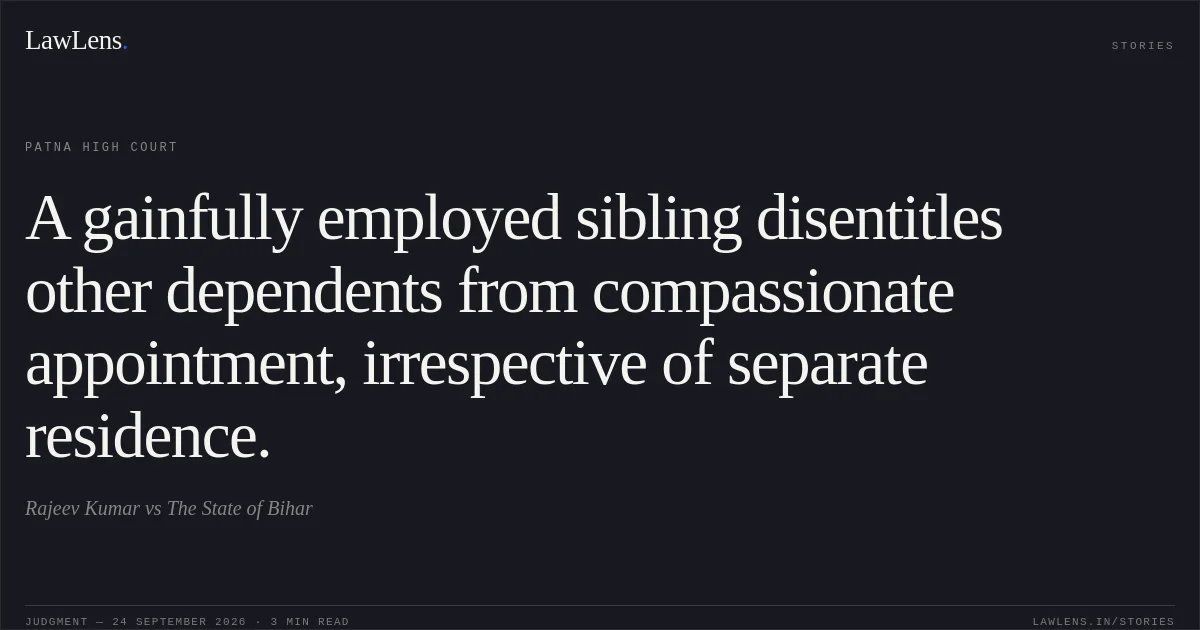
Source reference: pp. 2–4Under the applicable Government policy, where any dependent of the deceased government servant is “gainfully employed,” another dependent is not entitled to compassionate appointment; the rule applies irrespective of whether the employed dependent lives with or separately from the other family members.
Source reference: pp. 2–3, 5–6The Court relied principally on the Full Bench decision in Niraj Kumar Mallick v. State of Bihar, 2018 (2) PLJR 951, especially paragraphs 46 and 47, which held that “gainfully employed” must be assessed objectively and that the authority need not determine whether the employed sibling is actually willing to maintain the other dependents.
Source reference: pp. 2–4The Court also referred to the principles in Umesh Kumar Nagpal v. State of Haryana and Asha Ramchandra Ambedkar, namely that compassionate appointment must be governed by the applicable policy and that courts cannot disregard the law merely on sympathetic grounds.
Source reference: p. 3Reasoning
The Court found that there was no dispute that the appellant’s elder brother, who was also a dependent of the deceased employee, was employed in Andhra Bank.
Source reference: pp. 4–5Applying the objective test laid down in Niraj Kumar Mallick, such employment constituted gainful employment for the purposes of the compassionate-appointment policy.
Source reference: no citationThe policy did not permit the appellant to claim appointment merely because the employed sibling lived separately or was allegedly unwilling to support the family; those considerations were outside the scope of the statutory or policy inquiry.
Source reference: pp. 2–4, 5–6Since the authorities had reconsidered the claim pursuant to the earlier writ order and had rejected it on a ground consistent with the governing policy, the learned Single Judge was justified in declining interference.
Source reference: no citationThe Division Bench therefore found no error in the impugned order and additionally noted that the appeal suffered from a delay of 771 days.
Source reference: p. 6Holding
The Division Bench held that the appellant was not entitled to compassionate appointment because his elder brother, another dependent of the deceased government servant, was gainfully employed in Andhra Bank.
The rejection of the claim was consistent with the Government policy and the Full Bench ruling in Niraj Kumar Mallick.
Source reference: pp. 5–6The appeal was dismissed both on merits and on the ground of delay of 771 days.
Source reference: p. 6Original Court PDF
Rajeev KumarvsThe State of Bihar
Click to open original judgment
Original judgment, available to read, download and summarize on LawLens.in