Facts
The petitioner sought quashing of FIR No. 51 of 2026, registered at Police Station Nanakmatta under Section 117(2) of the Bharatiya Nyaya Sanhita and Section 27 of the Arms Act, and protection from arrest.
Source reference: para. 4The FIR alleged that a country-made pistol discharged during a marriage ceremony, causing injury to respondent no. 3.
Source reference: para. 5The petitioner claimed the discharge was accidental and stated that the parties, who were related, had no prior enmity.
Source reference: paras. 5–6During the proceedings, the petitioner and the injured respondent filed a joint compounding application; respondent no. 3 confirmed in person that the settlement was voluntary and that he did not object to quashing.
Source reference: paras. 6–8The State opposed the application, noting that the Arms Act offence was non-compoundable.
Source reference: para. 9Issues
1. Whether the High Court could quash the FIR and consequential proceedings, including those involving a non-compoundable Arms Act offence, on the basis of the parties’ settlement.
Source reference: paras. 9–122. Whether, in the circumstances of this case, continuation of the criminal proceedings would serve a useful purpose or amount to an abuse of process.
Source reference: para. 13Law Applied
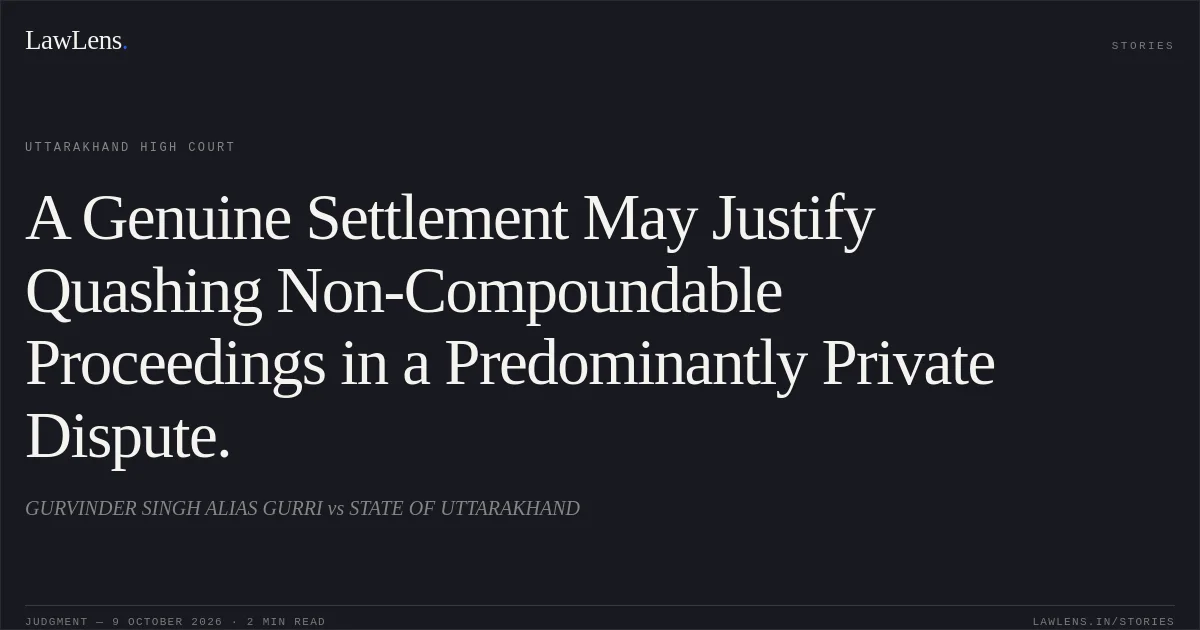
Under Article 226 of the Constitution and the inherent jurisdiction referred to by the Court under Section 482 of the Code of Criminal Procedure, the High Court may quash proceedings involving non-compoundable offences where the dispute is predominantly private or personal, the settlement is genuine and voluntary, and continuation of proceedings would serve no useful purpose or amount to an abuse of process.
Source reference: paras. 11–12Non-compoundability alone does not bar that exercise; the Court must consider the nature and gravity of the offence, the circumstances of the alleged occurrence, the relationship between the parties, and the genuineness of the settlement.
Source reference: paras. 11–12The Court relied on Gian Singh v. State of Punjab, (2012) 10 SCC 303; Narinder Singh v. State of Punjab, (2014) 6 SCC 466; and State of Madhya Pradesh v. Laxmi Narayan, (2019) 5 SCC 688.
Source reference: para. 11Reasoning
The Court accepted that respondent no. 3 had freely and voluntarily settled the dispute and did not wish to pursue the prosecution.
Source reference: paras. 8, 10Considering the allegations, the parties’ relationship, and the settlement, the Court concluded that the compromise was genuine and that continuing the proceedings would serve no useful purpose and would amount to an abuse of process.
Source reference: para. 13It therefore granted relief notwithstanding the State’s objection that the Arms Act offence was non-compoundable.
Source reference: paras. 9, 12–14Holding
The Court allowed the compounding application and quashed FIR No. 51 of 2026, together with all consequential proceedings.
It accordingly allowed the criminal writ petition and disposed of any pending applications.
Source reference: paras. 14–16Acts & Sections Cited
3 provisions across 3 statutes referred to in this judgment. Each provision opens on LawLens.
Bharatiya Nyaya Sanhita, 20231
Arms Act, 19591
Code of Criminal Procedure, 19731
Original Court PDF
GURVINDER SINGH ALIAS GURRIvsSTATE OF UTTARAKHAND
Click to open original judgment
Original judgment, available to read, download and summarize on LawLens.in