Facts
The Applicants sought appointment of a sole arbitrator under Section 11 of the Arbitration and Conciliation Act, 1996, in relation to disputes arising from a Development Agreement dated 12 February 2016 and subsequent addendums and agreements concerning redevelopment of the property.
Source reference: para. 1The Applicants alleged, inter alia, non-allotment of six stilt parking spaces, unauthorised changes in sanctioned plans, withholding of amounts allegedly payable for retained area and corpus, non-payment of rent, failure to provide terrace rights, and non-provision of CCTV and intercom facilities.
Source reference: paras. 6–8The Respondents contended that arbitration had already been invoked by the Applicants’ notice dated 6 September 2022, that the Respondents had refused the proposed arbitrator, and that the Section 11 Application filed in 2026 was barred by the three-year limitation period under Article 137 of the Limitation Act, 1963.
Source reference: paras. 9–10The Applicants issued fresh notices invoking arbitration on 14 May 2026.
Source reference: para. 12Issues
Whether the Section 11 Application was barred by limitation because arbitration had previously been invoked in 2022 in respect of the same contractual arrangement?
Source reference: paras. 12–18, 23–26Whether the disputes raised in the 2026 invocation were distinct disputes arising from subsequent events, including the amended sanctioned plans of October 2023 and post-completion failures to provide facilities?
Source reference: paras. 17–25Whether the Applicants were parties to, or otherwise sufficiently connected with, the relevant arbitration agreements so as to seek reference under Section 11?
Source reference: paras. 27–29Whether the Court should undertake a detailed determination of limitation, contractual entitlement and the merits of the alleged breaches at the Section 11 stage?
Source reference: paras. 22, 29–31Law Applied
The Court applied Section 11 of the Arbitration and Conciliation Act, 1996, under which the Court may appoint an arbitrator where the agreed appointment procedure has failed, and Section 21, which relates to commencement of arbitral proceedings in respect of a particular dispute.
Source reference: paras. 14, 18, 24Article 137 of the Limitation Act, 1963 prescribes a three-year limitation period for a Section 11 application, commencing when the right to apply accrues—ordinarily after a valid invocation of arbitration and failure or refusal by the other party to act as required under the arbitration agreement, as held in Arif Azim Co. Ltd. v. Aptech Ltd., 2024 INSC 155.
Source reference: para. 14The Court relied on Golden Chariot Recreations Pvt. Ltd. v. Mukesh Panika, 2021 SCC OnLine Del 5808, for the principle that a subsequent notice cannot revive an old or stale dispute by creating an artificial fresh cause of action.
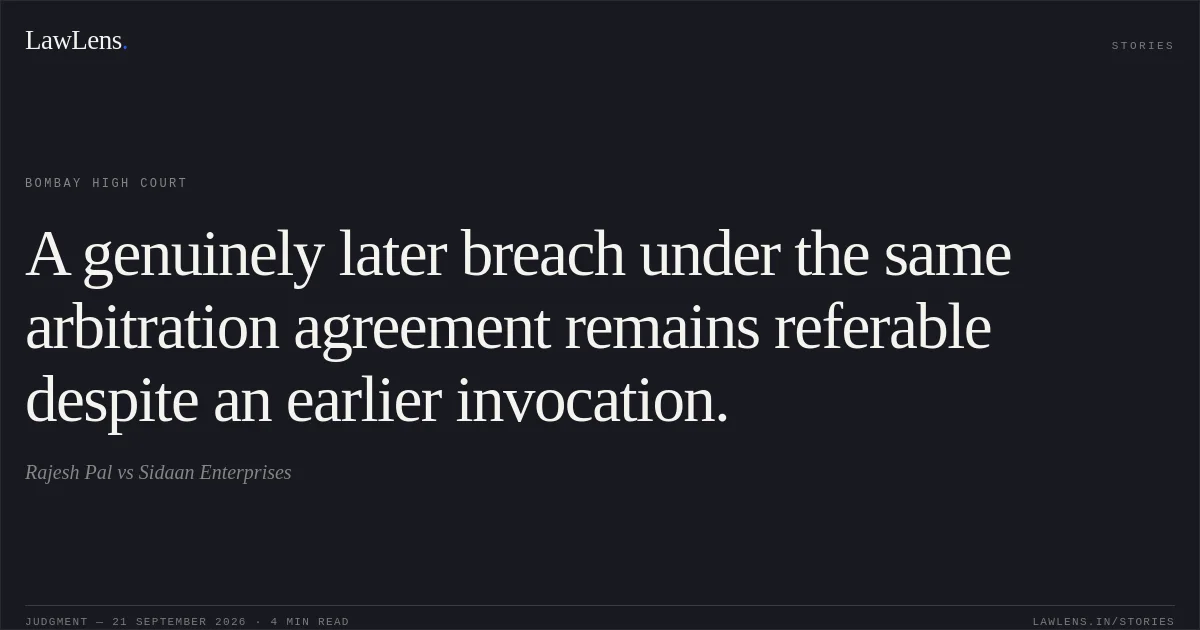
Source reference: para. 16However, relying on M/s Bhagheeratha Engineering Ltd. v. State of Kerala, 2026 INSC 4, the Court held that different disputes may arise under the same contract at different times and that a later breach is not necessarily barred merely because an earlier dispute under the contract had been invoked.
Source reference: para. 18It also relied on State of West Bengal v. M/s B.B.M. Enterprises, 2026 INSC 358, for the principle that a subsequent notice cannot create a fresh limitation period for a stale claim, while detailed factual examination of limitation is generally inappropriate at the Section 11 stage.
Source reference: para. 22Under Adavya Projects Pvt. Ltd. v. M/s Vishal Structurals Pvt. Ltd., 2025 INSC 507, the Court recognised that party status and the existence and scope of the arbitration agreement are relevant at the reference stage, but non-signatory or connected-party questions may require examination of the transaction as a whole.
Source reference: para. 27Reasoning
The Court distinguished between stale claims that had already arisen by 2022 and genuinely subsequent disputes.
Source reference: no citationIt held that claims which had become enforceable in 2022, including claims for amounts payable at that time, could not be revived merely by repeating them in the 14 May 2026 invocation notice; similarly, later reminders did not create a new cause of action for rent accruing up to March 2023.
Source reference: para. 21However, the alleged entitlement to six stilt parking spaces was linked to the revised sanctioned plans of October 2023, while the complaints concerning CCTV, intercom facilities and pocket terrace rights were alleged to have arisen after completion of the building and handing over of possession in October 2023.
Source reference: paras. 19–20Since these events post-dated the 2022 invocation, the Court held that they could not, at the Section 11 stage, be treated as necessarily time-barred or identical to the earlier disputes.
Source reference: paras. 24–25The Court further held that the Applicants’ connection with the overall transaction was prima facie established through the Family Settlement, Supplementary Agreement and subsequent addendums.
Source reference: paras. 27–29Whether each Applicant was bound by a particular arbitration clause, and whether Applicant No. 3’s status as a confirming party conferred enforceable rights, depended on the language of the relevant documents and was not suitable for final determination in the Section 11 proceedings.
Source reference: paras. 27–29The Court therefore declined to conduct a full trial on limitation, contractual interpretation or the merits, leaving those matters to the arbitral tribunal.
Source reference: paras. 29–31Holding
The Court held that the Section 11 Application could not be rejected merely because arbitration had been invoked in 2022.
Claims that were already stale or enforceable more than three years before the Section 11 proceedings could not be revived by the 2026 notice, but disputes arising from genuinely later events remained capable of reference.
Source reference: paras. 26, 30–31Accordingly, the Court appointed Ms. Arti Raghavan, Advocate, as the sole arbitrator to adjudicate disputes and counterclaims arising from the Development Agreement dated 12 February 2016 and the subsequent addendums and agreements, subject to the observations regarding limitation and stale claims.
Source reference: para. 32(A)The parties were directed to share the arbitral fees and costs equally in the first instance, subject to the final award on costs; all merits-related issues were expressly left open before the arbitral tribunal.
Source reference: paras. 32(F), 33Acts & Sections Cited
4 provisions across 2 statutes referred to in this judgment. Each provision opens on LawLens.
Arbitration and Conciliation Act, 19963
Limitation Act, 19631
Original Court PDF
Rajesh PalvsSidaan Enterprises
Click to open original judgment
Original judgment, available to read, download and summarize on LawLens.in