Facts
The batch comprised eight writ petitions filed by five exporters and three suppliers challenging Show Cause Notices dated 29 July 2022 and 26 February 2024, the consequential Order-in-Original dated 5 February 2025, and Circulars Nos. 31/05/2018-GST, 169/01/2022-GST and 239/33/2024-GST concerning the appointment of a common adjudicating authority for composite notices issued by the Directorate General of Goods and Services Tax Intelligence (“DGGI”).
Source reference: paras. 1; p. 5The investigation alleged a three-layer fraudulent invoicing scheme involving non-existent L-2 suppliers, L-1 suppliers and exporter/end-user entities, resulting in wrongful availment and utilisation of Input Tax Credit and IGST refunds without actual movement of goods.
Source reference: paras. 4–9; pp. 7–9A composite show cause notice was issued to 146 noticees under Section 74(1) of the Central Goods and Services Tax Act, 2017 (“CGST Act”), alleging fraud and wilful suppression of facts.
Source reference: para. 10; p. 9The Additional Commissioner, CGST, Delhi confirmed tax, interest and penalties against the concerned firms and individuals through the Order-in-Original dated 5 February 2025.
Source reference: para. 11; p. 9Instead of pursuing statutory appeals, the petitioners invoked Article 226, principally challenging the jurisdiction of the Delhi-based common adjudicating authority and the validity of the impugned circulars.
Source reference: paras. 12–13; p. 9The Court confined the hearing to the jurisdictional issue.
Source reference: para. 2; p. 5Issues
1. Whether the common adjudicating authority had lawful jurisdiction to adjudicate a composite DGGI show cause notice involving noticees situated in different Commissionerates, pursuant to Notification No. 2/2017-Central Tax, Notification No. 2/2022-Central Tax and the impugned circulars?
Source reference: paras. 24–30; pp. 19–212. Whether Circular Nos. 169/2022-GST and 239/2024-GST impermissibly conferred or transferred adjudicatory jurisdiction, contrary to Sections 3, 5(3), 167 and 168 of the CGST Act?
Source reference: paras. 14.1–14.4, 17–23; pp. 10–183. Whether the “highest amount of demand” criterion for selecting the common adjudicating authority was arbitrary and violative of Article 14 of the Constitution?
Source reference: paras. 14.5 and 35–36; pp. 11, 23–244. Whether the absence of a separately specified pan-India appellate authority rendered the adjudicatory arrangement legally invalid?
Source reference: paras. 14.6 and 32–33; pp. 12, 225. Whether the writ petitions should be dismissed on the ground that an efficacious statutory appeal under Section 107 of the CGST Act was available?
Source reference: paras. 37–39; pp. 23–24Law Applied
Sections 2(91), 3, 5(3), 166, 167 and 168 of the CGST Act formed the statutory basis of the decision.
Source reference: paras. 17–20; pp. 15–17Section 2(91) treats the “proper officer” as the Commissioner or officer assigned the relevant function; Section 3 authorises appointment of classes of officers; Section 5(3) permits delegation by the Commissioner; and Section 167 authorises, by notification, the exercise of statutory powers by another specified authority or officer.
Source reference: paras. 17–20; pp. 15–17Section 166 requires notifications to be laid before Parliament, while Section 168 primarily empowers the Board to issue administrative instructions for uniform implementation and does not independently create or transfer jurisdiction.
Source reference: paras. 21–23; pp. 17–18Applying generalia specialibus non derogant, a general circular under Section 168 cannot override the specific statutory mechanism for conferring jurisdiction, though it may operationalise a jurisdiction already validly created by notification.
Source reference: para. 23; p. 18Notification No. 2/2017 assigned territorial and pecuniary jurisdiction, while Notification No. 2/2022 inserted Table V and conferred pan-India jurisdiction on specified Additional/Joint Commissioners for DGGI notices.
Source reference: paras. 24–25; pp. 19–20The Court also applied the principle in Assistant Commissioner of State Tax v. Commercial Steel Ltd., (2022) 16 SCC 447, that writ jurisdiction may be exercised where jurisdiction itself is challenged, but ordinarily should not be used to bypass an available statutory appeal.
Source reference: paras. 37–39; pp. 23–24Anirudhsinhji Karansinhji Jadeja v. State of Gujarat, (1995) 5 SCC 302, was distinguished because the present case did not involve conferral of power upon an officer lacking statutory authority.
Source reference: para. 36; p. 24Reasoning
The Court held that Notification No. 2/2017 validly assigned ordinary territorial jurisdiction and that Notification No. 2/2022 specifically conferred pan-India adjudicatory jurisdiction on the officers listed in Table V for DGGI-issued notices.
Source reference: paras. 24–25; pp. 19–20The absence of an officer-specific allocation for every possible combination of noticees did not create a jurisdictional vacuum.
Source reference: paras. 24–25; pp. 19–20The impugned circulars did not appoint a new officer or enlarge jurisdiction; they merely prescribed that, where a composite notice involved multiple competent officers, the officer having jurisdiction over the noticee facing the highest demand would adjudicate the entire notice.
Source reference: paras. 26–28; pp. 19–20The Court therefore characterised the circulars as administrative allocation-of-business directions rather than instruments conferring jurisdiction.
Source reference: paras. 26–28; pp. 19–20The absence of an express recital of statutory source or Board approval was only a drafting deficiency, and the petitioners produced no material showing that the circulars lacked authority or approval.
Source reference: para. 29; p. 20The “highest demand” criterion was held to be objective, quantifiable and uniformly applicable, with a rational nexus to securing consistent adjudication of a single investigation and avoiding conflicting findings.
Source reference: paras. 35–36; p. 23The appellate objection was also rejected as a jurisdictional challenge could initially be examined under Article 226; however, once the Court upheld the adjudicating authority’s jurisdiction, the remaining merits, evidentiary and natural-justice objections had to be pursued in statutory appeals.
Source reference: paras. 37–39; pp. 23–24Holding
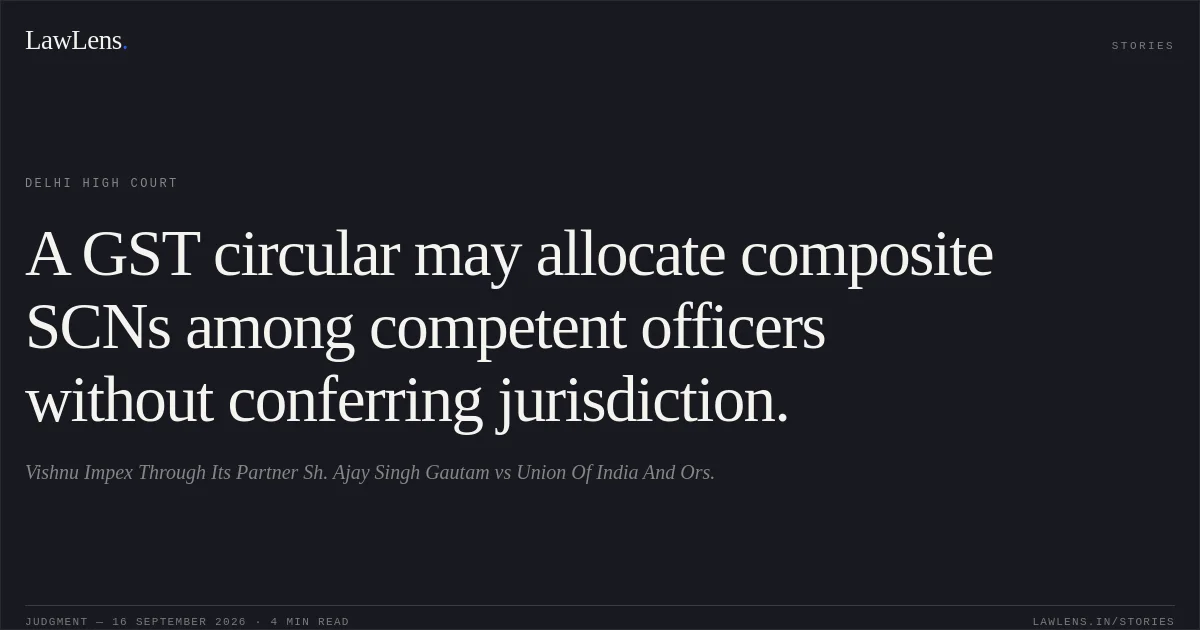
The Delhi High Court upheld the jurisdiction of the common adjudicating authority and rejected the challenge to the impugned circulars.
It held that the authority’s jurisdiction was traceable to Notifications Nos. 2/2017 and 2/2022, validly issued under the CGST Act, while the circulars merely allocated composite notices among officers already vested with jurisdiction.
Source reference: paras. 40–41; p. 25All writ petitions and pending applications were dismissed.
Source reference: paras. 42–44; p. 25The petitioners were granted liberty to file appeals under Section 107 of the CGST Act against the Order-in-Original and to raise all remaining merits-based contentions before the appellate authority, which was directed to decide them uninfluenced by the observations in the judgment.
Source reference: paras. 42–44; p. 25The petitioners were also permitted to seek exclusion of the period spent prosecuting the writ petitions under Section 14 of the Limitation Act, 1963, subject to consideration by the appellate authority in accordance with law.
Source reference: para. 43; p. 25Acts & Sections Cited
21 provisions across 2 statutes referred to in this judgment. Each provision opens on LawLens.
Central Goods and Services Tax Act, 2017
Limitation Act, 19631
Original Court PDF
Vishnu Impex Through Its Partner Sh. Ajay Singh GautamvsUnion Of India And Ors.
Click to open original judgment
Original judgment, available to read, download and summarize on LawLens.in