Facts
The plaintiff, a Christian, and the defendant, a Hindu, married according to Hindu customs and rites on 13 March 2020.
Source reference: pp. 2–4Their marriage was not registered under the Special Marriage Act, 1954.
Source reference: pp. 2–4They began living separately on 20 September 2020, and the defendant did not dispute the separation.
Source reference: pp. 2–4The plaintiff sued under Section 7 of the Family Courts Act, 1984, seeking a declaration that the marriage was null and void and that no husband-and-wife relationship existed.
Source reference: pp. 2–4The Family Court dismissed the suit; the plaintiff appealed.
Source reference: pp. 2–4, 7Issues
Whether the marriage between the plaintiff and defendant, solemnised on 13 March 2020, was valid.
Source reference: p. 4, para. 6(i)Whether the Family Court’s judgment and decree dismissing the suit were sustainable in law.
Source reference: p. 4, para. 6(ii)Law Applied
Section 7 of the Family Courts Act, 1984, permits a suit seeking a declaration concerning the existence or validity of a marriage or the marital status of the parties.
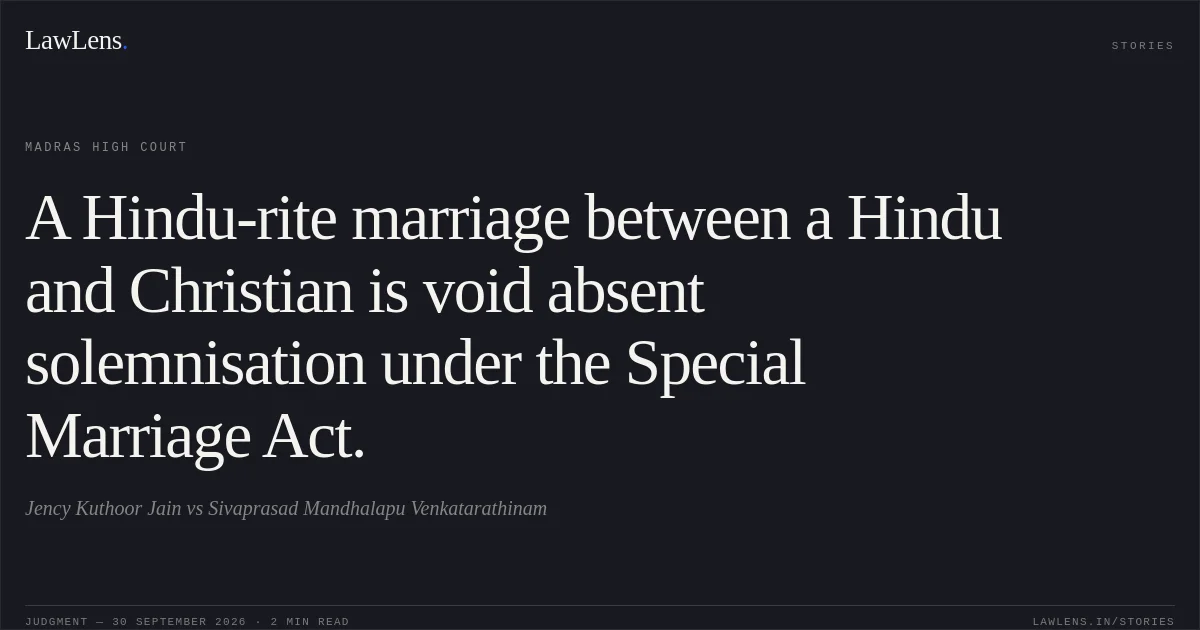
Source reference: p. 5, paras. 8, 10Relying on Gullipilli Sowria Raj v. Bandaru Pavani @ Gullipilli Pavani, Civil Appeal No. 2446 of 2025, the Court applied the principle that a marriage between a Christian and a Hindu, solemnised according to Hindu customs without satisfying the statutory requirements of the Hindu Marriage Act, is a nullity.
Source reference: p. 5, para. 9The Court also relied on K. Shanmugha Raja @ Raja v. Shanthakumari, 2019 2 CTC 616, and Jeyakumari v. Stephen, A.S. (MD) No. 96 of 2016, decided 29 January 2025, concerning the availability of a declaration under Section 7 and the legal effect of such a marriage.
Source reference: pp. 5–6, paras. 10–11Reasoning
The parties’ religions, the Hindu rites used for the ceremony, and the absence of registration under the Special Marriage Act were undisputed.
Source reference: pp. 5–6, paras. 8–12Applying the Supreme Court’s ruling and the cited Madras High Court decisions, the Court held that the Hindu-rites ceremony could not be recognised as a valid marriage in these circumstances.
Source reference: pp. 5–6, paras. 8–12It also found that the Family Court had failed to consider that the suit was brought under Section 7 of the Family Courts Act, which permitted the plaintiff to seek the declaration.
Source reference: pp. 5–6, paras. 8–12Holding
The Court answered both issues in favour of the plaintiff, allowed the appeal, and set aside the Family Court’s judgment and decree.
It declared the marriage solemnised on 13 March 2020 null and void and declared that no legal husband-and-wife relationship existed between the parties.
Source reference: p. 7, para. 13No order was made as to costs.
Source reference: p. 7, para. 13Acts & Sections Cited
2 provisions across 2 statutes referred to in this judgment. Each provision opens on LawLens.
Code of Civil Procedure, 19081
Family Courts Act, 19841
Original Court PDF
Jency Kuthoor JainvsSivaprasad Mandhalapu Venkatarathinam
Click to open original judgment
Original judgment, available to read, download and summarize on LawLens.in
![Termination founded on impersonation is punitive and requires an inquiry and an opportunity to respond.. SUNIL KUMAR vs COMPTROLLER AND AUDITOR-GENERAL OF INDIA. CAT - ['Chandigarh']. LawLens](/stories/thumbnails/termination-founded-on-impersonation-is-punitive-and-requires-an-inquiry-and-an-opportunit-273dc59ea6dc43d39c6e48275fd09246.webp)
![Tribunal upholds removal of Chandigarh teachers named as beneficiaries in recruitment paper-leak probe, despite their not being charge-sheeted in the case. Sonia vs Education Deptt., Ut Chandigarh. CAT - ['Chandigarh']. LawLens](/stories/thumbnails/tribunal-upholds-removal-of-chandigarh-teachers-named-as-beneficiaries-in-recruitment-pape-3f061884a7cc4bab9996e2cb58c5b0db.webp)
![A decades-late challenge to alternative absorption and pay fixation is barred by limitation.. PRANAB KUMAR GHOSH vs EAST CENTRAL RAILWAY. CAT - ['Kolkata']. LawLens](/stories/thumbnails/a-decades-late-challenge-to-alternative-absorption-and-pay-fixation-is-barred-by-limitatio-4687b7e84bf84893a401e61b221dcaa7.webp)