Facts
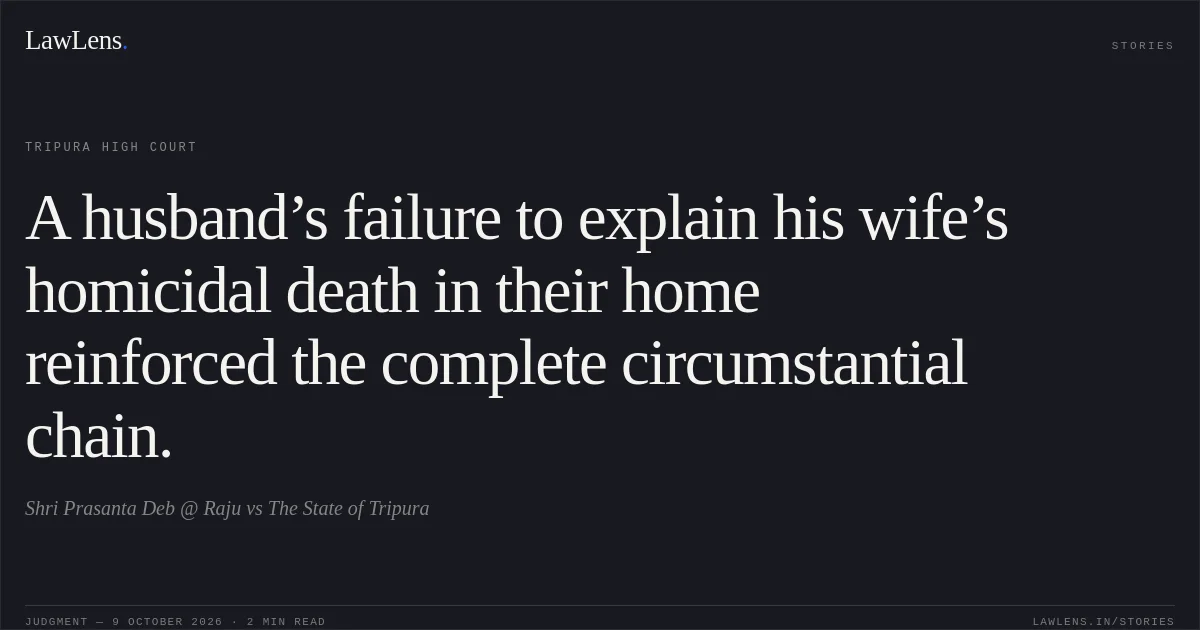
The appellant was convicted under Section 302 IPC for the murder of his wife and sentenced to life imprisonment and a fine.
Source reference: para. 1–7, 12–14, 25, 33–35The prosecution case was that the appellant had subjected her to cruelty and money demands; on the night before her death, neighbours heard a quarrel between them.
Source reference: para. 1–7, 12–14, 25, 33–35The next morning, the deceased was found dead inside the matrimonial home.
Source reference: para. 1–7, 12–14, 25, 33–35The post-mortem doctor attributed her death to asphyxia caused by manual strangulation and opined that it was homicidal.
Source reference: para. 1–7, 12–14, 25, 33–35The appellant denied the allegations in his Section 313 CrPC examination and offered no explanation for the death.
Source reference: para. 1–7, 12–14, 25, 33–35The Sessions Court convicted him, and he appealed against that conviction and sentence
Source reference: para. 1–7, 12–14, 25, 33–35Issues
Whether the prosecution proved beyond reasonable doubt, by circumstantial evidence, that the appellant committed the homicidal death of his wife
Source reference: para. 28, 33–37Whether the appellant’s failure to explain the death, in light of the circumstances proved by the prosecution, could be considered under Section 106 of the Evidence Act
Source reference: para. 35Law Applied
Section 302 IPC criminalises murder.
Source reference: para. 8.5In a case based on circumstantial evidence, the prosecution must prove each circumstance and establish a complete chain pointing exclusively to the accused’s guilt; suspicion alone cannot substitute for proof
Source reference: para. 8.5Section 106 of the Evidence Act does not relieve the prosecution of its burden to prove guilt, but where foundational facts are established and a relevant fact is especially within the accused’s knowledge, failure to offer a reasonable explanation may provide an additional link in the chain
Source reference: para. 9.3–9.5The Court also relied on the medical evidence as expert evidence concerning the cause and nature of death
Source reference: para. 25, 33Reasoning
The Court found that the medical evidence established death by manual strangulation and that the death was homicidal.
Source reference: para. 25, 32–33It accepted the evidence of family members and neighbours concerning the appellant’s prior cruelty and demands for money, and the neighbours’ evidence that they heard a quarrel between the couple on the preceding night.
Source reference: para. 29–35The deceased was found dead inside the matrimonial home, while the appellant was absent when others arrived; he gave no explanation either in his defence or under Section 313 CrPC as to how she died.
Source reference: para. 35The Court treated that failure as an additional link—not as a substitute for the prosecution’s proof—and concluded that the circumstances formed a complete chain pointing to the appellant’s guilt.
Source reference: para. 35–37Holding
The Court held that the prosecution proved the appellant’s guilt beyond reasonable doubt and found no infirmity in the conviction under Section 302 IPC or the sentence imposed by the trial court.
The appeal was dismissed, and the conviction and sentence were affirmed
Source reference: para. 37–39Acts & Sections Cited
6 provisions across 2 statutes referred to in this judgment. Each provision opens on LawLens.
Code of Criminal Procedure, 19732
Indian Penal Code, 18604
Original Court PDF
Shri Prasanta Deb @ RajuvsThe State of Tripura
Click to open original judgment
Original judgment, available to read, download and summarize on LawLens.in