Facts
The appellant was convicted under Section 302 IPC and sentenced to life imprisonment for the murder of Ajay Kumar Singh.
Source reference: para. 2–10The prosecution case rested on circumstantial evidence, including last-seen testimony and the recovery of a blood-stained gandasa and clothing; the trial court acquitted the co-accused but convicted the appellant.
Source reference: para. 2–10During the appeal, the appellant claimed juvenility, relying on educational records showing his date of birth as 15 November 1981. The State verified those records and did not dispute the date of birth.
Source reference: para. 12–22The offence occurred on 2 February 1999, when the appellant was 17 years, 2 months and 17 days old.
Source reference: para. 22The appellant did not challenge his conviction, but sought to have the sentence set aside and the matter remitted to the Juvenile Justice Board.
Source reference: para. 24Issues
Whether the appellant was a juvenile on the date of the offence, and what evidence governed determination of his age.
Source reference: para. 13–22Whether, upon accepting the juvenility claim, the High Court should interfere with the conviction or the sentence and refer the matter to the Juvenile Justice Board.
Source reference: para. 23–36Law Applied
Section 7A of the Juvenile Justice (Care and Protection of Children) Act, 2000 permits a claim of juvenility to be raised at any stage, including after final disposal, and requires the court to determine the claim.
Source reference: para. 14Section 94 of the Juvenile Justice Act, 2015 gives priority to the prescribed documentary evidence, including school or matriculation records, for age determination.
Source reference: para. 18–20The Court applied the principles discussed in Mumtaz v. State of U.P., (2016) 11 SCC 786: under Section 20 of the 2000 Act, a court may maintain a finding of guilt but, upon finding the person was a juvenile on the offence date, should not impose an ordinary criminal sentence and should instead refer the matter to the Juvenile Justice Board for appropriate orders.
Source reference: para. 32–35The Court also relied on the cited decisions concerning the effect of Section 20 and the Board’s role in determining the appropriate order.
Source reference: para. 32–35Reasoning
The verified High School and school-transfer records established the appellant’s date of birth as 15 November 1981; applying Section 94’s documentary-evidence approach, the Court held he was a juvenile when the offence occurred.
Source reference: para. 18–22The appellant expressly did not contest the conviction. The Court nevertheless considered the evidence, including the last-seen testimony and recovery evidence, and found no perversity or illegality warranting interference with the trial court’s finding of guilt.
Source reference: para. 24, 26–30Because the appellant was a juvenile on the offence date, the ordinary sentence of life imprisonment could not stand; the appropriate order was for the Juvenile Justice Board to determine the order permissible under the applicable juvenile-justice law.
Source reference: para. 31–36Holding
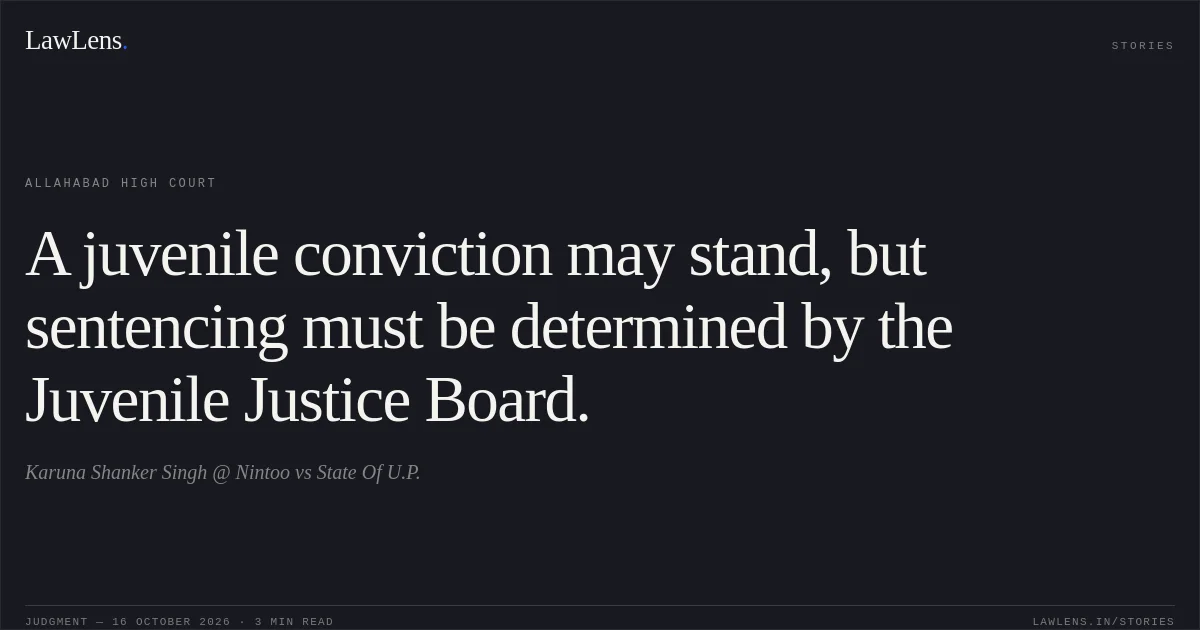
The High Court held that the appellant was a juvenile on the date of the offence and upheld his conviction under Section 302 IPC.
It set aside the sentence and remitted the matter to the jurisdictional Juvenile Justice Board for appropriate orders in accordance with law.
Source reference: para. 36–39The appellant, already on bail, was directed to appear before the Board on 27 October 2026; the Board was directed to pass orders within four weeks of receiving a certified copy of the judgment.
Source reference: para. 36–39The appeal was partly allowed to that extent.
Source reference: para. 36–39Acts & Sections Cited
6 provisions across 3 statutes referred to in this judgment. Each provision opens on LawLens.
Indian Penal Code, 18601
Code of Criminal Procedure, 19731
Juvenile Justice (Care and Protection of Children) Act, 2015.4
Original Court PDF
Karuna Shanker Singh @ NintoovsState Of U.P.
Click to open original judgment
Original judgment, available to read, download and summarize on LawLens.in