Facts
The appellant was convicted under Sections 302 and 201 IPC and sentenced to life imprisonment and three years’ rigorous imprisonment, respectively, with fines
Source reference: p.1During the appeal, he claimed that he was 17 years old when the incident occurred on 27 October 2013.
Source reference: pp.1–2, 6An ossification test assessed his age at 25 years on 25 October 2021; following an inquiry directed by the Court, the Registrar (Judicial) concluded that he was 17 on the date of the incident.
Source reference: pp.1–2, 6The State did not dispute the inquiry report
Source reference: pp.1–2, 6Issues
1. Whether the appellant was a juvenile in conflict with law on the date of the incident, notwithstanding that the claim was raised during the appeal
Source reference: pp.2–3, 6–72. Whether, after finding the appellant to have been a juvenile, the Court could uphold his convictions while quashing the sentences imposed by the trial court
Source reference: pp.6–8Law Applied
Section 7A of the Juvenile Justice (Care and Protection of Children) Act, 2000 permits a claim of juvenility to be raised at any stage, including after final disposal, and requires the court to determine the person’s age; if the person was a juvenile on the date of the offence, the sentence passed by a court is deemed to have no effect
Source reference: pp.3–4Rule 12 of the Juvenile Justice Rules, 2007 prescribes the hierarchy of age evidence and permits medical opinion where the specified documentary records are unavailable; where age cannot be precisely assessed, the child is to receive the benefit of the lower age within a one-year margin
Source reference: pp.4–6Relying on Raju v. State of Haryana, (2019) 14 SCC 401, the Court treated an inquiry conducted by the Registrar (Judicial), upon the Court’s direction and subject to judicial consideration, as an inquiry by the Court
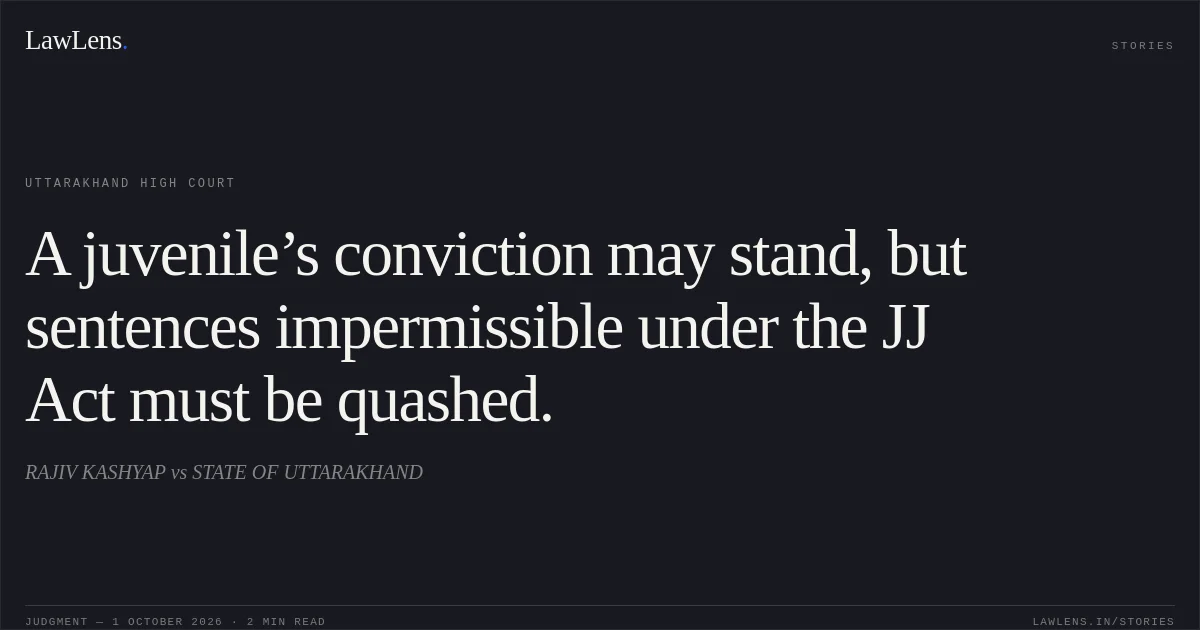
Source reference: pp.2–4Applying Pawan Kumar v. State of Uttar Pradesh, (2023) 15 SCC 683, the Court held that a juvenile’s conviction may be sustained while the sentences are quashed where the evidence and circumstances warrant that result
Source reference: pp.6–8Reasoning
The Registrar (Judicial), after considering the available material, found that the appellant was 17 on 27 October 2013; the ossification report was consistent with that finding, and the State raised no objection
Source reference: pp.2, 6The Court accepted the inquiry as its own and treated the finding as establishing the appellant’s juvenility under the applicable Act and Rules
Source reference: p.6Following Pawan Kumar, it distinguished the validity of the convictions from the sentences: the appellant’s juvenile status required the sentences imposed by the trial court to be quashed, but did not require the convictions under Sections 302 and 201 IPC to be set aside
Source reference: pp.6–8Holding
The Court held that the appellant was a juvenile in conflict with law on the date of the incident.
It upheld his convictions under Sections 302 and 201 IPC but quashed the sentences imposed on him
Source reference: pp.6–8As the appellant was already on bail, his bail bonds were cancelled, his sureties discharged, and he was not required to surrender; the Court also held that he was entitled to the benefit of Section 19 of the JJ Act
Source reference: p.8Acts & Sections Cited
4 provisions across 1 statute referred to in this judgment. Each provision opens on LawLens.
Indian Penal Code, 18604
Original Court PDF
RAJIV KASHYAPvsSTATE OF UTTARAKHAND
Click to open original judgment
Original judgment, available to read, download and summarize on LawLens.in