Facts
On 9 September 2013, Suresha was injured while travelling as a passenger in an auto-rickshaw that collided with a bullock cart.
Source reference: p. 2–5, 8He sought compensation under Section 166 of the Motor Vehicles Act, 1988.
Source reference: p. 2–5, 8The Tribunal awarded ₹4,25,800 with interest at 9% per annum and held the insurer liable.
Source reference: p. 2–5, 8The insurer appealed, disputing liability because the vehicle’s fitness certificate had not been renewed after 24 November 2011, and challenging the assessment of compensation.
Source reference: p. 2–5, 8The claimant’s notice was held sufficient by publication, but he did not appear in the appeal.
Source reference: p. 5Issues
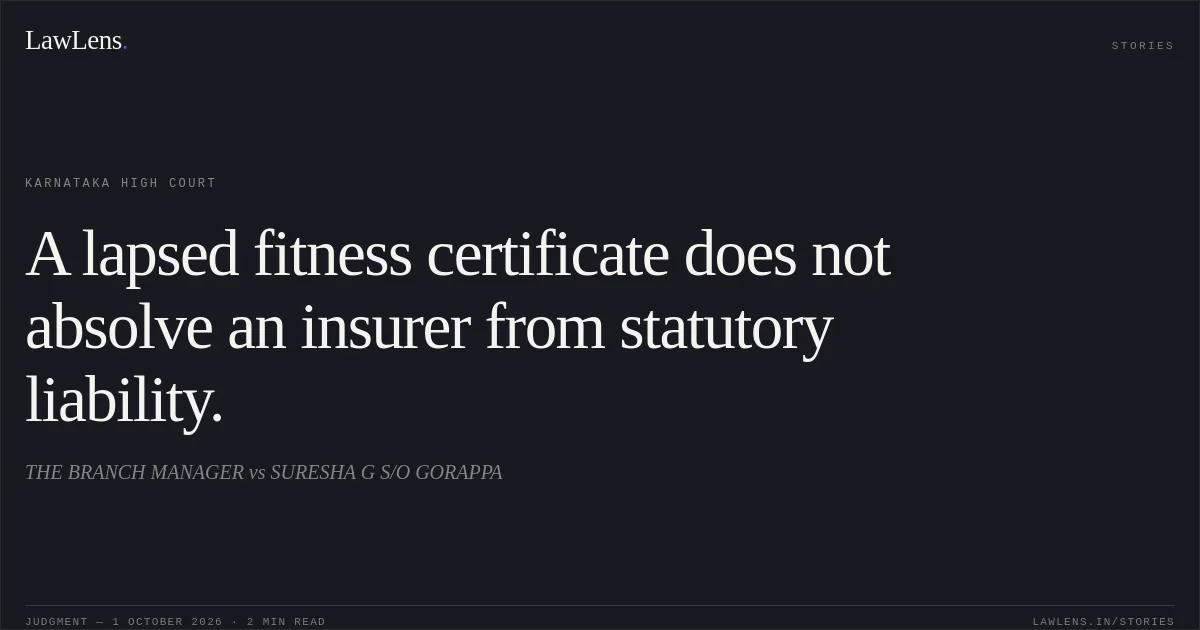
Whether the insurer could avoid liability because the auto-rickshaw lacked a valid fitness certificate on the date of the accident.
Source reference: p. 6Whether the Tribunal’s assessment of compensation required modification.
Source reference: p. 6Law Applied
Sections 149 and 166 of the Motor Vehicles Act, 1988, were relevant to the insurer’s statutory defences and the claimant’s compensation claim.
Source reference: no citationThe Court held that lack of a fitness certificate was not among the defences enumerated under Section 149 and noted that the insurance policy contained no condition permitting avoidance of liability on that ground.
Source reference: p. 7It relied on the Division Bench decision of the Karnataka High Court in MFA No. 5993 of 2015, decided on 22 December 2020, in assessing the insurer’s liability.
Source reference: p. 7The insurer also relied on Pareed Pillai v. Oriental Insurance Co. Ltd., AIR 2019 Kerala 9, and MFA No. 501 of 2021 and connected matter, but the Court did not accept those submissions as a basis to avoid liability in this case.
Source reference: p. 5Reasoning
Although the vehicle’s fitness certificate had not been shown as renewed beyond 24 November 2011, the evidence did not establish that the certificate had been cancelled.
Source reference: p. 6–7The Court further found that the policy was issued on 28 June 2013 without verification of the certificate’s currency, and that neither the policy nor Section 149 supplied a basis to relieve the insurer of liability.
Source reference: p. 6–7On quantum, the doctor confirmed that the fractures had properly united.
Source reference: p. 8–9The Court therefore set aside the award for future loss of income based on permanent disability, but increased pain-and-suffering compensation from ₹50,000 to ₹75,000, awarded ₹50,000 for loss of amenities, and reassessed six months’ loss of income using the 2013 notional monthly income of ₹8,000.
Source reference: p. 8–9Holding
The Court held the insurer liable despite the absence of a valid fitness certificate and modified the compensation award.
It reduced the total from ₹4,25,800 to ₹2,75,800, with interest at 9% per annum from the date of the claim petition until deposit.
Source reference: p. 10The insurer was directed to deposit the amount before the Tribunal within six weeks; any excess deposit was to be refunded to the insurer.
Source reference: p. 10Acts & Sections Cited
3 provisions across 1 statute referred to in this judgment. Each provision opens on LawLens.
Motor Vehicles Act, 19883
Original Court PDF
THE BRANCH MANAGERvsSURESHA G S/O GORAPPA
Click to open original judgment
Original judgment, available to read, download and summarize on LawLens.in