Facts
The appellant was convicted under Section 376(1) IPC and sentenced to ten years’ rigorous imprisonment and a fine of ₹25,000 by the Principal Sessions Judge, Pakur.
Source reference: para. 1–7, 21, 23The prosecution case was that the complainant was taken to the appellant’s house on an assurance of marriage and had physical relations with him for about a year before he made her leave.
Source reference: para. 1–7, 21, 23At trial, she additionally testified that he had chased her at a market, taken her to a field, and raped her.
Source reference: para. 1–7, 21, 23The Medical Board assessed her age at 18–19 years; she also acknowledged that the appellant was recorded as her husband on her Aadhaar card.
Source reference: para. 1–7, 21, 23The appellant appealed under Section 374(2) CrPC.
Source reference: para. 1–7, 21, 23Issues
1. Whether the complainant’s evidence was reliable and trustworthy
Source reference: para. 26(I)2. Whether her consent to sexual intercourse was voluntary or given under a misconception of fact
Source reference: para. 26(II)3. Whether the prosecution proved the appellant’s guilt under Section 376 IPC beyond reasonable doubt
Source reference: para. 26(III)4. Whether the trial court erred in convicting and sentencing the appellant
Source reference: para. 26(IV)Law Applied
Section 376 IPC criminalises rape, while Section 90 IPC concerns consent given under a misconception of fact.
Source reference: no citationUnder State of Punjab v. Gurmit Singh, Vishnu v. State of Maharashtra, Raju v. State of M.P. and Narender Kumar v. State (NCT of Delhi), a prosecutrix’s evidence may sustain conviction without corroboration if it inspires confidence; corroboration is a matter of prudence, not a legal requirement, and material infirmities may nevertheless make the evidence unreliable.
Source reference: para. 32–37Under Uday v. State of Karnataka, consent to intercourse on a promise of future marriage does not, without more, establish consent under a misconception of fact; the court must assess the evidence and surrounding circumstances, and the prosecution bears the burden of proving every ingredient of the offence.
Source reference: para. 48–49The prosecution must prove guilt beyond reasonable doubt, and where the evidence reasonably permits competing views, the view favourable to the accused is to be adopted.
Source reference: para. 57–61Reasoning
The Court found a material divergence between the complaint—which alleged that the appellant took the complainant to his house and had relations with her over a period of about a year—and her trial testimony introducing an allegation of rape in a field.
Source reference: para. 38–45The Investigating Officer also testified that she had not made the field-rape allegation in her restatement.
Source reference: para. 38–45The Court considered this improvement alongside evidence of a prior love relationship, the complainant’s adult age, and her admission that the appellant was recorded as her husband on her Aadhaar card.
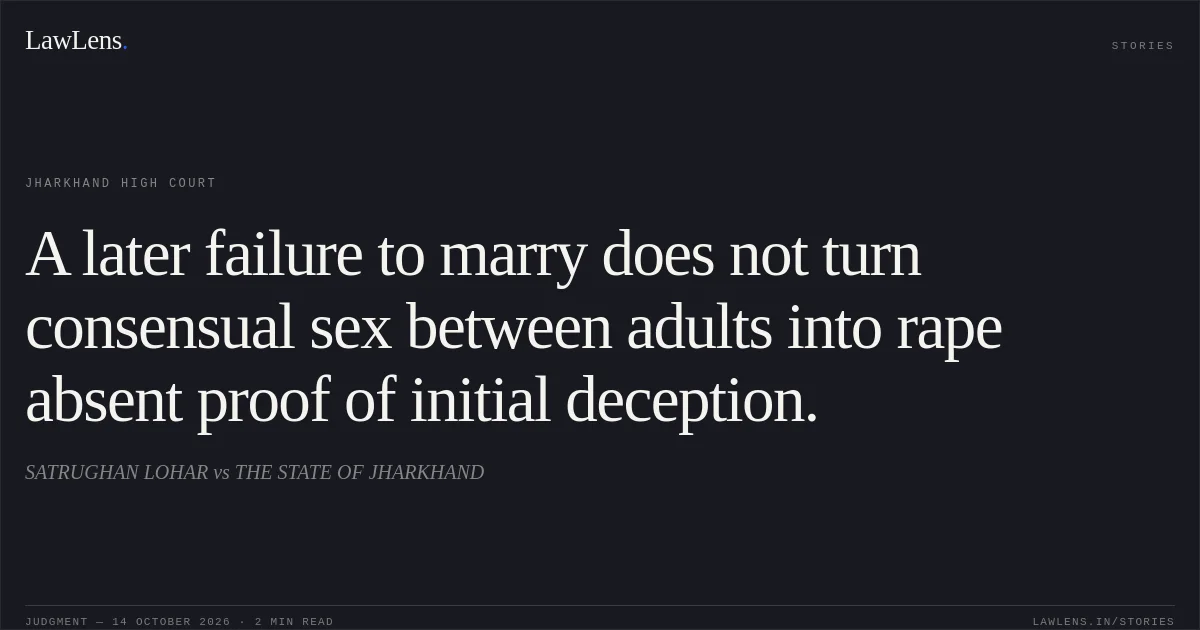
Source reference: para. 50–55It concluded that the evidence did not establish that the appellant induced her consent through a false promise of marriage from the outset; accordingly, the trial court’s finding of consent under a misconception of fact was unsupported.
Source reference: para. 50–55In the Court’s view, the complainant’s testimony did not inspire sufficient confidence to prove the charge beyond reasonable doubt.
Source reference: para. 54, 62Holding
The High Court held that the prosecution had not proved the charge under Section 376(1) IPC beyond reasonable doubt.
It set aside the conviction and sentence dated 26 February 2018, allowed the appeal, and directed the appellant’s release forthwith unless required in another case.
Source reference: para. 62–65Acts & Sections Cited
7 provisions across 2 statutes referred to in this judgment. Each provision opens on LawLens.
Code of Criminal Procedure, 19733
Indian Penal Code, 18604
Original Court PDF
SATRUGHAN LOHARvsTHE STATE OF JHARKHAND
Click to open original judgment
Original judgment, available to read, download and summarize on LawLens.in
![Non-inclusion in railway pass or medical records cannot alone defeat compassionate appointment consideration.. YADVENDRA vs NORTH EASTERN RAILWAY. CAT - ['Allahabad']. LawLens](/stories/thumbnails/non-inclusion-in-railway-pass-or-medical-records-cannot-alone-defeat-compassionate-appoint-e186bad941e646b9b28be0fa75663d2f.webp)
![Ten years’ qualifying service is not required for family pension after one year of continuous railway service.. ANJANA DEVI vs NORTH EASTERN RAILWAY. CAT - ['Allahabad']. LawLens](/stories/thumbnails/ten-years-qualifying-service-is-not-required-for-family-pension-after-one-year-of-continuo-21aef602d06c48fbabbee8c57d854298.webp)
![Back-wage claims require merits-based assessment; absence of an earlier direction alone cannot defeat them.. MANNO LAL SAROJ vs NORTH CENTRAL RAILWAY. CAT - ['Allahabad']. LawLens](/stories/thumbnails/back-wage-claims-require-merits-based-assessment-absence-of-an-earlier-direction-alone-can-62ea890f59a24aa499e6a8a6e1f6bf69.webp)