Facts
On 13 October 2019, the claimant was struck by a Honda Activa while crossing a road in Mandya and sustained severe injuries, including a spinal cord injury that left her wheelchair-bound.
Source reference: pp. 3–8The Tribunal found the scooter rider solely negligent, assessed her permanent whole-body disability at 85%, and awarded Rs. 40,46,560 with interest at 8% per annum.
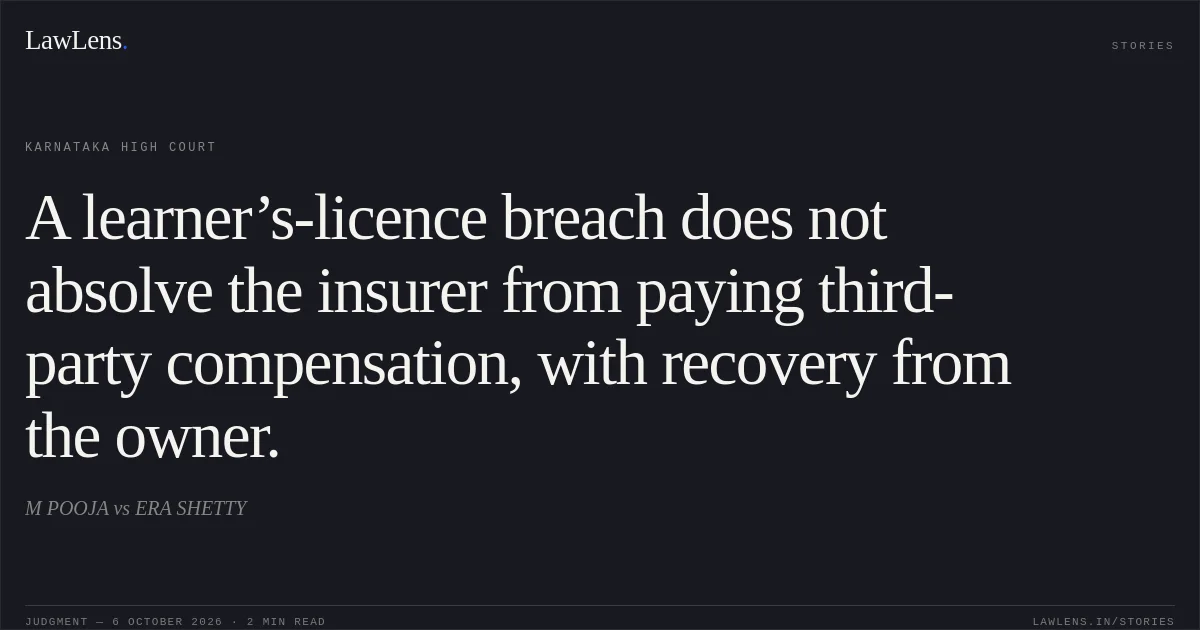
Source reference: pp. 3–8It directed the insurer to satisfy the award and recover the amount from the vehicle owner because the rider had used an unassisted learner’s licence.
Source reference: pp. 3–8The claimant appealed seeking enhancement; the insurer appealed, challenging the pay-and-recover direction, quantum and interest rate
Source reference: pp. 3–8Issues
1. Whether the insurer could be directed to satisfy the third-party award and recover it from the owner despite the alleged breach concerning the rider’s learner’s licence
Source reference: p. 82. Whether the compensation of Rs. 40,46,560 required enhancement or reduction
Source reference: p. 83. Whether the Tribunal’s award of interest at 8% per annum required modification
Source reference: p. 9Law Applied
Section 149(2) of the Motor Vehicles Act, 1988 permits an insurer to rely on specified policy defences, but a breach of policy conditions does not, by itself, extinguish the insurer’s obligation to third-party victims; where a breach is established, the insurer may be directed to pay the victim and recover the amount from the insured.
Source reference: p. 9The Court relied on Shamanna v. Divisional Manager, Oriental Insurance Co. Ltd., (2018) 9 SCC 650, for the pay-and-recover principle
Source reference: p. 9In assessing compensation, the Court referred to Pappu Deo Yadav v. Naresh Kumar, (2022) 13 SCC 523, in connection with future prospects
Source reference: p. 10The Court also considered Section 181(3) of the Motor Vehicles Act and Rule 3 of the Central Motor Vehicles Rules, 1989, in relation to the alleged unassisted learner’s licence
Source reference: pp. 5, 7–9Reasoning
The Court upheld the Tribunal’s finding that the learner’s-licence breach did not defeat the claimant’s right to recover compensation from the insurer in the first instance; the insurer’s remedy was recovery from the owner under the pay-and-recover doctrine
Source reference: p. 9It found no basis to disturb the Tribunal’s assessment of income, future prospects, multiplier, disability or total compensation, and rejected both the claimant’s request for enhancement and the insurer’s challenge to quantum
Source reference: p. 10However, it accepted the insurer’s submission that 8% interest was excessive and reduced the rate to 6% per annum
Source reference: pp. 11–12Holding
The insurer’s appeal was allowed in part solely to reduce interest from 8% to 6% per annum; the claimant’s appeal was dismissed, and the compensation award of Rs. 40,46,560 was affirmed.
Interest runs from the date of the claim petition until realization, excluding Rs. 20,000 awarded for future medical expenses.
Source reference: pp. 12–13The insurer was directed to deposit the amount within eight weeks and may recover it from the vehicle owner by executing the decree, without filing a separate suit.
Source reference: pp. 12–13Acts & Sections Cited
4 provisions across 1 statute referred to in this judgment. Each provision opens on LawLens.
Motor Vehicles Act, 19884
Original Court PDF
M POOJAvsERA SHETTY
Click to open original judgment
Original judgment, available to read, download and summarize on LawLens.in