Facts
The Petitioner entered into a nine-year License Agreement with the Respondent (DMRC) on 14.08.2024 to develop and operate commercial spaces at three metro stations
Source reference: p.2The Petitioner allegedly failed to pay license fees and utility charges regularly, leading DMRC to issue multiple Cure and Termination Notices throughout 2024 and 2025
Source reference: p.6, 17On 02.03.2026, DMRC issued an order terminating the License Agreement due to non-payment of dues and non-compliance with fire safety norms
Source reference: p.3, 26The Petitioner filed this Section 9 petition seeking to stay the termination, restrain dispossession, and restore utility services, arguing that the termination was procedurally flawed and arbitrary
Source reference: p.1-2Issues
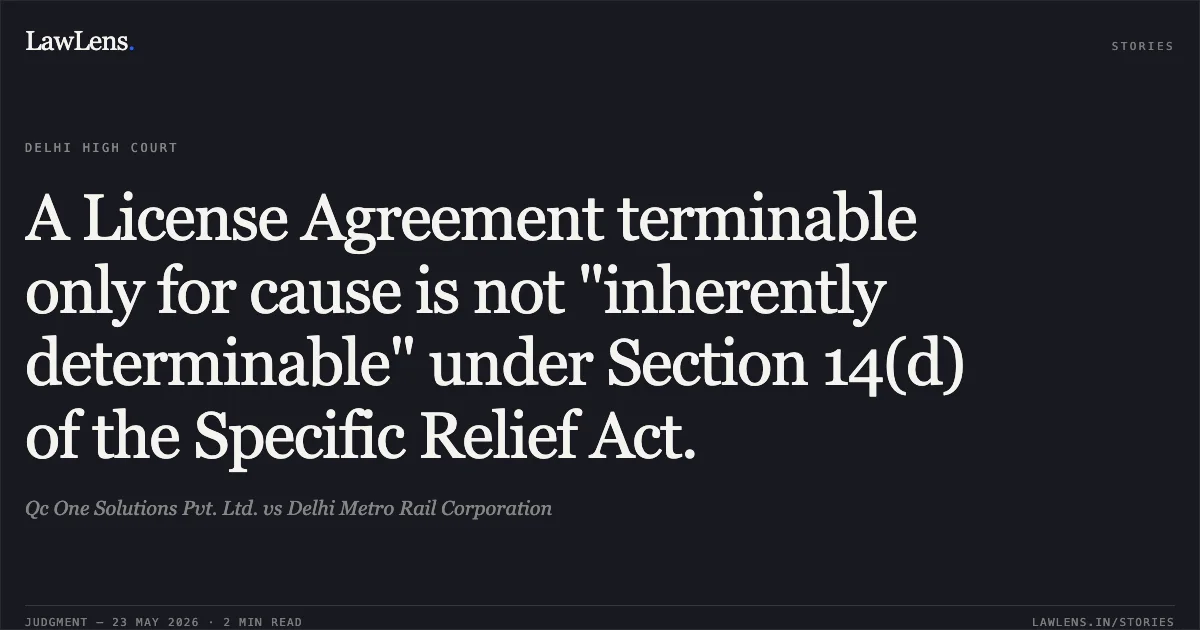
1. Whether the License Agreement is "determinable in nature" under Section 14(d) of the Specific Relief Act, 1963, thereby barring the grant of an injunction
Source reference: p.9 / para. 322. Whether the Respondent followed the mandatory contractual procedure for termination under Clauses 7.1 and 12.3 of the Agreement
Source reference: p.3 / para. 93. Whether the Petitioner is entitled to interim protection under Section 9 of the Arbitration and Conciliation Act, 1996
Source reference: p.16 / para. 41Law Applied
The court applied Section 14(d) of the Specific Relief Act, 1963, which prohibits specific performance of contracts that are "in their nature determinable"
Source reference: p.10It relied on the Supreme Court’s decision in K.S. Manjunath v. Moorasavirappa, which clarified that contracts terminable only "for cause" with notice and cure periods are generally not "determinable" under Section 14(d)
Source reference: p.13-14The court also assessed the principles for interim relief under Section 9 of the Arbitration and Conciliation Act, 1996, which require a prima facie case, balance of convenience, and irreparable injury
Source reference: p.16Reasoning
The Court first rejected DMRC’s preliminary objection, holding that the contract was not "determinable" because termination was conditioned upon a breach (non-payment) and required a cure period, rather than being terminable "at will"
Source reference: para. 35-40The Court noted the Petitioner’s repeated written admissions of liability and requests to adjust dues from the security deposit
Source reference: p.18-25The Court held that DMRC was not contractually obligated to exhaust the security deposit before terminating for default and found that the 2025 Cure and Termination notices remained valid as the defaults were never fully cured
Source reference: p.30-31, 26The Court further ruled that Clause 13.6 (suspension of work during arbitration) does not freeze a valid termination but merely ensures payment of outstanding dues
Source reference: p.29-30Since the injury was purely commercial and quantifiable in damages, the triple test for an injunction was not met
Source reference: p.35Holding
The Court held that while the contract was not legally "determinable" so as to bar the suit entirely, the Petitioner failed to establish a prima facie case because its persistent defaults provided a valid basis for termination under the Agreement
The Court dismissed the petition, refused to stay the termination or restore utilities, and left all substantive disputes for the Arbitral Tribunal to decide
Source reference: p.35, 36Acts & Sections Cited
3 provisions across 3 statutes referred to in this judgment. Each provision opens on LawLens.
Arbitration and Conciliation Act, 19961
Specific Relief Act, 19631
Indian Contract Act, 18721
Original Court PDF
Qc One Solutions Pvt. Ltd.vsDelhi Metro Rail Corporation
Click to open original judgment
Original judgment, available to read, download and summarize on LawLens.in