Facts
Respondent No. 2, a tenant receiving electricity through an existing connection standing in another person’s name, applied for an independent electricity connection on 28 June 2004. CESC withheld the application on the ground that substantial arrears were outstanding against connections associated with the premises and their previous consumers.
Source reference: p.2–4After the existing connection was disconnected and certain dues were paid by respondent No. 2 and other consumers, respondent No. 2 reapplied for a new connection on 7 December 2005.
Source reference: p.4CESC delayed processing the application while investigating whether a nexus existed between respondent No. 2 and the previous defaulting consumer, Amal Kumar Dey. After hearing the parties and inspecting the premises, CESC concluded that no such nexus existed, issued an estimate on 6 June 2006, and effected the connection on 19 September 2006 after payment by respondent No. 2.
Source reference: p.4–6The Ombudsman rejected respondent No. 2’s claim for refund of Rs. 45,394 for want of proof that she had personally paid the amount, but awarded Rs. 8,350 as compensation for delay in issuing the estimate. CESC challenged that order in the present writ petition.
Source reference: p.7–8Issues
1. Whether CESC’s investigation into the existence of a nexus between the new applicant and the previous defaulting consumer suspended or otherwise excluded the statutory time-limit for issuing the estimate for a new electricity connection.
Source reference: para. 16–182. Whether the Ombudsman was justified in awarding Rs. 8,350 as compensation for CESC’s delay in issuing the estimate under the applicable standards-of-performance regulations.
Source reference: para. 15, 20–213. Whether CESC could withhold or refuse the new connection by seeking recovery of the previous consumer’s arrears without proving a nexus between that consumer and the new applicant.
Source reference: para. 11, 16–18Law Applied
The Court applied Section 42(6) of the Electricity Act, 2003 and Regulations 3.1.1 and 3.1.2 of the West Bengal Electricity Regulatory Commission Regulations, 2005, under which the distribution licensee must inspect the premises and issue the estimate within the prescribed period—two weeks for LV/MV supply in an urban area—and the intending consumer must make the required payment within 45 days of the estimate.
Source reference: p.8–10Regulation 12 imposed compensation for failure to meet guaranteed standards, including failure to release a new connection within the prescribed time, at the applicable daily rate.
Source reference: p.10–11Regulation 3.4.2 of the 2007 Regulations permitted recovery of previous dues from a subsequent consumer only where a nexus with the previous defaulting consumer was proved, with the burden resting on the licensee.
Source reference: p.11The Court also considered Isha Marbles v. Bihar State Electricity Board, (1995) 2 SCC 648, and Paschimanchal Vidyut Vitran Nigam Ltd. v. DVS Steels & Alloys (P) Ltd., (2009) 1 SCC 210, which recognize the licensee’s right to investigate and recover arrears where the requisite nexus or succession is established, but do not dispense with the applicable statutory requirements.
Source reference: para. 12, 18Reasoning
The Court accepted that CESC was entitled to investigate whether respondent No. 2 had a nexus with the previous defaulting consumer before granting a fresh connection, particularly because substantial arrears were associated with the premises.
Source reference: para. 17However, that investigative entitlement did not override or suspend the mandatory timeline for issuing the estimate under Regulation 3.1.1. Since Regulation 3.4.2 placed the burden of proving the nexus on CESC, any delay in conducting the investigation or inspection was attributable to the licensee unless circumstances justified exclusion of that period.
Source reference: para. 17–18The Court noted that respondent No. 2 applied on 7 December 2005, whereas the estimate was issued only on 6 June 2006, approximately six months later.
Source reference: para. 21The Ombudsman appropriately confined compensation to the delay in issuing the estimate and did not penalize CESC for the subsequent period during which respondent No. 2 failed to make payment after receiving the offer letter.
Source reference: para. 20The absence of any established nexus also meant that CESC could not fasten the previous consumer’s arrears upon respondent No. 2.
Source reference: para. 18–19Holding
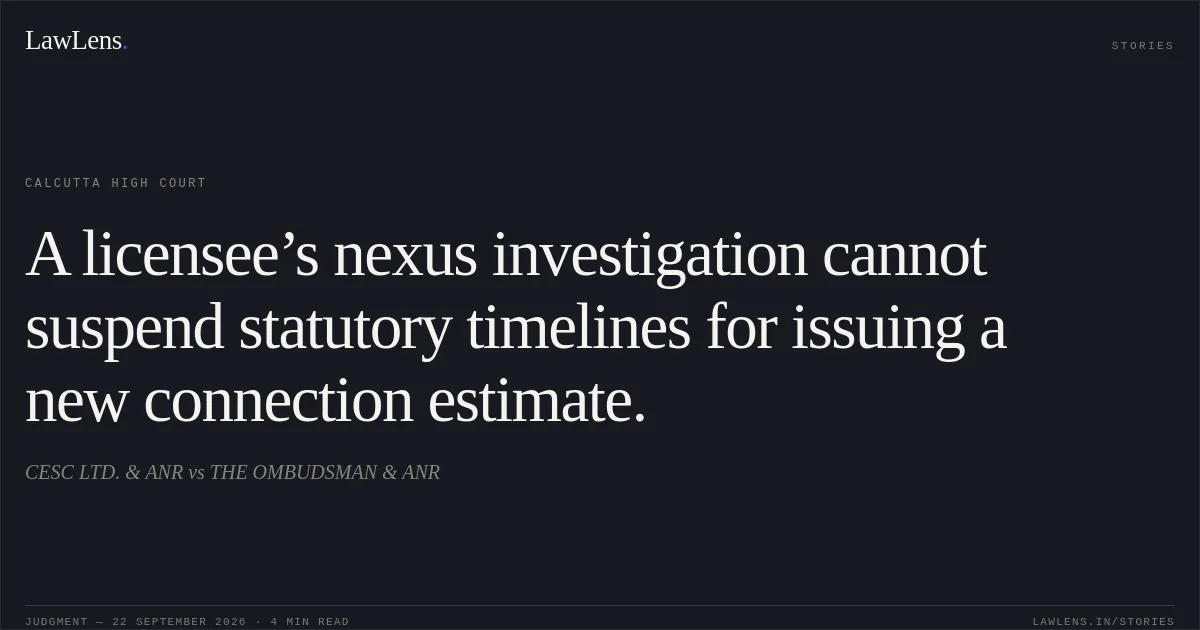
The Court held that CESC’s right to verify the existence of a nexus between the new applicant and the previous defaulting consumer did not suspend the prescribed time-limit for issuing the estimate.
The delay was attributable to CESC, and the Ombudsman was justified in awarding Rs. 8,350 as compensation for failure to meet the applicable standard of performance.
Source reference: para. 20–21The writ petition, WPA 2655 of 2009, was dismissed; the Ombudsman’s order dated 4 December 2008 was affirmed, connected applications were disposed of, and any interim order was vacated.
Source reference: paras. 22–24Acts & Sections Cited
2 provisions across 1 statute referred to in this judgment. Each provision opens on LawLens.
Electricity Act, 20032
Original Court PDF
CESC LTD. & ANRvsTHE OMBUDSMAN & ANR
Click to open original judgment
Original judgment, available to read, download and summarize on LawLens.in