Facts
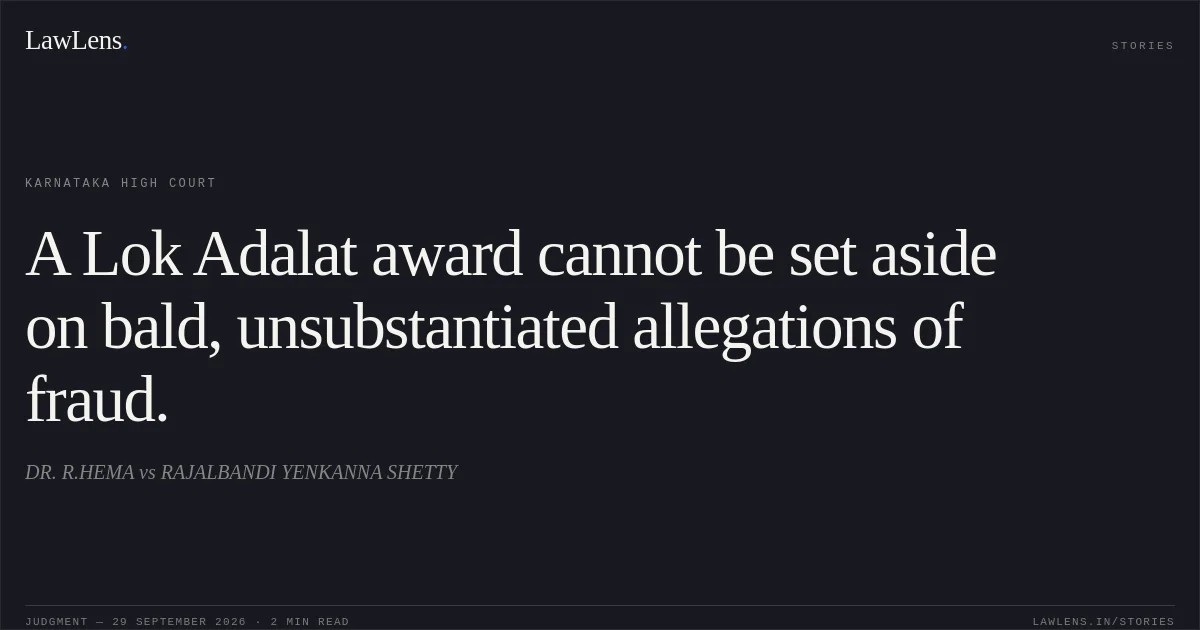
Respondent No. 4 instituted a partition suit against his parents, brothers and the petitioner, his sister.
Source reference: para. 2On 5 October 2013, the petitioner and the other parties, with their respective counsel, signed a joint memo reporting settlement and seeking reference to the Lok Adalat. On 24 October 2013, the parties presented a compromise petition before the Lok Adalat, which passed an award recording the settlement.
Source reference: paras. 2, 10–12The petitioner later alleged that she had been hurried into signing without understanding the terms, that the settlement denied her a proper share, and that the respondents had not complied with it.
Source reference: para. 3She had separately sought to set aside the award and claim partition, but the plaint was rejected and the rejection was upheld in revision; she then challenged the award under Articles 226 and 227.
Source reference: para. 6The High Court found that she had not disclosed her earlier appearance at Raichur on 5 October 2013, when she signed the joint memo.
Source reference: paras. 11–12Issues
Whether the petitioner established that the Lok Adalat award was obtained by fraud or misrepresentation so as to warrant interference under Articles 226 and 227
Source reference: paras. 6, 15–16, 27Whether alleged non-compliance with the compromise terms was a ground to set aside the award
Source reference: para. 17Law Applied
Under Section 21 of the Legal Services Authorities Act, 1987, a Lok Adalat award has the status and enforceability of a decree.
Source reference: no citationA challenge to such an award by writ petition may be maintainable, including on an allegation of fraud, but the award cannot be set aside merely on assertion; fraud must be specifically pleaded and strictly proved with supporting material.
Source reference: para. 18; para. 23The court also relied on the principle that a compromise decree is ordinarily treated as an agreement with the court’s approval and that non-compliance with an enforceable decree is ordinarily addressed through execution, not by setting the decree aside.
Source reference: paras. 23, 25–26Reasoning
The Court found that the petitioner had signed the joint memo reporting settlement on 5 October 2013, appeared with the parties and counsel before the Lok Adalat on 24 October, and signed the compromise petition.
Source reference: paras. 11–16, 27It also noted that she later furnished stamp paper and obtained the award engrossed on stamp paper. These circumstances, together with her failure to disclose the earlier appearance and the absence of specific pleadings or corroborative material, did not support her allegations of fraud or misrepresentation.
Source reference: paras. 11–16, 27Her allegation that the respondents had not performed the settlement was unsupported by pleadings or evidence and, in any event, did not justify setting aside the award; the award could be enforced as a decree.
Source reference: paras. 17, 25–27Holding
The Court held that the petitioner had not established fraud or any other sufficient ground to invalidate the Lok Adalat award, and that alleged non-compliance was not a basis to set it aside.
The writ petition was dismissed.
Source reference: paras. 27–28Acts & Sections Cited
4 provisions across 3 statutes referred to in this judgment. Each provision opens on LawLens.
Legal Services Authorities Act, 19871
Code of Civil Procedure, 19081
Indian Contract Act, 18722
Original Court PDF
DR. R.HEMAvsRAJALBANDI YENKANNA SHETTY
Click to open original judgment
Original judgment, available to read, download and summarize on LawLens.in