Facts
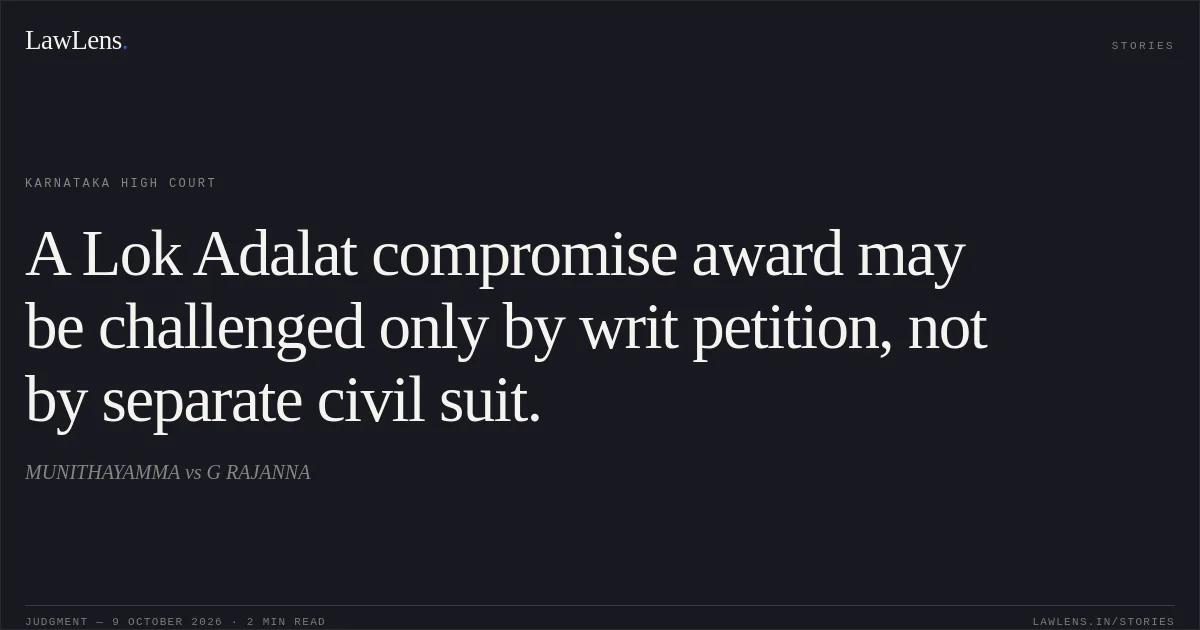
The respondents filed O.S. No. 919/2024 seeking a declaration that a judgment and decree in O.S. No. 1151/2023, stated to have been entered by compromise before a Lok Adalat, was null and void and not binding on them, as well as an injunction against the defendants
Source reference: p.3; p.6Defendant No. 1 sought rejection of the plaint under Order VII Rule 11 CPC, contending that Order XXIII Rule 3A barred a separate suit to challenge the compromise decree. The trial court dismissed the application, relying on *M.L. Vijaya v. T. Srinath* and distinguishing its circumstances
Source reference: pp.3–4Defendant No. 1 challenged that order in this revision petition
Source reference: p.3Issues
1. Whether the trial court’s dismissal of the application under Order VII Rule 11 CPC should be set aside where the specific ground concerning the Lok Adalat award and the remedy available to the respondents had not been raised before that court
Source reference: pp.6–72. Whether the petitioner should be permitted to file a fresh application for rejection of the plaint, for the trial court to consider in light of the law governing challenges to Lok Adalat awards
Source reference: p.7Law Applied
Order VII Rule 11 CPC provides for rejection of a plaint on the grounds specified in that provision; the application must be considered on the grounds properly raised and the material relevant to that inquiry
Source reference: pp.3, 6–7Section 115 CPC limits the High Court’s revisional jurisdiction
Source reference: p.7Relying on *Dilip Mehta v. Rakesh Gupta & Ors.*, 2025 LiveLaw (SC) 1188, the Court noted that the validity of a Lok Adalat award is to be tested in writ proceedings before the High Court, rather than through an independent civil suit or an expanded execution inquiry
Source reference: pp.5–7The Court did not finally determine whether the respondents’ suit was barred; it directed the trial court to consider that question on a fresh application and in light of the cited decision
Source reference: p.7Reasoning
The plaint averments indicated that the compromise had been entered before a Lok Adalat, and the petitioner relied on *Dilip Mehta* to contend that a writ petition, rather than a civil suit, was the available remedy
Source reference: pp.5–7However, the High Court observed that this ground had not been raised before the trial court, leaving that court no occasion to consider it
Source reference: p.6Given the limits of its revisional jurisdiction, the High Court declined to decide the contention in the first instance and instead considered it appropriate to allow the petitioner to raise the relevant grounds through a fresh Order VII Rule 11 application
Source reference: p.7Holding
The High Court allowed the revision petition, set aside the trial court’s order dated 23 February 2026, and remanded the matter
The petitioner was permitted to file a fresh application under Order VII Rule 11 CPC, which the trial court must consider in light of *Dilip Mehta v. Rakesh Gupta & Ors.*
Source reference: p.7The Court did not itself hold that the plaint was barred or order its rejection.
Source reference: p.7Acts & Sections Cited
2 provisions across 1 statute referred to in this judgment. Each provision opens on LawLens.
Code of Civil Procedure, 19082
Original Court PDF
MUNITHAYAMMAvsG RAJANNA
Click to open original judgment
Original judgment, available to read, download and summarize on LawLens.in