Facts
The Association’s representative initiated a criminal case alleging financial and audit irregularities by the named accused. After investigation, the police submitted a final report.
Source reference: pp. 2–4; paras. 2–6Following a request for further investigation, a further report dated 31 December 2021 treated the complaint as false and sought action against the representative under Sections 182 and 211 IPC. By order dated 7 March 2022, the Magistrate directed summons to issue to him. He challenged that order, contending that the Magistrate had acted mechanically and without adequate reasons or supporting material.
Source reference: pp. 2–4, 9–10; paras. 2–6, 9–10Issues
1. Whether the Magistrate could issue summons against the petitioner under Sections 182 and 211 IPC merely on the basis of the police report, without a separate complaint and without recording adequate reasons for proceeding.
Source reference: pp. 5–9; paras. 11–162. Whether the materials before the Magistrate disclosed sufficient grounds to issue process against the petitioner.
Source reference: pp. 7–9; paras. 14–16Law Applied
Sections 182 and 211 IPC require, respectively, false information given to a public servant with the requisite knowledge and intent, and a false criminal charge made with intent to injure and without just or lawful ground.
Source reference: pp. 6–7; paras. 11–13Under Section 204 CrPC, issuing process requires the Magistrate’s satisfaction that there are sufficient grounds for proceeding; issuance of summons is a serious judicial act and must not be mechanical.
Source reference: pp. 7–9; paras. 14–16The Court relied on Delhi Race Club (1940) Ltd. v. State of U.P., Bhushan Kumar v. State (NCT of Delhi), M/s Pepsi Foods Ltd. v. Special Judicial Magistrate and Sunil Bharti Mittal v. CBI for the requirement of judicial application of mind and sufficient material before process issues.
Source reference: pp. 7–9; paras. 14–16The Court also referred to Umashankar Yadav v. State of Uttar Pradesh in considering the procedural significance of a complaint in relation to cognizance.
Source reference: pp. 6–7; para. 13Reasoning
The Magistrate’s order showed that he relied on the investigating officer’s report and prayer for process but did not record any assessment of the report’s acceptability, the ingredients of Sections 182 and 211 IPC, or the material establishing sufficient grounds against the petitioner.
Source reference: pp. 7–9; paras. 11–16The High Court therefore found that the summons had been issued mechanically. It also noted that no separate complaint had been lodged before the Magistrate and that the order contained no reasoned satisfaction justifying process.
Source reference: pp. 7–9; paras. 11–16The Court did not decide the underlying truth of the petitioner’s allegations concerning the audit or the disciplinary action against the chartered accountant.
Source reference: pp. 7–9; paras. 11–16Holding
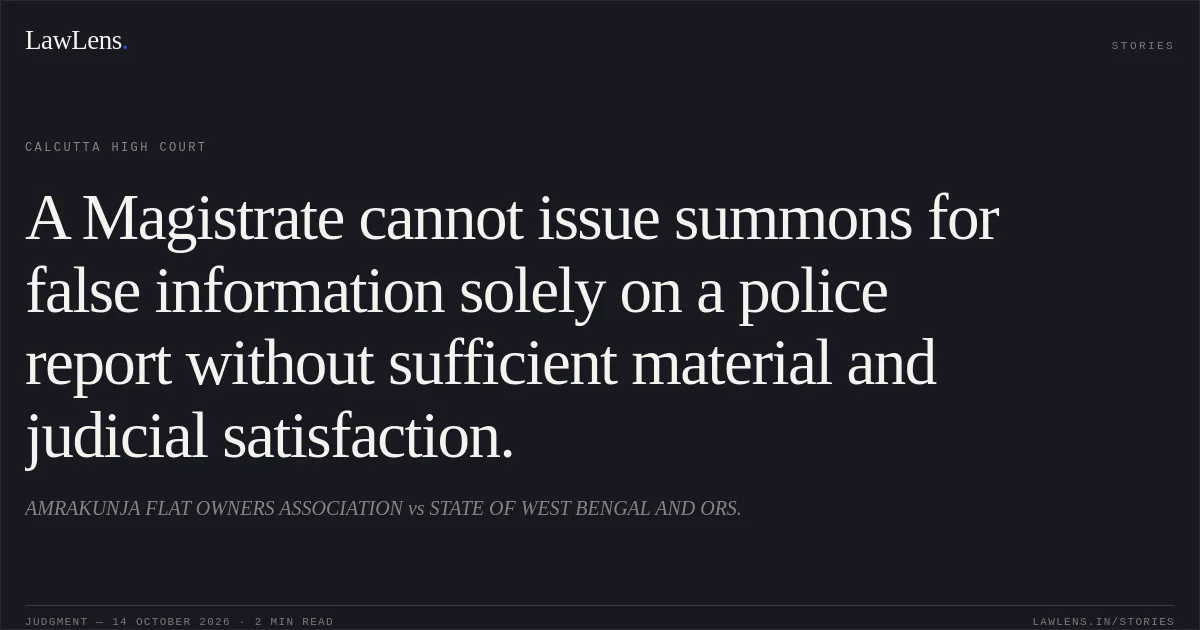
The High Court held that the order issuing summons was legally unsustainable because it lacked reasoned judicial satisfaction and was based merely on the investigating officer’s report.
The criminal revisional application was allowed, and the Magistrate’s order dated 7 March 2022 issuing summons to the petitioner was set aside.
Source reference: pp. 9–10; paras. 17–19Acts & Sections Cited
19 provisions across 2 statutes referred to in this judgment. Each provision opens on LawLens.
Indian Penal Code, 1860
Code of Criminal Procedure, 19737
Original Court PDF
AMRAKUNJA FLAT OWNERS ASSOCIATIONvsSTATE OF WEST BENGAL AND ORS.
Click to open original judgment
Original judgment, available to read, download and summarize on LawLens.in


