Facts
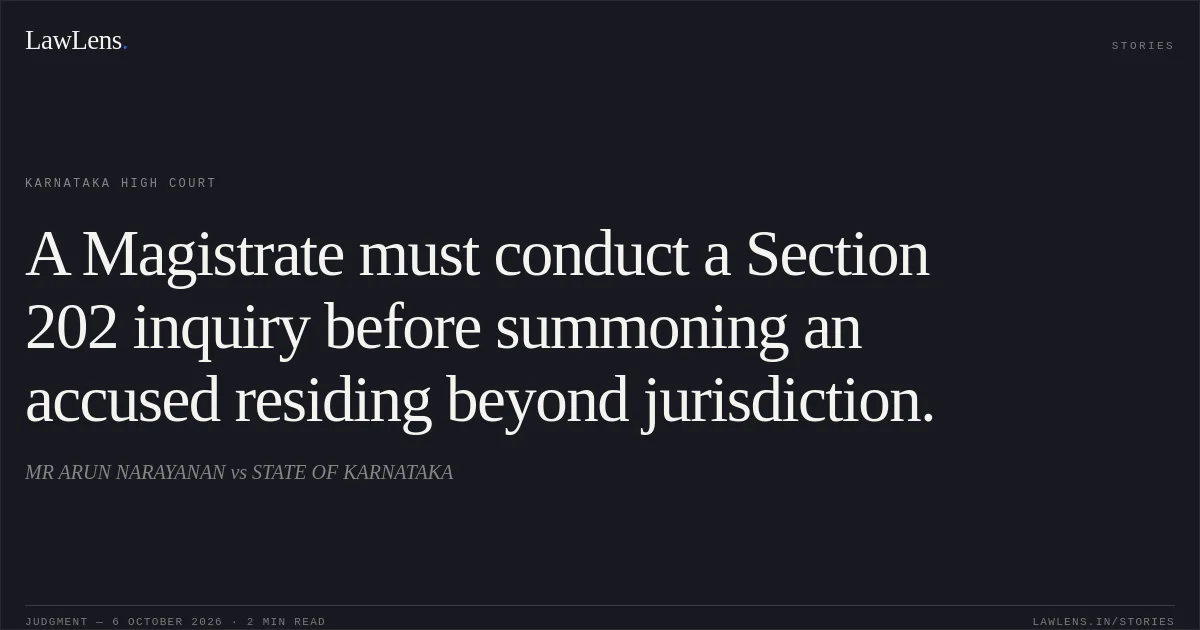
Respondents 2 and 3 initiated a private complaint against the petitioners, which resulted in C.C. No. 36572/2021, arising from P.C.R. No. 14571/2019, before the IX Additional Chief Metropolitan Magistrate, Bengaluru.
Source reference: para. 2–5The Magistrate took cognizance and summoned the petitioners by an order dated 17 December 2021.
Source reference: para. 2–5The petitioners sought to quash the complaint and order, contending, among other things, that some accused resided outside the Magistrate’s territorial jurisdiction and no inquiry under Section 202 CrPC had been held.
Source reference: para. 2–5They also argued that the dispute was civil in nature, involved an arbitration clause, and did not disclose the alleged criminal or copyright offences.
Source reference: para. 2–5Respondents’ counsel accepted that the Section 202 inquiry had not been conducted and requested remand; the other issues, they submitted, could be reconsidered by the Magistrate.
Source reference: para. 8–9Issues
1. Whether the Magistrate’s order taking cognizance and summoning the petitioners was sustainable when some accused resided outside the Magistrate’s territorial jurisdiction and no inquiry under Section 202 CrPC had been conducted.
Source reference: para. 3, 8, 112. Whether the cognizance order was legally infirm in light of the alleged deficiencies in the offences and the petitioners’ contention that the dispute was predominantly civil.
Source reference: para. 5, 12–16Law Applied
Section 202 CrPC requires the Magistrate to conduct the prescribed inquiry or investigation before issuing process where the accused resides beyond the Magistrate’s territorial jurisdiction.
Source reference: para. 11The Court relied on Sri Sathya Sai Central Trust v. State of Karnataka, ILR 2022 Karnataka 3127, observing that its principles had not been followed.
Source reference: para. 11It also referred to Parag Kishore Satoskar v. State of Jharkhand, AIR 2026 SC 3892, directing the Magistrate to consider the principles concerning criminal proceedings arising from predominantly civil transactions.
Source reference: para. 7, 16The Court further held that, in the circumstances before it, taking cognizance for offences under Sections 406 and 420 IPC was erroneous, and found the order insufficiently reasoned regarding the Copyright Act allegations.
Source reference: para. 12–14Reasoning
The admitted failure to conduct a Section 202 inquiry, despite some accused residing outside the Magistrate’s jurisdiction, rendered the process order procedurally infirm.
Source reference: para. 11–14The Court also found errors in the cognizance order concerning the alleged offences and observed that it did not explain how the complaint’s allegation about a plan submitted to the accused disclosed a Copyright Act offence.
Source reference: para. 11–14It did not finally determine the petitioners’ contention that the dispute was civil in nature; instead, it directed the Magistrate to consider that contention and the cited Supreme Court principles afresh.
Source reference: para. 15–16Holding
The petition was allowed.
The order dated 17 December 2021 in C.C. No. 36572/2021 was set aside, and the matter was remitted to the Trial Magistrate to pass fresh orders in accordance with law, taking account of the Court’s observations.
Source reference: para. 17Acts & Sections Cited
6 provisions across 2 statutes referred to in this judgment. Each provision opens on LawLens.
Code of Criminal Procedure, 19734
Indian Penal Code, 18602
Original Court PDF
MR ARUN NARAYANANvsSTATE OF KARNATAKA
Click to open original judgment
Original judgment, available to read, download and summarize on LawLens.in