Facts
The CBI registered RC No. 8/E/2002/CBI/EOW/Mumbai for offences under Sections 120-B, 420, 467, 468 and 471 of the IPC, read with Sections 13(1)(d) and 13(2) of the Prevention of Corruption Act, 1988 (“PC Act”).
Source reference: p.2, para. 4(a)Although IDBI officials and the petitioner were initially named as accused, the CBI subsequently found no material against the IDBI officials and filed a chargesheet only against the petitioner and three others for offences under Sections 420, 467, 468 and 471 of the IPC.
Source reference: p.2, para. 4(b)–(d)The chargesheet was taken cognizance of by the Additional Chief Metropolitan Magistrate, Mumbai, in Criminal Case No. 735/PW/2009.
Source reference: no citationThe petitioner’s first application under Section 239 of the Cr.P.C. for discharge was rejected on 7 March 2014, and his revision against that order was dismissed on 18 February 2019.
Source reference: p.2–3, para. 4(e)–(h)The petitioner thereafter filed a second application for discharge on 4 April 2019, marked Exhibit 132.
Source reference: p.3, para. 4(i)The Magistrate rejected that application on 31 January 2025.
Source reference: p.3, para. 4(j)The petitioner challenged the order under Article 227 of the Constitution read with Section 482 of the Cr.P.C., principally contending that, since the FIR originally included offences under the PC Act, the proceedings ought to have been entertained by the Special Court constituted under the PC Act.
Source reference: p.3–4, paras. 5–6Issues
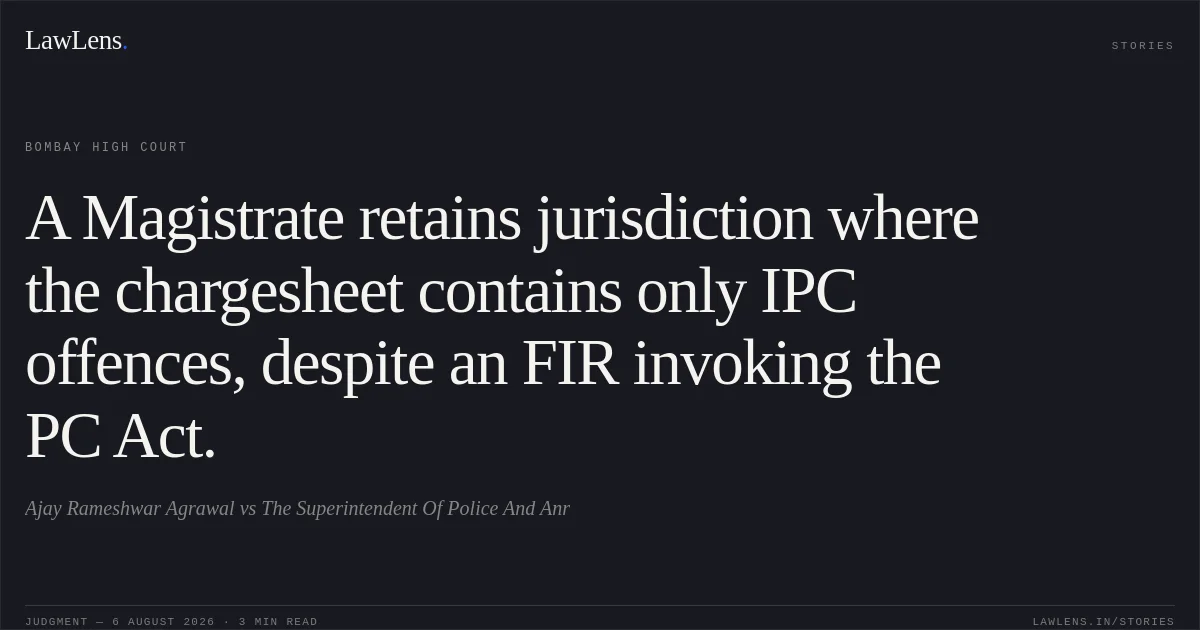
Whether the filing of an FIR initially alleging offences under the PC Act, along with IPC offences, vested jurisdiction in the Special Court under the PC Act even though the final report and chargesheet contained only IPC offences?
Source reference: p.6, paras. 9–10; p.8–9, paras. 13–16Whether the Magistrate’s rejection of the petitioner’s subsequent application for discharge under Section 239 of the Cr.P.C. disclosed perversity or otherwise warranted interference under Article 227 of the Constitution or Section 482 of the Cr.P.C.?
Source reference: p.9–10, paras. 17–19Law Applied
Section 3(1) of the PC Act empowers Special Judges to try offences punishable under the PC Act and conspiracies, attempts or abetments relating to such offences; consequently, the Special Court’s jurisdiction depends upon the existence of an offence falling within Section 3(1)(a) or (b) of the PC Act.
Source reference: p.7, para. 12Where the final report discloses only IPC offences and no offence under the PC Act, the competent Judicial Magistrate has jurisdiction to entertain and try the case.
Source reference: p.8–9, paras. 14 and 16The Court distinguished Sampat Singh v. State of Haryana, (1993) 1 SCC 561, where the FIR and cancellation report related to offences triable exclusively by the Special Court under the anti-corruption law.
Source reference: p.5–6, para. 6; p.9, para. 15The High Court’s supervisory and inherent jurisdiction under Article 227 and Section 482 of the Cr.P.C. is not to be exercised absent perversity, illegality or an abuse of process.
Source reference: p.9–10, paras. 17–19Reasoning
The Court held that the relevant jurisdictional question was determined by the offences contained in the final report and chargesheet, not merely by the offences originally mentioned in the FIR.
Source reference: p.8–9, paras. 13–16The chargesheet alleged only offences under the IPC; no offence under the PC Act remained against the petitioner, who was also not a public servant within the meaning of the PC Act.
Source reference: p.8, para. 13Therefore, the Special Court had no jurisdiction under Section 3 of the PC Act, and the Magistrate was the competent court.
Source reference: no citationThe decision in Sampat Singh was distinguishable because that case concerned a cancellation report arising from offences that could only be tried by a Special Court.
Source reference: p.9, para. 15The Court further found that Exhibit 132 did not establish a substantive case for discharge and that the petitioner had failed to demonstrate perversity in the Magistrate’s order.
Source reference: p.9–10, paras. 17–18Holding
The High Court answered the jurisdictional issue against the petitioner, holding that the Magistrate was competent to entertain and try the IPC-only charges notwithstanding the inclusion of PC Act offences in the original FIR.
It found no ground to interfere with the rejection of the discharge application and dismissed the writ petition as meritless.
Source reference: p.10, paras. 18–19Rule was discharged, with no order as to costs, and Criminal Writ Petition No. 1508 of 2025 was disposed of.
Source reference: p.10, paras. 19–21Original Court PDF
Ajay Rameshwar AgrawalvsThe Superintendent Of Police And Anr
Click to open original judgment
Original judgment, available to read, download and summarize on LawLens.in