01Facts
The petitioner claimed that he worked as a driver for the respondent company’s Managing Director from 20 July 1994, drawing a last salary of ₹4,400 per month, and that he was denied statutory employment benefits.
p. 1 · ¶ 1–3After he complained to the Labour Department on 28 May 1998, a Labour Inspector inspected the respondent’s premises on 12 June 1998. His services were allegedly terminated with effect from 31 May 1999, following which he issued a demand notice and raised an industrial dispute.
pp. 1–2 · ¶ 1–4The dispute was referred to the Labour Court on whether his termination was illegal or unjustified. The Labour Court held that he failed to establish an employer–employee relationship with the respondent and consequently denied relief.
pp. 2–3 · ¶ 5–8The petitioner challenged the award under Articles 226 and 227 of the Constitution, relying principally on an identity card issued by the Managing Director and the Labour Inspector’s record. The respondent contended that he was only the Managing Director’s personal driver and not an employee of the company.
p. 3 · ¶ 9–1002Issues
i.Whether the petitioner established an employer–employee relationship with the respondent company, or whether he was merely engaged as the personal driver of its Managing Director.
p. 3 · ¶ 7, 9–10 · pp. 4–5 · ¶ 13–14ii.Whether the petitioner’s termination was illegal or unjustified so as to entitle him to relief under the industrial-dispute reference.
p. 2 · ¶ 5–6 · p. 3 · ¶ 7–8iii.Whether the Labour Court’s findings warranted interference by the High Court in exercise of its writ jurisdiction under Articles 226 and 227 of the Constitution.
p. 4 · ¶ 1203Law Applied
The High Court applied the limited scope of judicial review under Articles 226 and 227 of the Constitution in relation to an award of a Labour Court.
p. 4 · ¶ 12Interference is justified only where the tribunal’s findings are perverse, based on no evidence or irrelevant evidence, suffer from patent illegality, or disclose a jurisdictional error; the High Court cannot re-appreciate evidence merely because another view is possible.
p. 4 · ¶ 12The Court relied on International Airport Authority of India v. International Air Cargo Workers Union, (2009) 13 SCC 374, which holds that findings of fact based on relevant material should ordinarily not be disturbed in writ jurisdiction, although findings based on no evidence or irrelevant evidence may be interfered with.
p. 4 · ¶ 12An industrial-termination claim requires the claimant first to establish the existence of an employer–employee relationship with the alleged employer.
pp. 3–5 · ¶ 7, 13–1404Reasoning
The High Court found that the Labour Court had considered the relevant evidence, including the identity card, gate pass, vehicle documents, and the circumstances surrounding the petitioner’s engagement.
p. 5 · ¶ 13Although one vehicle was owned by the company, the material showed that the petitioner drove another vehicle allotted to the Managing Director for personal use.
p. 5 · ¶ 13The fact that the Managing Director’s wife was travelling in that vehicle, that repair expenses were paid from the Managing Director’s personal funds, and that no disciplinary memorandum was issued by the company supported the conclusion that the petitioner served the Managing Director in a personal capacity.
p. 5 · ¶ 13The identity card and gate pass merely facilitated access to the company premises and did not establish employment by the company.
pp. 5–6 · ¶ 14Since the petitioner failed to prove the foundational employer–employee relationship, the question of illegal termination by the respondent did not arise.
pp. 4–6 · ¶ 12–16The Labour Court’s view was at least a plausible view based on evidence and was therefore not amenable to correction under Articles 226 and 227.
pp. 4–6 · ¶ 12–1605Holding
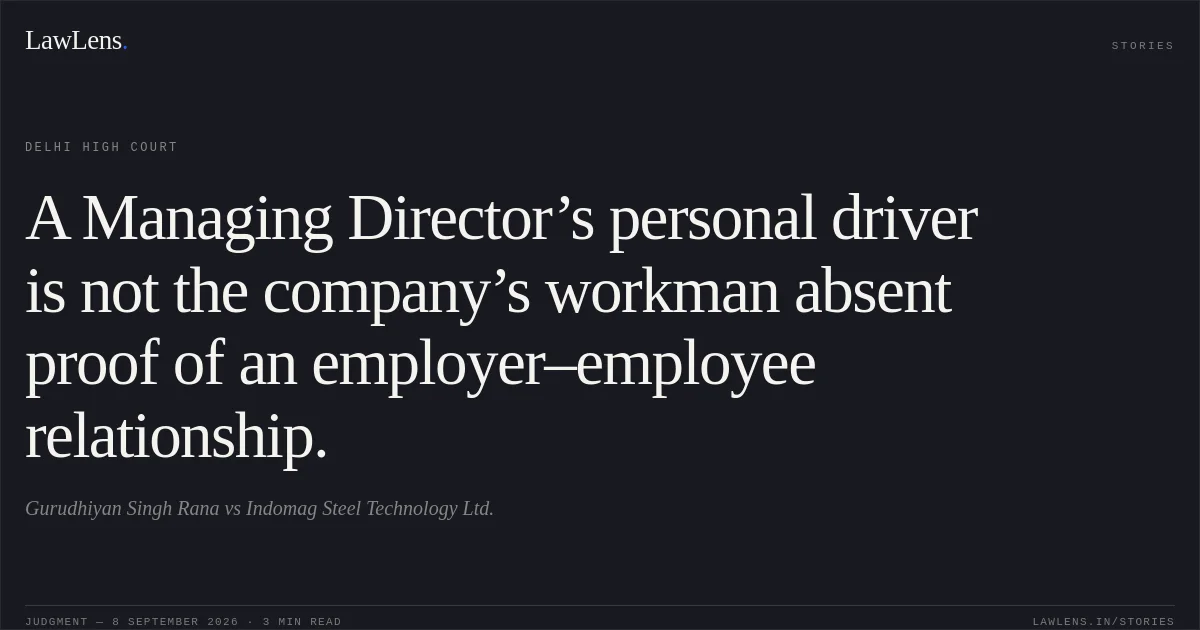
The High Court held that the petitioner was the Managing Director’s personal driver and had not established an employer–employee relationship with the respondent company.
pp. 5–6 · ¶ 15–18Consequently, the Labour Court was justified in rejecting the claim that his termination by the respondent was illegal or unjustified.
pp. 5–6 · ¶ 15–18Finding no perversity, patent illegality, jurisdictional error, or error apparent on the face of the record, the Court dismissed the writ petition and upheld the award dated 16 December 2006.
pp. 5–6 · ¶ 15–18No order as to costs was made, and pending applications were disposed of.
pp. 5–6 · ¶ 17–18Original Court PDF
Gurudhiyan Singh RanavsIndomag Steel Technology Ltd.
Click to open original judgment
Original judgment, available to read, download and summarize on LawLens.in