Facts
The plaintiff, Revamma, sued for a permanent injunction and later sought a mandatory injunction, alleging that the defendant, Rudrappa, had encroached on her portion of ancestral property by constructing a house.
Source reference: para. 3–6The defendant disputed the alleged encroachment and sought a Court Commissioner to determine the properties’ boundaries and measurements.
Source reference: para. 3–6The Trial Court rejected the Commissioner’s report as fundamentally defective but nevertheless ordered the defendant to remove the encroachment; the First Appellate Court affirmed that decree.
Source reference: para. 8–10The defendant appealed to the High Court, which admitted the appeal on a substantial question of law concerning whether a mandatory injunction was justified when the Commissioner’s report disclosed that the boundaries did not tally.
Source reference: para. 11Issues
Whether the Courts below were justified in granting a mandatory injunction when the Commissioner’s report disclosed that the boundaries did not tally.
Source reference: para. 11Whether a mandatory injunction requiring removal of an alleged encroachment could be granted without reliable evidence identifying its precise extent and location.
Source reference: para. 14, 20–22Law Applied
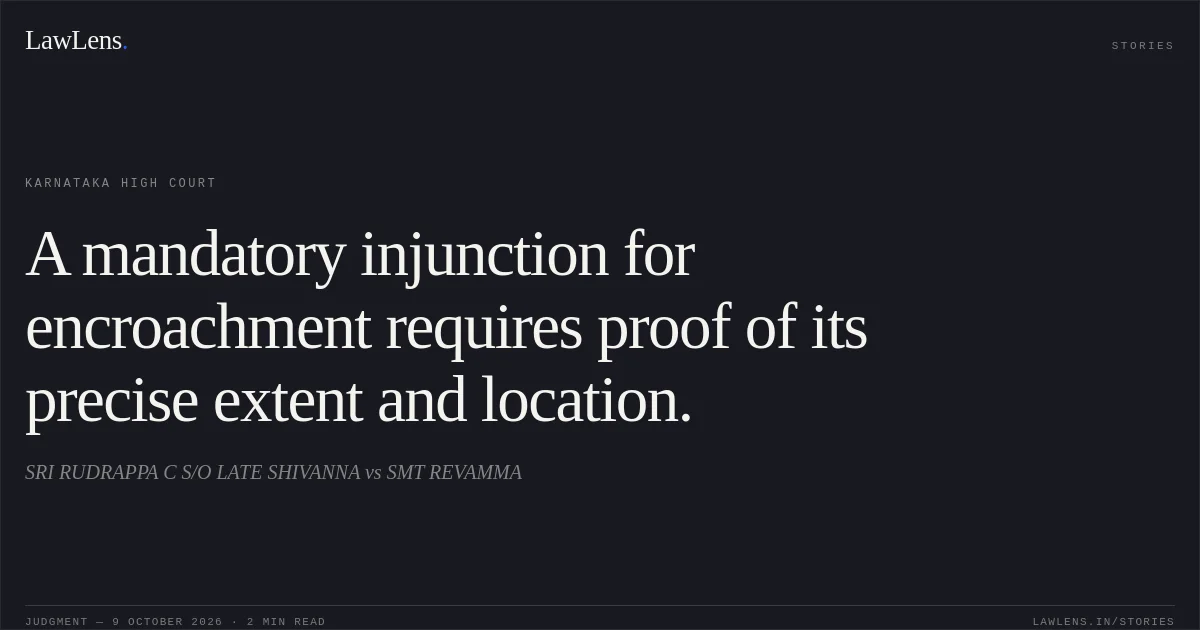
A plaintiff seeking a mandatory injunction—particularly one requiring demolition or removal of a permanent structure—must establish the alleged encroachment, including its precise extent and location, by cogent and reliable evidence.
Source reference: para. 14, 17The decree must identify the portion to be removed; otherwise, it is uncertain and incapable of effective execution.
Source reference: para. 20, 25Mandatory injunction is an exceptional and discretionary remedy, requiring a clear legal right and breach, together with irreparable injury not compensable in damages.
Source reference: para. 29The judgment cites no statute or precedent as the basis for these principles.
Source reference: no citationReasoning
The plaintiff did not produce title material sufficient to establish the precise boundaries and measurements of the parties’ respective portions.
Source reference: para. 15The Trial Court rejected the Commissioner’s report, leaving no reliable measurement of the alleged encroachment; the report, as discussed by the First Appellate Court, also failed to disclose its exact extent.
Source reference: para. 16, 19, 28The general division of the ancestral property among branches did not prove that the defendant had occupied a specific part belonging to the plaintiff.
Source reference: para. 15, 21, 24Because the decree neither quantified nor identified the portion to be removed, it lacked an adequate evidentiary foundation and could not be effectively executed.
Source reference: para. 18, 20, 25–26Holding
The High Court answered the substantial question of law in the negative and against the plaintiff, holding that the Courts below were not justified in granting a mandatory injunction without proof of the precise boundaries and extent of the alleged encroachment.
It allowed the appeal, set aside the judgments and decrees of both lower courts, and dismissed the suit.
Source reference: para. 31; Order, clauses (i)–(iii)Acts & Sections Cited
1 provisions across 1 statute referred to in this judgment. Each provision opens on LawLens.
Code of Civil Procedure, 19081
Original Court PDF
SRI RUDRAPPA C S/O LATE SHIVANNAvsSMT REVAMMA
Click to open original judgment
Original judgment, available to read, download and summarize on LawLens.in