Facts
Bimal Kumar Pradhan was appointed by NTPC in 1991 as a nominee of his maternal grandfather, Haramohan Pradhan, whose land had been acquired for the Talcher Super Thermal Power Project.
Source reference: p. 6–9After a challenge by a son of Haramohan, the High Court directed an inquiry into whether Bimal was a member of Haramohan’s family under the Odisha Land Reforms Act, 1960.
Source reference: p. 6–9Following the inquiry, NTPC found that Bimal, as the son of a married daughter, was outside the applicable definition of “family”; disciplinary proceedings followed and he was dismissed from service on 11 November 2022.
Source reference: p. 14–17The appellate authority affirmed the decision on 21 February 2023. Bimal challenged the Collector’s 2009 communication in W.P.(C) No. 189 of 2010 and the appellate order in W.P.(C) No. 18805 of 2022
Source reference: p. 18–19Issues
1. Whether a maternal grandson, nominated by a land loser through his married daughter, qualified as a member of the land loser’s “family” for employment under NTPC’s Rehabilitation and Resettlement Plan
Source reference: p. 38–40, 49–522. Whether the High Court should interfere under Articles 226 and 227 with the appellate order confirming dismissal, where the petitioner principally challenged that order without separately seeking to quash the inquiry report and disciplinary authority’s order
Source reference: p. 56–57, 67–68Law Applied
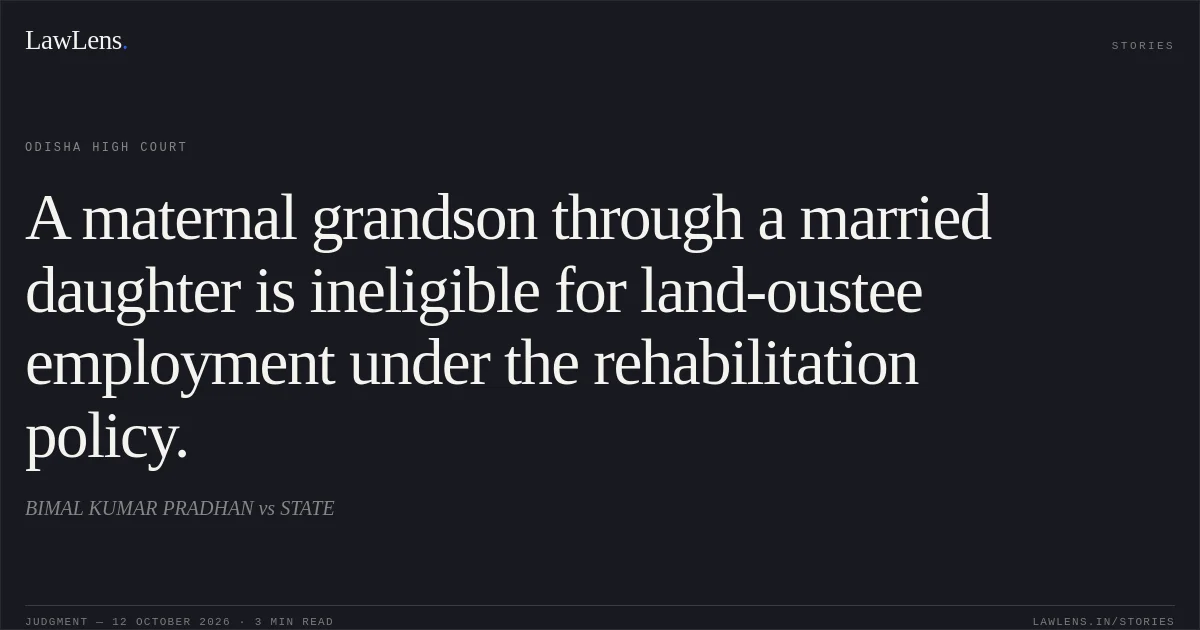
Paragraph 7(c) of NTPC’s Revised Rehabilitation Plan defined “family” as the affected person, their spouse, unmarried sons and unmarried daughters; the Court read that definition with the definition of “family” in Section 37(b) of the Odisha Land Reforms Act, 1960, and held that a married daughter—and consequently her son—was not included in the land loser’s family for this purpose
Source reference: p. 39–40, 49–50, 57In State of Odisha v. K. Srinivasa Rao, (2001) 4 SCC 743, the Supreme Court held that a married daughter forms a separate family unit and is not part of her parents’ family under the Act.
Source reference: p. 62–67Judicial review of disciplinary proceedings is supervisory, not appellate: under State of Andhra Pradesh v. S. Sree Rama Rao, AIR 1963 SC 1723, and Union of India v. P. Gunasekaran, (2015) 2 SCC 610, the Court may intervene for procedural or natural-justice violations, perversity, or findings based on no evidence, but may not reappreciate evidence where some evidence supports the findings
Source reference: p. 26–30, 79–81A penalty may be reconsidered if it shocks the Court’s conscience, but ordinarily the matter is remitted to the disciplinary or appellate authority
Source reference: p. 34–35Reasoning
The Rehabilitation Plan’s express definition of “family,” read with Section 37(b) and K. Srinivasa Rao, excluded a married daughter from her parental family; Bimal, her son, therefore did not qualify for employment merely because his maternal grandfather nominated him
Source reference: p. 49–52, 63–67The genuineness of the grandfather’s affidavit did not cure the ineligibility created by the Plan’s definition
Source reference: p. 40–43, 49–50The Court also found that Bimal had participated in the inquiry and had adequate opportunity to respond, and identified no procedural infirmity or other ground warranting judicial intervention.
Source reference: p. 82–85Further, the disciplinary authority’s order and inquiry findings had not themselves been challenged, although the appellate order affirmed them.
Source reference: p. 56–57, 67–68Holding
The Court held that Bimal was not a member of Haramohan’s family for purposes of employment under the Rehabilitation and Resettlement Plan and found no basis to interfere with the appellate decision under Articles 226 and 227.
Both writ petitions were dismissed, interim orders were vacated, pending interlocutory applications were disposed of, and no order as to costs was made
Source reference: p. 84–85Acts & Sections Cited
7 provisions across 3 statutes referred to in this judgment. Linked provisions open on LawLens.
Orissa Land Reforms Act, 19604
Land Acquisition Act, 18942
Indian Evidence Act, 18721
Original Court PDF
BIMAL KUMAR PRADHANvsSTATE
Click to open original judgment
Original judgment, available to read, download and summarize on LawLens.in