Facts
The wife appealed the Family Court’s decree granting the husband a divorce on the ground of cruelty under Section 13(1)(ia) of the Hindu Marriage Act, 1955.
Source reference: pp. 2–4In a connected appeal, she challenged dismissal of her petition for restitution of conjugal rights under Section 9 of that Act.
Source reference: pp. 2–4During the appeals, the parties reached a settlement and filed a joint memo.
Source reference: pp. 4–7The husband paid the wife ₹20,00,000 by demand draft in court.
Source reference: pp. 4–7The settlement also provided for the child’s permanent custody with the mother and visitation for the father, and contemplated resolution of other matrimonial proceedings.
Source reference: pp. 4–7Issues
1. Whether the appeals should be disposed of in accordance with the parties’ settlement, including by setting aside the Family Court’s decrees.
Source reference: pp. 4, 72. Whether the marriage should be dissolved by mutual consent and the agreed arrangements recorded.
Source reference: pp. 6–7Law Applied
The appeals were brought under Section 19(1) of the Family Courts Act, 1984; the underlying Family Court proceedings concerned Sections 13(1)(ia) and 9 of the Hindu Marriage Act, 1955.
Source reference: pp. 2–3Its stated basis for disposing of them was the parties’ amicable settlement, confirmed voluntarily in court, and the court’s acceptance of the joint memo.
Source reference: pp. 4, 7Reasoning
The parties appeared before the Court and confirmed that they had read and understood the settlement and entered it freely.
Source reference: pp. 6–7The Court also recorded that the husband had handed over the agreed ₹20,00,000 demand draft to the wife during the proceedings.
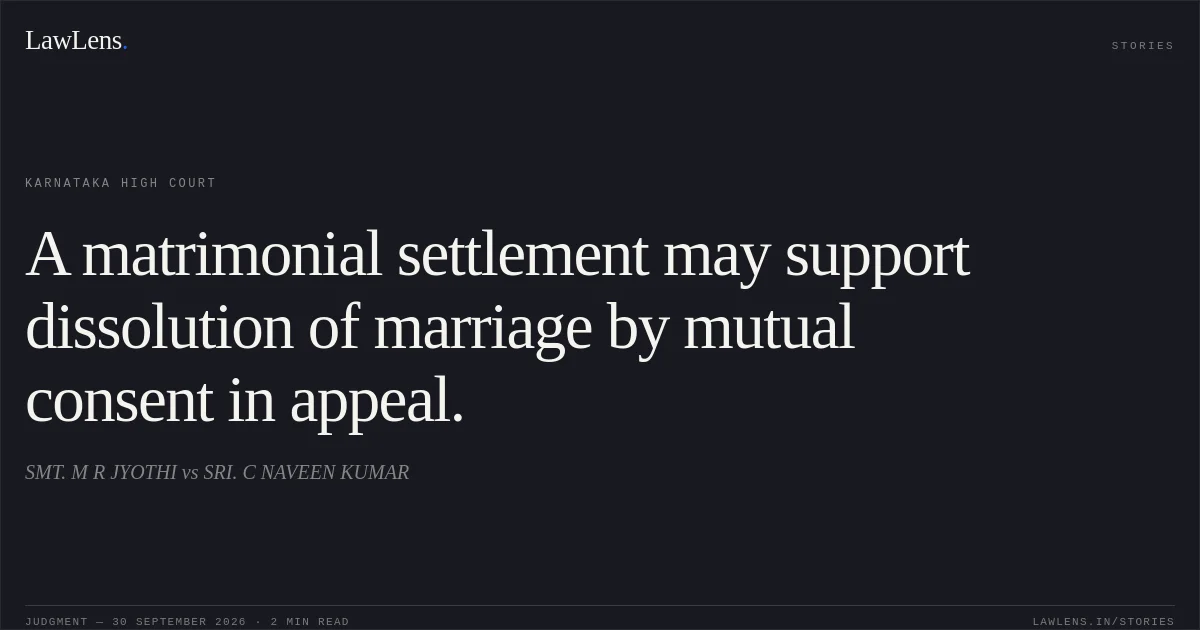
Source reference: pp. 6–7In light of the settlement, which addressed the parties’ financial claims and the child’s custody and visitation, the Court set aside the Family Court’s judgment and decree and dissolved the marriage by mutual consent.
Source reference: p. 7The settlement contemplated steps to end other proceedings in accordance with law; the order does not itself dispose of those separately pending cases.
Source reference: pp. 5–7Holding
The Court disposed of both appeals, set aside the Family Court’s judgment and decree in the connected proceedings, and dissolved the marriage by mutual consent.
It directed the Registry to draw the decree accordingly and disposed of any pending interlocutory applications.
Source reference: p. 7Acts & Sections Cited
3 provisions across 2 statutes referred to in this judgment. Each provision opens on LawLens.
Family Courts Act, 19841
Hindu Marriage Act, 19552
Original Court PDF
SMT. M R JYOTHIvsSRI. C NAVEEN KUMAR
Click to open original judgment
Original judgment, available to read, download and summarize on LawLens.in