Facts
The prosecutrix and respondent No. 2 were university alumni, became friends through a common assignment, and later worked together on a start-up project.
Source reference: no citationShe alleged that respondent No. 2 promised to marry her and, on that representation, forcibly established sexual relations with her at Hotel Royal-In, Gwalior, on 30.04.2022, and subsequently at Hotel Stay Bell, Indore, on 13.05.2022 and 15.05.2022.
Source reference: para. 3She further alleged that respondent No. 2 later refused marriage, threatened her, and asked her to commit suicide.
Source reference: para. 3An FIR was registered under Sections 376(2)(n) and 506 Part II of the IPC, followed by investigation, filing of the charge-sheet, and trial.
Source reference: para. 4The Trial Court acquitted respondent No. 2 on both charges on 14.02.2026. The prosecutrix challenged the acquittal under Section 413 of the BNSS.
Source reference: para. 1Issues
Whether the prosecutrix’s consent to the sexual relationship was vitiated by a misconception of fact under Section 90 of the IPC because it was allegedly obtained on a false promise of marriage?
Source reference: paras. 8–10, 15Whether the evidence, including the prosecutrix’s testimony, the evidence of her father and other witnesses, and the forensic/DNA evidence, was sufficient to establish the offences under Sections 376(2)(n) and 506 Part II of the IPC?
Source reference: paras. 11–15Whether the Trial Court’s acquittal was perverse or otherwise liable to be interfered with in an appeal against acquittal?
Source reference: paras. 7, 13–14Law Applied
The Court considered Section 90 of the IPC, under which consent given under fear of injury or under a misconception of fact is not legally valid, and Sections 376(2)(n) and 506 Part II of the IPC.
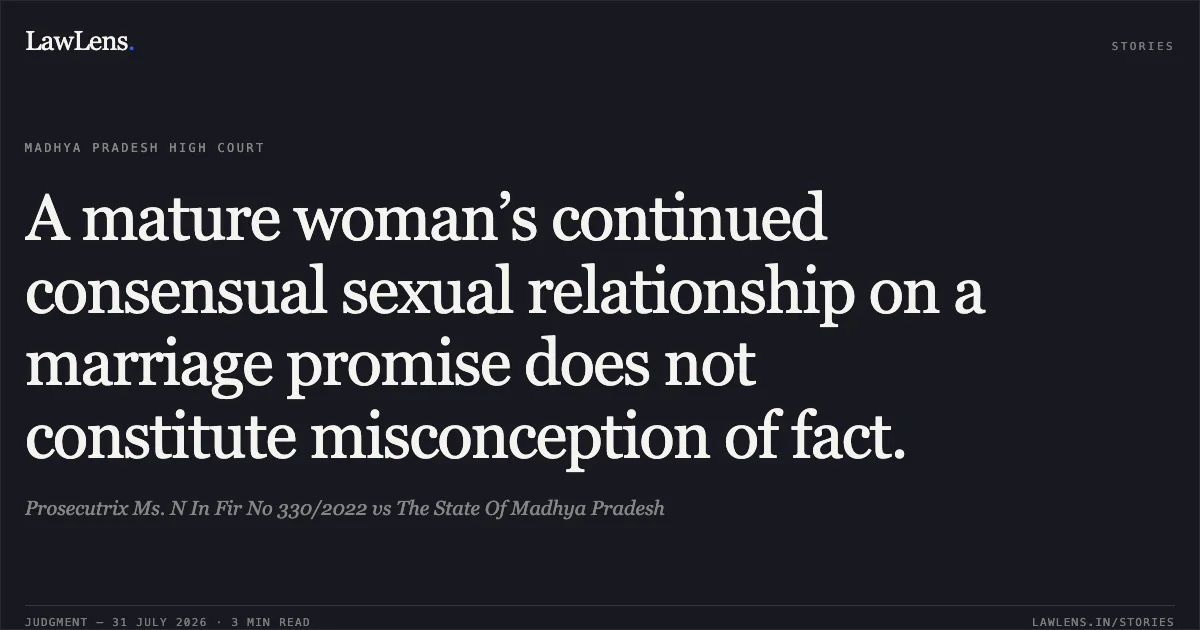
Source reference: paras. 1, 10Relying on Manishwar Tigga v. State of Jharkhand, AIR 2020 SC 4535, and Uday v. State of Karnataka, (2003) 4 SCC 46, the Court held that a promise to marry vitiates consent only where it was a fraudulent representation made without intention to fulfil it from the inception; a conscious and informed relationship maintained over time does not automatically constitute consent under misconception.
Source reference: para. 10For appeals against acquittal, the Court applied Chandrappa v. State of Karnataka, (2007) 4 SCC 189, and K. Gopal Reddy v. State of Andhra Pradesh, (1979) 1 SCC 355, concerning appellate restraint where two views are reasonably possible.
Source reference: para. 13It also relied on Ajmer Singh v. State of Punjab, AIR 1953 SC 76, for the principle that acquittal strengthens the accused’s presumption of innocence and may be reversed only for substantial and compelling reasons.
Source reference: para. 14Reasoning
The Court found material inconsistencies between the FIR and the prosecutrix’s testimony. Although the FIR stated that she had initially rejected respondent No. 2’s marriage proposal, her evidence suggested that she had agreed to marry him and informed her family well before the alleged incidents.
Source reference: para. 8The Court considered her conduct in staying overnight with respondent No. 2 at a hotel in Gwalior, her alleged failure to resist the subsequent sexual relations, and her continued friendly conduct inconsistent with the claim of forcible intercourse.
Source reference: para. 9The father’s evidence regarding respondent No. 2’s alleged visits and evasive conduct was treated as an improvement over his police statement.
Source reference: para. 11The Court also relied on the DNA evidence: the prosecutrix’s undergarment contained the same male DNA profile as respondent No. 2’s blood sample, and the Court considered the forensic result inconsistent with the asserted date of the last incident, inferring that the parties continued their physical relationship thereafter.
Source reference: para. 12In light of these circumstances, the Court held that the relationship was consensual and that the consent was not based on a legally relevant misconception of fact.
Source reference: paras. 13, 15It further held that the prosecution had failed to establish the charges beyond reasonable doubt and that there were no substantial or compelling grounds to disturb the acquittal.
Source reference: paras. 13–14Holding
The Court answered the principal issues against the prosecutrix. It held that her consent was not vitiated under Section 90 of the IPC, that the prosecution evidence did not establish the offences under Sections 376(2)(n) and 506 Part II of the IPC, and that the Trial Court’s acquittal did not warrant appellate interference.
The appeal was found meritless and was dismissed in limine at the admission stage. The judgment of acquittal dated 14.02.2026 was upheld, and the original record was directed to be returned to the Trial Court for information and compliance.
Source reference: paras. 16–18Acts & Sections Cited
6 provisions across 3 statutes referred to in this judgment. Each provision opens on LawLens.
Bharatiya Nagarik Suraksha Sanhita, 20231
Indian Penal Code, 18604
Code of Criminal Procedure, 19731
Original Court PDF
Prosecutrix Ms. N In Fir No 330/2022vsThe State Of Madhya Pradesh
Click to open original judgment
Original judgment, available to read, download and summarize on LawLens.in


![Subsequent exoneration does not retrospectively invalidate a finalized promotion select list.. UNNIKRISHNAN M vs M/o Environment And Forests. CAT - ['Ernakulam']. LawLens](/stories/thumbnails/subsequent-exoneration-does-not-retrospectively-invalidate-a-finalized-promotion-select-li-ce80a0e84f2f4887857271e8b4341c42.webp)