Facts
The applicant, Nirmala Devi, was the mother-in-law of Pratibha Yadav @ Pooja, who married the applicant’s son on 4 May 2021. The deceased was allegedly subjected to dowry-related harassment and cruelty by her husband and in-laws. She left the matrimonial home on 22 June 2024 but returned on 25 January 2025 after assurances from the matrimonial family.
Source reference: paras. 3, 8–9; pp. 2–5On 15 February 2025, she allegedly informed her mother that the applicant and her sister-in-law had physically assaulted her. She was found unconscious at the matrimonial home during the night of 18/19 February 2025, treated first at Lakshmi Hospital and thereafter at Ujala Cygnus Rainbow Hospital, Agra, and died on 25 February 2025.
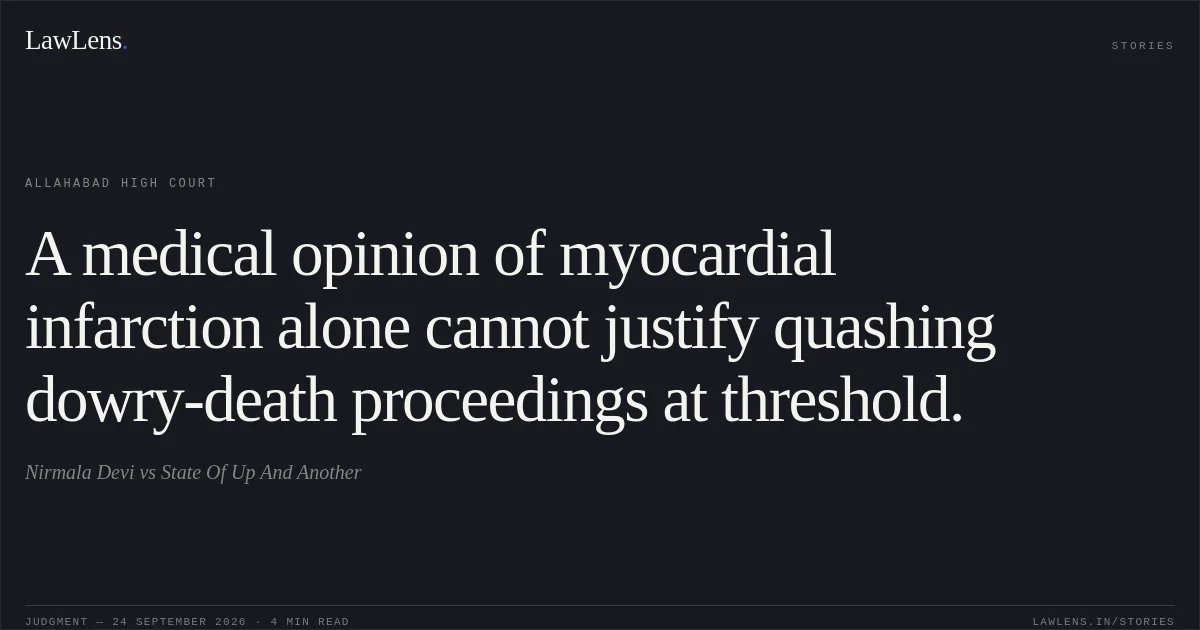
Source reference: paras. 3, 8–9; pp. 2–5The post-mortem attributed the cause of death to shock resulting from myocardial infarction, while the hospital record referred to fever, seizures and possible meningitis.
Source reference: paras. 4–5; pp. 2–3The informant lodged a Zero FIR alleging offences under Sections 80(2), 85, 61 and 115(2) of the Bharatiya Nyaya Sanhita, 2023 (“BNS”) and Sections 3/4 of the Dowry Prohibition Act. The FIR was subsequently transferred and registered as Case Crime No. 109 of 2025 at Police Station Tundla, District Firozabad. After investigation, the police filed a charge-sheet dated 10 September 2025, and the Magistrate took cognizance and summoned the applicant on 3 January 2026.
Source reference: paras. 2–3; pp. 1–2The applicant invoked Section 528 of the Bharatiya Nagarik Suraksha Sanhita, 2023 (“BNSS”), seeking quashing of the charge-sheet, summoning order and consequential criminal proceedings, principally on the ground that the deceased had died from natural medical causes and that the ingredients of dowry death were absent.
Source reference: paras. 4–7; pp. 2–4Issues
1. Whether the allegations and material collected during investigation prima facie disclosed the offences under Sections 85, 61 and 115(2) of the BNS and Sections 3/4 of the Dowry Prohibition Act against the applicant.
Source reference: paras. 14–18; pp. 9–102. Whether the deceased’s death from myocardial infarction, in the absence of an apparent external injury or poisoning, excluded the essential ingredient of death “otherwise than under normal circumstances” under Section 80 of the BNS.
Source reference: paras. 6, 19–22; pp. 3–4, 10–123. Whether the High Court, while exercising inherent jurisdiction under Section 528 BNSS, could determine the disputed medical and factual issues or was required to leave them for trial.
Source reference: paras. 12–13, 20–22; pp. 8–12Law Applied
The Court applied Section 528 BNSS, which confers extraordinary inherent jurisdiction to prevent abuse of process and secure the ends of justice, but requires that such power be exercised sparingly and without conducting a mini-trial.
Source reference: paras. 12–13; pp. 8–9Section 80 BNS defines dowry death where a woman dies within seven years of marriage from burns, bodily injury or otherwise than under normal circumstances and was subjected soon before death to dowry-related cruelty or harassment; Section 85 BNS criminalises cruelty by the husband or his relative, while Section 86 BNS defines cruelty to include grave wilful conduct or harassment connected with an unlawful demand for property or valuable security.
Source reference: para. 14; p. 9The Court further referred to the statutory presumption under Section 118 of the Bharatiya Sakshya Adhiniyam, 2023, once the foundational facts of dowry death are prima facie established.
Source reference: para. 21; p. 11It relied on Babu Bhai v. State of Gujarat, (2010) 12 SCC 254, for the requirement of fair and impartial investigation; State of Gujarat v. Afroz Mohammad Hasanfatta, (2019) 20 SCC 359, for the principle that at the summoning stage the court need only find sufficient ground to proceed and need not assess evidentiary sufficiency; Haji Iqbal v. State of U.P., (2023) 20 SCC 209, regarding careful scrutiny of allegedly frivolous proceedings; and Kans Raj v. State of Punjab, (2000) 5 SCC 207, for the proposition that “otherwise than under normal circumstances” is not confined to visible physical injuries or poisoning.
Source reference: paras. 7, 10, 20; pp. 5–7, 10–11Reasoning
The Court found that the allegations against the applicant were specific and were supported by statements recorded during investigation, including allegations of dowry demands, continuing harassment and physical assault shortly before the deceased became unconscious. These allegations, if accepted at the prima facie stage, satisfied the statutory concept of cruelty under Sections 85 and 86 BNS and could not be rejected merely because the applicant was the deceased’s mother-in-law.
Source reference: paras. 15–18; pp. 9–10The deceased had died within four years of the marriage, and the prosecution material alleged dowry-related cruelty soon before her death, thereby prima facie satisfying the foundational requirements of Section 80 BNS.
Source reference: paras. 19, 22; pp. 10–12The Court held that the post-mortem finding of myocardial infarction was not, by itself, conclusive at the quashing stage. Whether the medical condition was purely natural or was induced or precipitated by physical or mental cruelty required examination of treating doctors, medical experts, toxicological and other evidence, together with testimony concerning the proximity of the alleged harassment.
Source reference: paras. 20–22; pp. 10–12Since these matters involved disputed questions of fact and evaluation of evidence, the High Court declined to assess the defence version or conduct a premature trial under Section 528 BNSS.
Source reference: paras. 12–13, 21–22; pp. 8–12Holding
The High Court held that the prosecution material prima facie disclosed offences under Sections 80, 85, 61 and 115(2) BNS and Sections 3/4 of the Dowry Prohibition Act, and that the applicant’s defence that the deceased died solely from natural cardiac complications could not be conclusively determined in proceedings for quashing.
The application under Section 528 BNSS was accordingly dismissed, and the prayer to quash the charge-sheet dated 10 September 2025, the cognizance/summoning order dated 3 January 2026 and the criminal proceedings in Case No. 159 of 2026 was refused.
Source reference: para. 23; p. 12Acts & Sections Cited
12 provisions across 5 statutes referred to in this judgment. Each provision opens on LawLens.
Bharatiya Nagarik Suraksha Sanhita, 20231
Bharatiya Nyaya Sanhita, 20235
Code of Criminal Procedure, 19732
Bharatiya Sakshya Adhiniyam, 20231
Original Court PDF
Nirmala DevivsState Of Up And Another
Click to open original judgment
Original judgment, available to read, download and summarize on LawLens.in