01Facts
The petitioner, an Assistant Teacher, was issued a show-cause notice dated 1 June 2016 alleging misconduct in connection with duties assigned under the “School Chalen Hum–2016” campaign.
p. 2She submitted a detailed reply denying the allegations.
p. 2Without conducting a regular departmental inquiry, the disciplinary authority passed order dated 19 August 2016 imposing the minor penalty of withholding one increment without cumulative effect.
p. 2The petitioner initially challenged orders dated 19 August 2016 and 17 January 2017, but confined her relief to quashing the punishment order.
p. 2The State opposed the petition on the ground that the petitioner had an alternative appellate remedy under the Madhya Pradesh Civil Services (Classification, Control and Appeal) Rules, 1966.
p. 202Issues
i.Whether the disciplinary authority could impose the penalty of withholding one increment without cumulative effect, without conducting a regular departmental inquiry, when the petitioner denied the factual allegations.
pp. 8–10 · ¶ 12–14ii.Whether the impugned punishment order was liable to be quashed for being non-speaking, unreasoned, and passed without considering the petitioner’s reply.
pp. 2, 8, 10–13 · ¶ 5, 10, 15–19iii.Whether the existence of an alternative statutory appellate remedy barred the petitioner from invoking the writ jurisdiction under Article 226 in the circumstances of the case.
p. 2 · ¶ 3–603Law Applied
The Court applied Rule 16(1)(b) of the Madhya Pradesh Civil Services (Classification, Control and Appeal) Rules, 1966, requiring appropriate inquiry procedure where factual allegations are disputed.
p. 10 · ¶ 14Relying on O.K. Bhardwaj v. Union of India, (2001) 9 SCC 180, the Court held that even for a minor penalty, where factual charges are denied, an inquiry is ordinarily required as a minimum requirement of natural justice.
p. 9 · ¶ 12It also relied on Food Corporation of India v. A. Prahalada Rao, (2001) 1 SCC 165, and Union of India v. C.P. Singh, 2004 (2) MPJR 252, which establish that the disciplinary authority may dispense with a regular inquiry in minor-penalty cases only for valid, recorded reasons, and that such decision is subject to judicial review for arbitrariness.
pp. 3–8 · ¶ 7–9The Court further applied the duty to give reasoned orders under State of Punjab v. Bandip Singh, (2016) 1 SCC 724, and Kranti Associates Pvt. Ltd. v. Masood Ahmed Khan, (2010) 9 SCC 496, under which administrative and quasi-judicial decisions affecting rights must be self-contained, reasoned, and demonstrably based on relevant considerations.
pp. 11–13 · ¶ 16–1904Reasoning
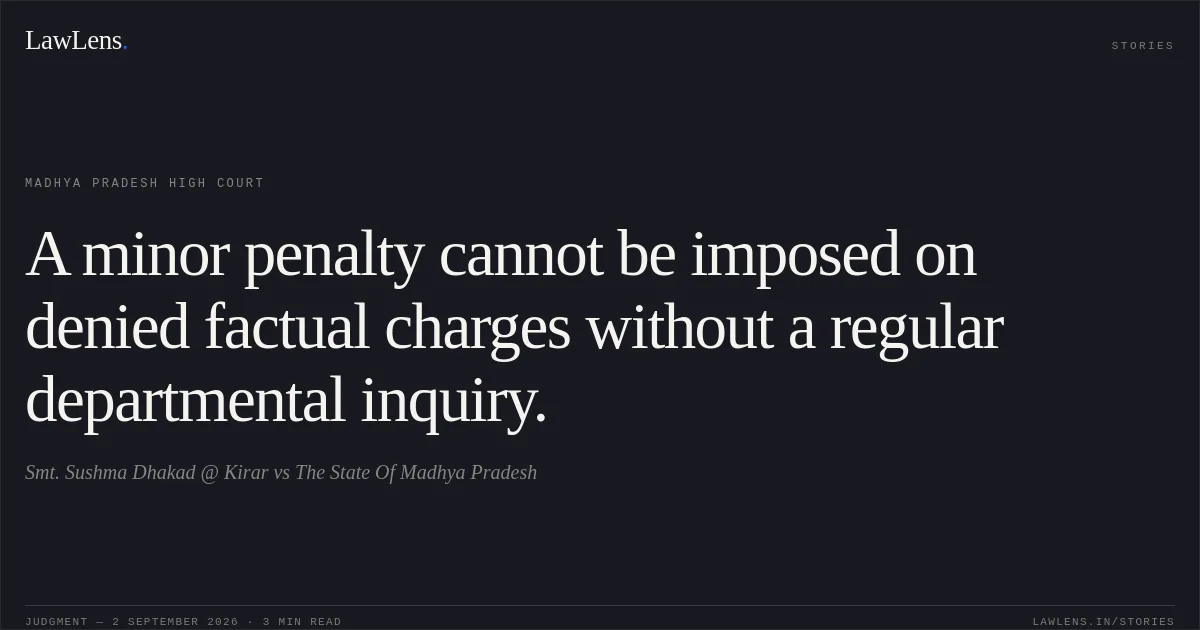
The Court found that the charges against the petitioner were factual and had been specifically denied in her reply. Consequently, the disciplinary authority was required either to conduct a regular inquiry or to record valid, objective reasons explaining why such inquiry was unnecessary.
p. 9 · ¶ 12 · p. 10 · ¶ 13–14The authority’s apparent reliance on documentary material did not, by itself, justify dispensing with the inquiry, particularly because the petitioner sought to establish factual matters concerning the alleged delay, non-cooperation, and performance of assigned duties.
p. 9 · ¶ 12 · p. 10 · ¶ 13–14The Court also held that withholding an increment could have continuing financial consequences for salary, provident-fund contributions, pension, gratuity, and other retiral benefits; therefore, the penalty could not be treated as inconsequential merely because it was classified as a minor penalty.
pp. 5–7 · ¶ 9(iv)–(v), 18–21The punishment order did not meaningfully consider the petitioner’s defence, record reasons for not holding an inquiry, or disclose a rational basis for its conclusion. It was therefore arbitrary and non-speaking.
pp. 10–13 · ¶ 15–19In view of this fundamental defect and breach of natural justice, the alternative-remedy objection did not bar writ jurisdiction.
p. 2 · ¶ 5–605Holding
The Court allowed the writ petition and quashed the impugned punishment order dated 19 August 2016 imposing withholding of one increment without cumulative effect.
p. 14 · ¶ 21The respondents were directed to grant the petitioner consequential benefits within three months from receipt of the certified copy of the judgment.
p. 14 · ¶ 21–22The respondents were, however, left at liberty to take fresh action against the petitioner in accordance with law, if so advised.
p. 14 · ¶ 21–22The petition was accordingly disposed of.
p. 14 · ¶ 21–22Original Court PDF
Smt. Sushma Dhakad @ KirarvsThe State Of Madhya Pradesh
Click to open original judgment
Original judgment, available to read, download and summarize on LawLens.in