Facts
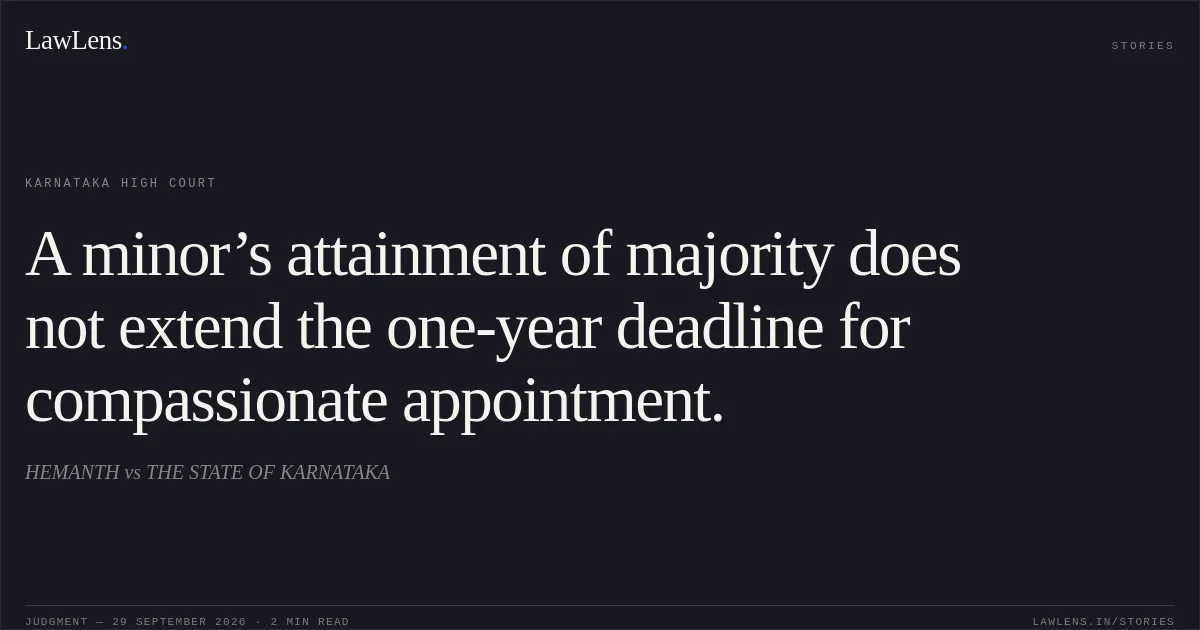
The petitioner’s father, an employee of the Kalaburagi Mahanagar Palike, died in service on 4 June 2023; his mother had died on 2 May 2022. The petitioner was a minor when his father died.
Source reference: p. 3He made a representation on 27 June 2023 seeking documents concerning service benefits and compassionate appointment, and later submitted a formal application for compassionate appointment on 24 September 2025.
Source reference: p. 3, p. 6The Palike rejected the claim by endorsement dated 7 April 2026, citing that the application was made 2 years, 3 months and 20 days after the employee’s death and that the petitioner had not attained majority.
Source reference: p. 6The petitioner sought certiorari and a direction for appointment.
Source reference: p. 2Issues
1. Whether the petitioner’s application for compassionate appointment, made more than one year after his father’s death while he was a minor, complied with Rule 5 of the Karnataka Civil Services (Appointment on Compassionate Grounds) Rules, 1996, as adopted by the Corporation.
Source reference: p. 6, p. 92. Whether the petitioner’s circumstances or a “human approach” justified relief despite non-compliance with the time and age requirements under the Rules.
Source reference: p. 3, p. 5, p. 9Law Applied
Rule 5 of the Karnataka Civil Services (Appointment on Compassionate Grounds) Rules, 1996, as amended, requires an application within one year of the government servant’s death; a minor applicant must also have attained eighteen years on the date of application.
Source reference: p. 8, p. 10In N.C. Santhosh v. State of Karnataka, (2020) 7 SCC 617, the Supreme Court held that the amended Rule 5 displaced the earlier provision allowing a minor to apply after attaining majority, and that applications contrary to the Rule are not maintainable.
Source reference: p. 9, p. 12Compassionate appointment is an exception to the ordinary equality-based recruitment process, not a right, and applicants must satisfy the governing rules.
Source reference: p. 12The Court also noted that the Division Bench had set aside the Single Judge’s order in Managing Director, North Western Karnataka State Road Transport Corporation v. Saroja, W.A. No. 100779 of 2025, dated 20 August 2026.
Source reference: p. 7Reasoning
The petitioner’s formal application was submitted beyond the one-year period prescribed by Rule 5, and he was below eighteen when he applied, as recorded in the impugned endorsement.
Source reference: p. 6Applying N.C. Santhosh, the Court held that the amended Rule did not permit a minor to defer applying until attaining majority where the one-year period from the employee’s death had expired.
Source reference: p. 9, p. 12The petitioner’s earlier representation seeking documents did not displace the formal application’s non-compliance with the Rule.
Source reference: no citationThe Court also declined to rely on the cited Saroja decision because the Division Bench had set aside the Single Judge’s order.
Source reference: p. 7The petitioner’s circumstances and appeal to a humane approach could not override the mandatory eligibility requirements.
Source reference: p. 3, p. 5, p. 9Holding
The Court held that the Corporation was justified in rejecting the petitioner’s claim because the application contravened Rule 5.
It found the writ petition devoid of merit and dismissed it.
Source reference: p. 9Original Court PDF
HEMANTHvsTHE STATE OF KARNATAKA
Click to open original judgment
Original judgment, available to read, download and summarize on LawLens.in