Facts
The victim, born on 21 February 2005 and aged approximately 17 years and 10 months at the time of the incident, met the appellant, aged 24, at a marriage ceremony in 2022. They developed a romantic relationship and the victim voluntarily stayed with the appellant in a rented house for several months.
Source reference: paras. 2–11They engaged in repeated sexual intercourse from December 2022, after which the victim became pregnant. Following a medical examination at the Primary Health Centre, Kadamtala, the victim’s statement was recorded and an FIR was registered under the POCSO Act on 22 May 2023. The appellant was charged under Sections 5(j)(ii) and 5(l), read with Section 6, of the POCSO Act. The prosecution examined 13 witnesses; the appellant did not cross-examine the victim, her mother, or several other material witnesses. The Special Court convicted the appellant on 15 April 2024 and sentenced him to ten years’ rigorous imprisonment on 16 April 2024. The appellant challenged the conviction and sentence in the present appeal.
Source reference: paras. 17–22Issues
Whether the prosecution proved beyond reasonable doubt that the appellant had committed repeated penetrative sexual assault upon the minor victim, notwithstanding the existence of a romantic relationship and the victim’s alleged consent.
Source reference: paras. 18, 24–28Whether the statutory presumption under Section 29 of the POCSO Act was attracted and, if so, whether the appellant had rebutted it.
Source reference: paras. 24–27Whether inconsistencies concerning the FIR, the victim’s statements, the delay in registration, and the manner of recording the initial statement rendered the prosecution case unreliable.
Source reference: para. 12; paras. 19–23Whether the “Romeo–Juliet clause” or the victim’s subsequent marriage justified interference with the conviction or sentence.
Source reference: paras. 30–34Law Applied
The Court applied Sections 5(j)(ii) and 5(l), read with Section 6, of the Protection of Children from Sexual Offences Act, 2012, concerning aggravated penetrative sexual assault and its punishment.
Source reference: paras. 2, 27Under Section 29 of the POCSO Act, once the foundational facts of an offence under Section 5 are established, the Court presumes that the accused committed the offence unless the contrary is proved.
Source reference: paras. 24–27Section 30 permits a presumption regarding the requisite culpable mental state, subject to rebuttal by the accused.
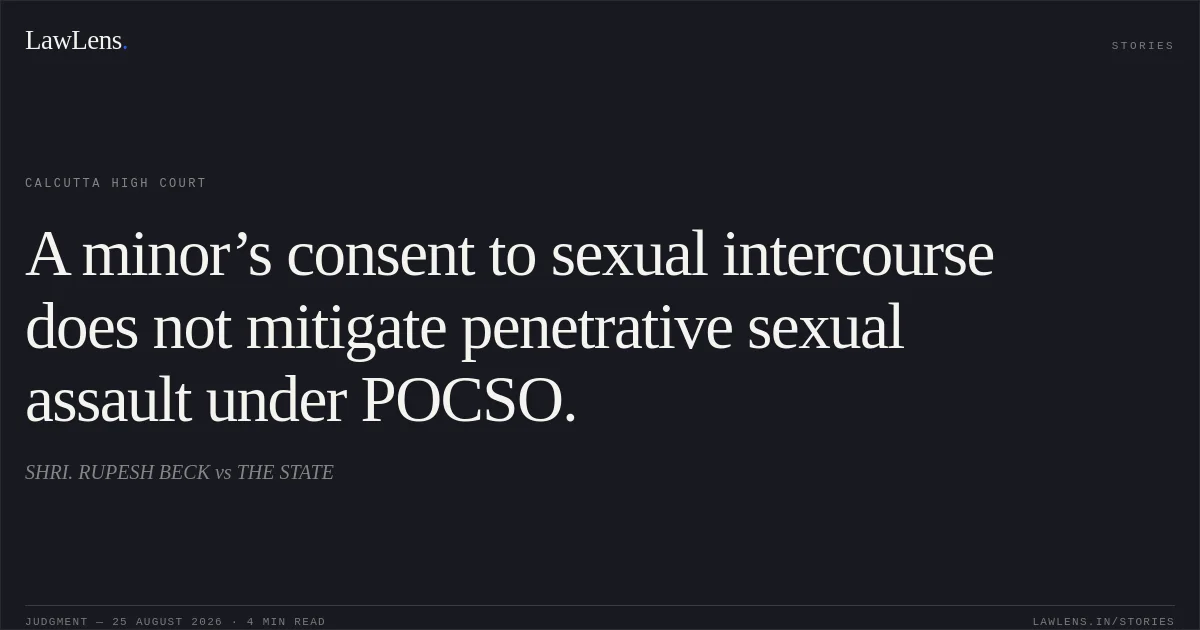
Source reference: para. 24The Court reiterated that a minor’s consent to sexual intercourse has no legal validity under the POCSO Act and cannot constitute a mitigating circumstance for the offence.
Source reference: para. 28It also considered the “Romeo–Juliet clause” discussed by the Supreme Court in State of Uttar Pradesh v. Anurudh & Anr., 2026 LiveLaw (SC) 29, and the approach adopted in Shri Roshan Lakra v. The State & Anr., CRA 4 of 2024, while noting that such considerations do not automatically exonerate an accused where the factual circumstances do not support their application.
Source reference: paras. 30, 34Reasoning
The Court found that the victim’s evidence established her cohabitation and repeated sexual relationship with the appellant, and that her pregnancy was attributable to that relationship.
Source reference: paras. 17–18, 22, 24Her testimony was not challenged in cross-examination, nor was the evidence of her mother and several other prosecution witnesses; the Court therefore treated the material evidence as effectively uncontroverted.
Source reference: paras. 19–21, 26The medical evidence corroborated the victim’s account of a continuing physical relationship with the appellant, and the appellant’s medical examination established his capacity to engage in sexual intercourse.
Source reference: para. 24These facts established the foundational basis for applying Section 29. The appellant neither adduced evidence nor otherwise rebutted the statutory presumption that he was responsible for the offence.
Source reference: paras. 24–27The Court held that the existence of a love affair and the victim’s apparent consent could not legally defeat the charge because she was below eighteen years of age.
Source reference: para. 28It further declined to apply the Romeo–Juliet principle because the victim had subsequently married another person and was living with her husband and child; pairing her with the appellant would not restore their relationship but could disrupt her existing family life.
Source reference: paras. 31–34Holding
The Court held that the victim’s minority invalidated any alleged consent, that the prosecution evidence and medical material were sufficient, and that the appellant had failed to rebut the presumption under Section 29.
The appeal was dismissed. The Court upheld the appellant’s conviction under Sections 5(j)(ii) and 5(l), read with Section 6, of the POCSO Act, and affirmed the sentence of ten years’ rigorous imprisonment imposed by the Special Court.
Source reference: paras. 29, 35–36Pending applications were disposed of, and directions were issued for transmission of the trial records and communication of the judgment to the Trial Court and the Superintendent of the correctional home.
Source reference: paras. 37–40Acts & Sections Cited
9 provisions across 2 statutes referred to in this judgment. Each provision opens on LawLens.
Protection of Children from Sexual Offences Act, 20127
Code of Criminal Procedure, 19732
Original Court PDF
SHRI. RUPESH BECKvsTHE STATE
Click to open original judgment
Original judgment, available to read, download and summarize on LawLens.in
![Courts will not interfere with transfers absent mala fides or violation of statutory rules.. M Ramya vs EMPLOYEES STATE INSURANCE CORPORATION (ESIC). CAT - ['Chennai']. LawLens](/stories/thumbnails/courts-will-not-interfere-with-transfers-absent-mala-fides-or-violation-of-statutory-rules-a6845e9ca6f548fca284c51c8351957f.webp)
![Courts cannot direct one-time recruitment age relaxation absent authority in the governing rules or advertisement.. UT OF PUDUCHERRY vs M ANDAL. CAT - ['Chennai']. LawLens](/stories/thumbnails/courts-cannot-direct-one-time-recruitment-age-relaxation-absent-authority-in-the-governing-895d78fde47143e2a8ed0207c4b6a44f.webp)
![A review cannot correct an allegedly erroneous decision absent an error apparent on the record.. Ajit Kumar Jha vs RAILWAY BOARD. CAT - ['Delhi']. LawLens](/stories/thumbnails/a-review-cannot-correct-an-allegedly-erroneous-decision-absent-an-error-apparent-on-the-re-8ac952fd4eba470c92f7da20af72a220.webp)