Facts
The respondent Trust owns a marriage hall in Nagercoil. Its property-tax assessment was enhanced in 1988, leading to civil proceedings that ultimately resulted in a decision in the Trust’s favour in second appeal.
Source reference: p.3–4In 2018, the Municipality demanded ₹27,24,318 for the period from the first half of 1989–1990 to the second half of 2017–2018. The Trust challenged only a condition requiring a notarised undertaking to pay that amount; the condition was set aside, and the Trust paid the tax.
Source reference: p.5The Municipality then issued a further assessment notice dated 8 June 2018, demanding ₹54,18,490 for substantially the same period, without enclosing the working sheet. The Trust challenged that notice in W.P.(MD) No.16446 of 2018.
Source reference: p.5–6The Single Judge allowed the petition and directed the Municipality to follow the lawful procedure for any assessment relating to the subsequent period. The Municipality appealed.
Source reference: p.5–6Issues
1. Whether the Municipality could reassess tax for a period already covered by its earlier demand and paid by the Trust
Source reference: p.5–72. Whether the availability of an alternate remedy precluded the High Court from exercising jurisdiction under Article 226 where the impugned assessment was alleged to be unlawful on its face
Source reference: p.7Law Applied
Article 226 of the Constitution permits the High Court to intervene notwithstanding an alternate remedy where the impugned order is facially invalid or unlawful.
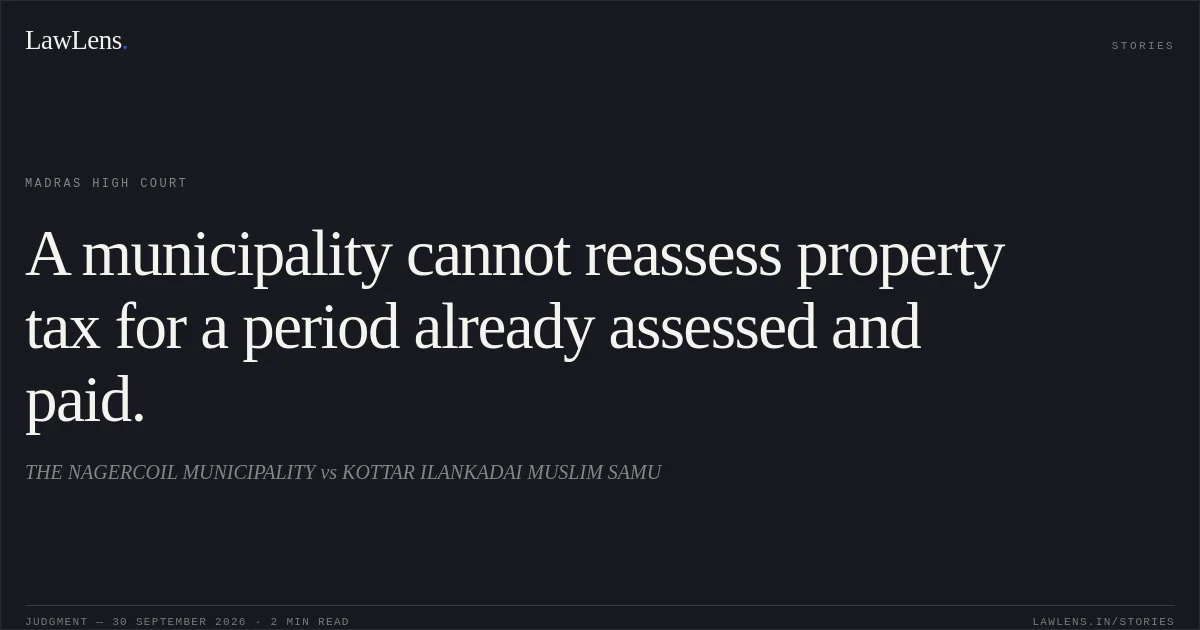
Source reference: p.7A municipality cannot issue a further assessment for a period already assessed and paid; any further revision must relate to a subsequent period and must be undertaken in accordance with law, including proper notice and an adequate opportunity to respond.
Source reference: p.6–7The judgment also recounts the earlier second appeal concerning the 1988 assessment, which addressed the procedural requirements under the Taxation and Finance Rules framed under the Tamil Nadu District Municipalities Act and the method of calculating property tax, but those issues were not the basis of the present appeal’s decision.
Source reference: p.3–4Reasoning
The Court found that the earlier demand covered the period from the first half of 1989–1990 through the second half of 2017–2018 and had been paid. The subsequent notice nevertheless reassessed substantially that same period and increased the demand to ₹54,18,490 without providing the working sheet.
Source reference: p.5–7The Municipality could not reopen the assessment for that period through the impugned notice; any further assessment had to concern the period beginning with the first half of 2018–2019 and follow the prescribed procedure.
Source reference: p.5–7Because the challenge concerned an unlawful reassessment for an already assessed period—not merely a dispute over the correctness of an assessment—the Court held that the alternate-remedy objection did not bar writ jurisdiction.
Source reference: p.7Holding
The Court dismissed the writ appeal, finding no merit in the Municipality’s challenge to the Single Judge’s order.
It affirmed that any assessment for the subsequent period must be made in accordance with law; there was no order as to costs, and the connected miscellaneous petition was closed.
Source reference: p.7–8Acts & Sections Cited
1 provisions across 1 statute referred to in this judgment. Linked provisions open on LawLens.
Tamil Nadu District Municipalities Act, 19201
Original Court PDF
THE NAGERCOIL MUNICIPALITYvsKOTTAR ILANKADAI MUSLIM SAMU
Click to open original judgment
Original judgment, available to read, download and summarize on LawLens.in
![Termination founded on impersonation is punitive and requires an inquiry and an opportunity to respond.. SUNIL KUMAR vs COMPTROLLER AND AUDITOR-GENERAL OF INDIA. CAT - ['Chandigarh']. LawLens](/stories/thumbnails/termination-founded-on-impersonation-is-punitive-and-requires-an-inquiry-and-an-opportunit-273dc59ea6dc43d39c6e48275fd09246.webp)
![Tribunal upholds removal of Chandigarh teachers named as beneficiaries in recruitment paper-leak probe, despite their not being charge-sheeted in the case. Sonia vs Education Deptt., Ut Chandigarh. CAT - ['Chandigarh']. LawLens](/stories/thumbnails/tribunal-upholds-removal-of-chandigarh-teachers-named-as-beneficiaries-in-recruitment-pape-3f061884a7cc4bab9996e2cb58c5b0db.webp)
![A decades-late challenge to alternative absorption and pay fixation is barred by limitation.. PRANAB KUMAR GHOSH vs EAST CENTRAL RAILWAY. CAT - ['Kolkata']. LawLens](/stories/thumbnails/a-decades-late-challenge-to-alternative-absorption-and-pay-fixation-is-barred-by-limitatio-4687b7e84bf84893a401e61b221dcaa7.webp)