Facts
On 24 April 2021, Nidhi alias Hansi was fatally injured by a cut to her neck at her home.
Source reference: para. 1–3, 5–13Haider was apprehended at the scene; Rehan and another person allegedly fled.
Source reference: para. 1–3, 5–13The Sessions Court convicted Haider under Section 302 IPC and sentenced him to death, and convicted Rehan under Section 302 read with Section 34 IPC and sentenced him to life imprisonment.
Source reference: para. 1–3, 5–13Haider appealed, Rehan appealed, and the High Court considered the statutory reference for confirmation of Haider’s death sentence.
Source reference: para. 1–3, 5–13The prosecution relied principally on eyewitness testimony, evidence that Haider was apprehended at the scene, and the deceased’s immediate identification of him.
Source reference: para. 29–37, 61–65Issues
1. Whether the prosecution proved beyond reasonable doubt that Haider committed the murder of Nidhi
Source reference: para. 57–882. Whether the evidence established Rehan’s participation in the offence or common intention under Section 34 IPC
Source reference: para. 50–563. Whether Haider’s case met the standard for imposing the death penalty, or whether the sentence should be reduced to life imprisonment
Source reference: para. 89–96Law Applied
The Court applied Sections 302 and 34 of the Indian Penal Code, governing murder and joint liability, respectively.
Source reference: para. 9, 54It considered the admissibility of electronic evidence under Section 65-B of the Indian Evidence Act, 1872, and held that the police-recorded confessional statements could not be read in evidence.
Source reference: para. 9, 54For capital sentencing, the Court applied the principles in Bachan Singh v. State of Punjab, which makes life imprisonment the rule and death the exception, permissible only in the rarest of rare cases when the alternative is unquestionably foreclosed; Machhi Singh v. State of Punjab, which requires assessment of the crime and offender and a balance of aggravating and mitigating circumstances; and Ramnaresh v. State of Chhattisgarh, which elaborates those circumstances.
Source reference: para. 91–94Reasoning
The Court found PW 2 Dheeraj’s account of seeing Haider enter the house and then assault the deceased reliable, and considered it corroborated by PW 3 Yogendra Singh, the immediate identification of Haider by the deceased, and evidence that Haider was apprehended at the scene.
Source reference: para. 29–30, 61–65, 74–88It did not rely on the later alleged dying declaration during the journey to Saharanpur, given evidence that the deceased was then unconscious.
Source reference: para. 65The Court treated the DVR recovery memo’s recorded description as corroborative, while declining to rely on unproved footage contents.
Source reference: para. 59, 62As to Rehan, the eyewitnesses did not identify him as an assailant; the alleged declarations implicating him were unreliable in light of the deceased’s reported unconsciousness, and Haider’s police-recorded confessions were inadmissible.
Source reference: para. 51–56The Court therefore found insufficient evidence to sustain Rehan’s conviction.
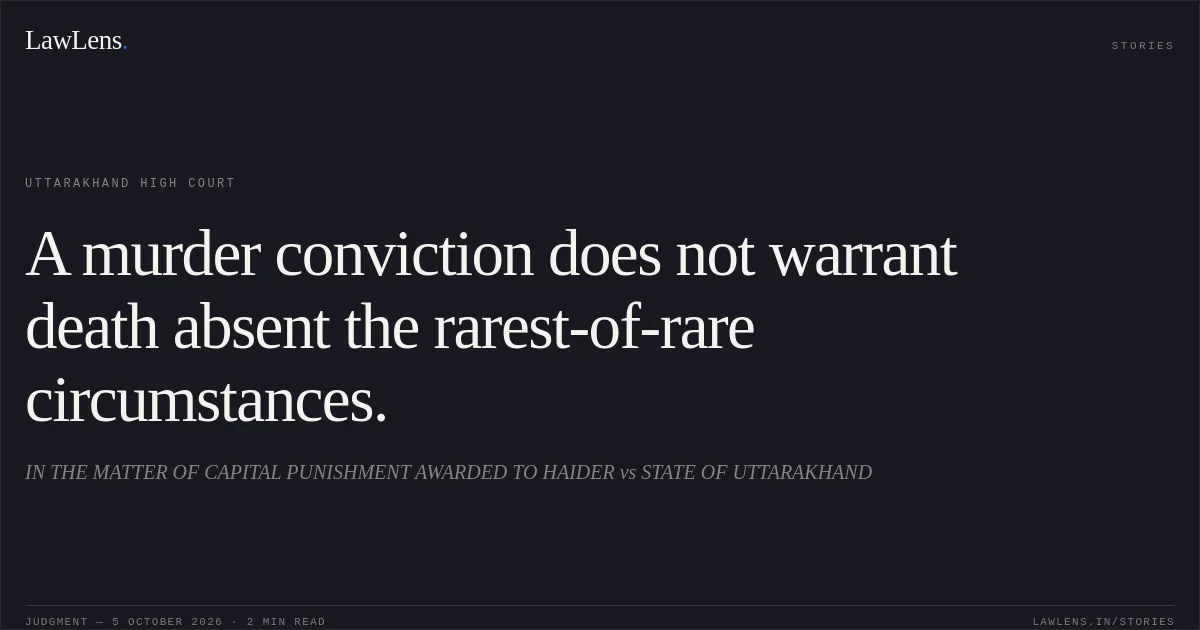
Source reference: para. 51–56In sentencing Haider, the Court concluded that the case did not fall within the rarest-of-rare category and that life imprisonment was appropriate.
Source reference: para. 95–96Holding
The Court affirmed Haider’s conviction under Section 302 IPC but converted his death sentence to imprisonment for life; the fine remained unchanged.
It acquitted Rehan of the charge under Section 302 read with Section 34 IPC and directed his release unless required in another case, subject to furnishing a bond and sureties under Section 437-A CrPC.
Source reference: para. 97Haider’s appeal was partly allowed, Rehan’s appeal was allowed, and the death reference was answered accordingly.
Source reference: para. 97Acts & Sections Cited
7 provisions across 2 statutes referred to in this judgment. Each provision opens on LawLens.
Indian Penal Code, 18603
Code of Criminal Procedure, 19734
Original Court PDF
IN THE MATTER OF CAPITAL PUNISHMENT AWARDED TO HAIDERvsSTATE OF UTTARAKHAND
Click to open original judgment
Original judgment, available to read, download and summarize on LawLens.in